MEMS Manufacturing Automation: Improving Precision, Yield, And Production Efficiency
MEMS devices are tiny, but making them is anything but simple. Every wafer passes through deposition, etching, inspection, testing, and packaging, and small process drifts can turn into scrap. That is why MEMS manufacturing automation has become a priority for fabs, foundries, and equipment makers. When tools, software, and data work together, manufacturers gain tighter control, fewer defects, and better use of every machine.
Why Automation Matters in MEMS Manufacturing
MEMS fabs often run equipment from several OEMs and several generations. Some tools speak SECS/GEM, some use PLCs, and some have no host interface at all. Without a common layer, engineers collect data by hand, recipes are loaded manually, and problems are found only after yield has already dropped.
Automation closes these gaps by:
- Collecting equipment and process data in real time
- Connecting tools to MES and factory host systems
- Monitoring alarms, events, and equipment health
- Supporting recipe control and process consistency
Start with Standardized Equipment Connectivity
SECS/GEM is the standard language between semiconductor equipment and factory hosts, and it is the foundation of a connected MEMS fab. For OEMs building new machines, the SECS/GEM SDK (EIGEMEquipment) adds SEMI-compliant host communication without building the stack from scratch. For 300mm tools, the GEM300 SDK covers the additional standards. Automated material handling is supported by the E84 SDK, which handles the handshake between equipment and transport systems.
Before anything reaches the factory floor, the EIGEMSim SECS/GEM simulator lets teams test host and equipment communication early. That means fewer surprises during commissioning and a faster path to production.
Modernize Legacy MEMS Equipment Without Replacing It
Many MEMS facilities depend on older tools that still perform well but cannot talk to a modern MES. Replacing them is costly and requires recipe requalification. Three eInnoSys solutions offer a different route:
- EIGEMBox is a plug-and-play box that adds SECS/GEM, Modbus, or OPC capability by connecting to the equipment's display output, with no software or hardware installed on the tool itself. Because the equipment controller is never modified, recipes do not need to be requalified. It has been deployed on 80+ fab and OSAT tools.
- EIGEMHMI brings SECS/GEM to equipment controlled through an HMI or PLC, so machines built around these controllers can join the factory network.
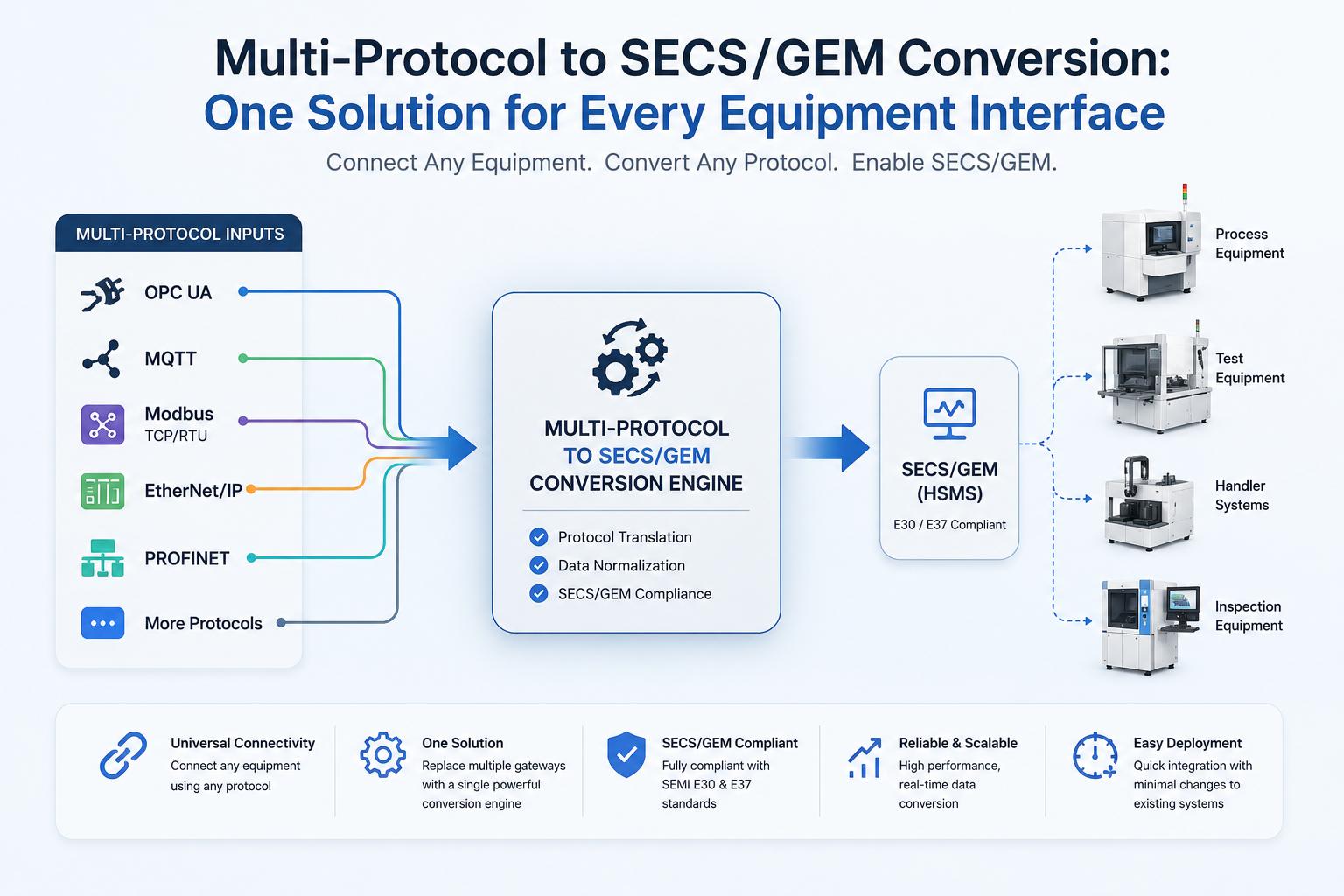
- EIGEMLink converts industrial protocols such as OPC UA, MQTT, Modbus, EtherCAT, and Profinet into SECS/GEM. It uses a configuration interface, so no programming or deep SECS/GEM expertise is needed.
Together, these options let a MEMS fab start with a single tool and expand across the facility at its own pace.
Improving Precision
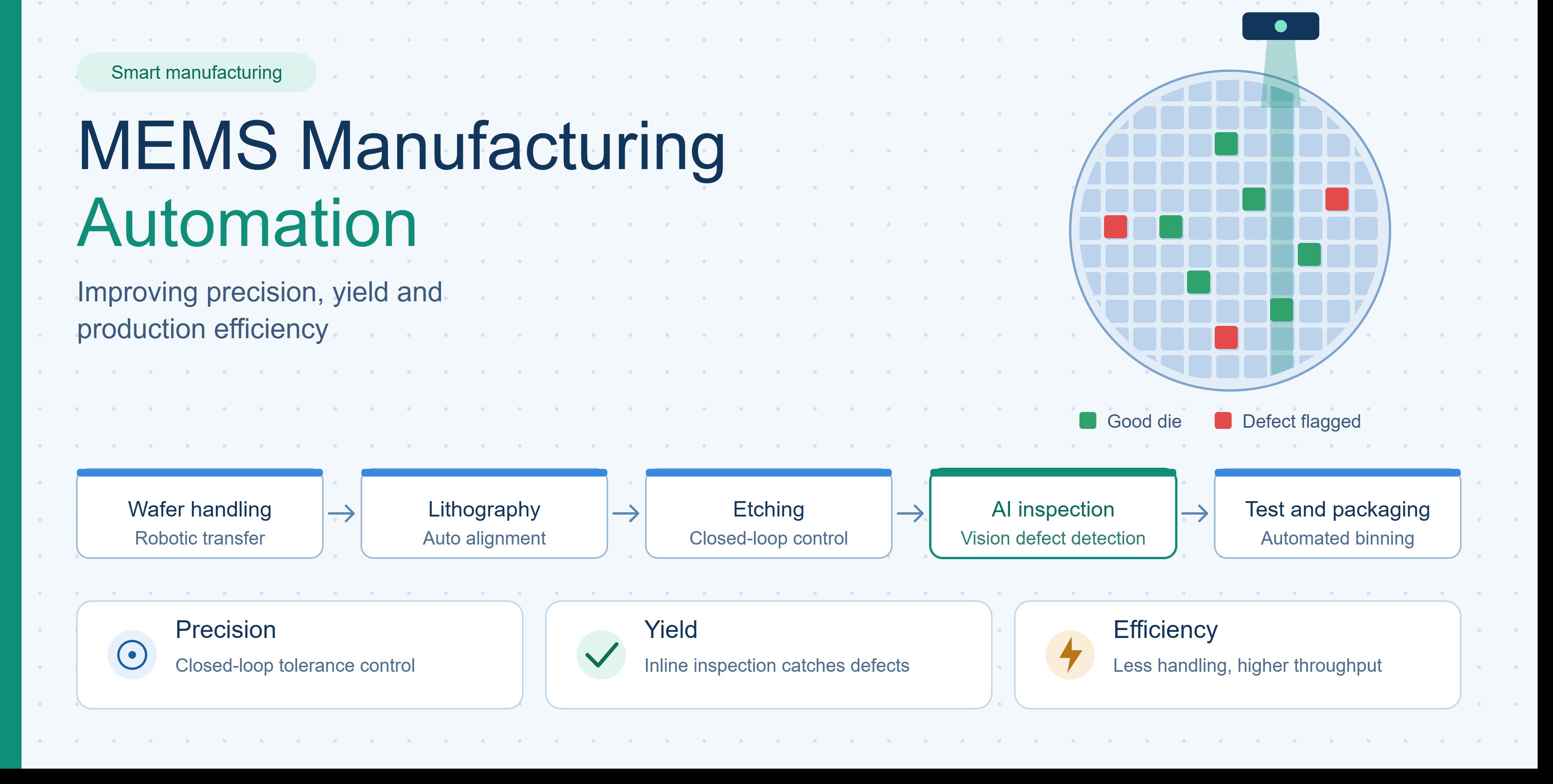
Precision in MEMS depends on process stability. Real-time monitoring of parameters, alarms, and events shows when a tool starts to drift. Pairing that data with Fault Detection & Classification (FDC) helps engineers catch abnormal conditions earlier. Advanced Process Control (APC) can then use the same data to keep processes within target.
Automated recipe download also removes a common source of variation. When the host sends the recipe, operators no longer type or select it by hand, which reduces recipe errors.
Protecting Yield
Yield losses in MEMS often come from small, unnoticed equipment problems. Automated data collection gives engineers a traceable record of what each tool did to each lot. When a defect appears, they can trace it back quickly instead of guessing.
Predictive maintenance adds another layer. xPump, eInnoSys's AI/ML-based predictive maintenance system, analyzes equipment data to flag potential failures before they cause scrap or unplanned stops. Moving from reactive repairs to planned maintenance protects both wafers and uptime. You can read more about this approach on the Yield Improvement solutions page.
Raising Production Efficiency
You cannot improve what you cannot see. Automated equipment data makes it possible to track availability, utilization, performance, and downtime, which are the core measures of OEE. With accurate, real-time numbers, teams can find the real bottlenecks instead of relying on manual logs. Learn more about improving throughput and OEE with equipment data.
Manual data entry also takes time and introduces errors. Replacing it with automated collection frees engineers and operators to focus on analysis and improvement.
How to Get Started
A practical roadmap looks like this:
- Audit your equipment. List which tools are SECS/GEM-ready, which use PLCs or HMIs, and which are legacy.
- Pick high-impact tools first. Start where downtime, scrap, or manual work is highest.
- Connect and test. Use the right connectivity option and validate communication with a simulator before go-live.
- Layer on intelligence. Add monitoring, OEE, FDC, and predictive maintenance once data is flowing.
- Scale. Extend the same approach across the fab.
Conclusion
MEMS manufacturing automation is not a single product. It is a connected approach that links equipment, MES, and analytics so precision, yield, and efficiency improve together. Whether you build equipment or run a fab, eInnoSys offers tools for every stage, from SDKs and simulators to legacy retrofits and AI-driven maintenance.
Ready to connect your MEMS equipment? Talk to a MEMS automation expert at eInnoSys.