
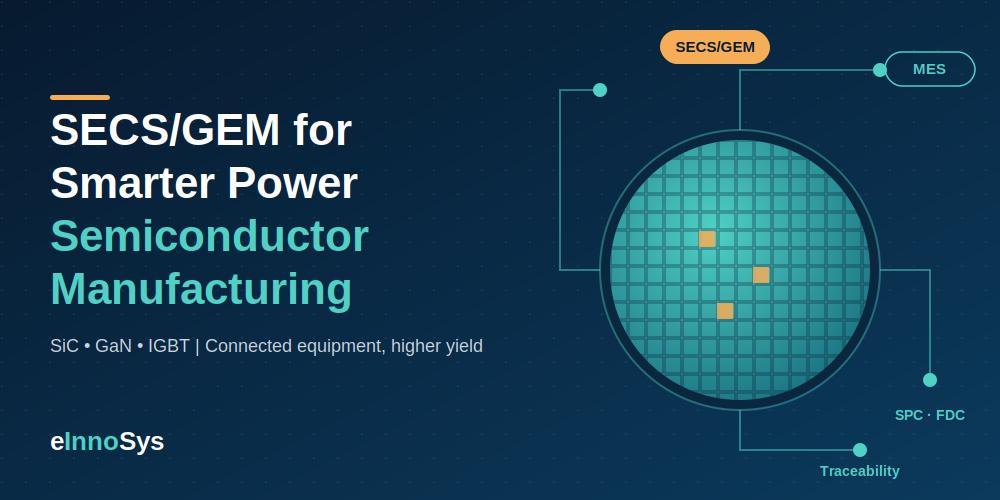
SECS/GEM For Smarter Power Semiconductor Manufacturing
What Is SECS/GEM?
SECS/GEM is the long-established standard for communication between semiconductor equipment and a host system such as a Manufacturing Execution System (MES). It combines two layers:
- SECS-II (SEMI E5) defines the message structure and data formats.
- GEM (SEMI E30) defines how equipment should behave, including what states it reports, which events it signals, and how it responds to host commands.
Together with transport layers like HSMS (SEMI E37), SECS/GEM gives equipment from different vendors a common language. Instead of building a custom interface for every tool, fabs can connect machines consistently and monitor, control, and analyze them from one place.
Why Power Semiconductor Fabs Need It More Than Ever
Power device manufacturing has its own demands. Wide-bandgap materials like SiC and GaN are harder to process than traditional silicon. Defect densities, epitaxy uniformity, implant activation, and high-temperature annealing all need very tight control. Many power fabs also run a mix of new and legacy tools, sometimes on 150 mm and 200 mm lines, which makes consistent connectivity difficult.
A properly implemented SECS/GEM interface helps in several ways.
Real-time visibility. GEM’s collection events and status variables let the host see what each tool is doing: idle, processing, in alarm, or waiting for material. Instead of relying on operator logs, engineers get live equipment states.
Better traceability. Automotive and industrial customers expect full lot and wafer genealogy. SECS/GEM lets the host collect process parameters, recipe names, and event timestamps for every run, creating a reliable record for audits and root cause analysis.
Remote control and recipe management. Using remote commands and recipe management capabilities, the host can start, stop, or pause processing and verify that the right recipe is loaded. This reduces human error, which is a major source of excursions.
Alarm management. Equipment alarms can be captured and routed to the right people immediately. Faster response means less unplanned downtime and fewer scrapped wafers.
From Connectivity to Intelligence
Connecting equipment is only the first step. The larger payoff comes from what you build on top of it.
Once tools reliably stream data, fabs can apply Statistical Process Control (SPC) to catch drift before it becomes yield loss. They can feed Fault Detection and Classification (FDC) systems with trace data to spot abnormal tool behavior. And they can support predictive maintenance, replacing fixed service intervals with maintenance driven by actual equipment condition.
For power semiconductor manufacturers, this matters because the cost of failure is high. A single excursion on an expensive SiC substrate wastes far more than the same event on a commodity silicon wafer. Early detection protects both yield and margins.
Common Challenges in Implementation
SECS/GEM is a standard, but implementing it is rarely plug-and-play. Fabs and equipment makers often run into these issues:
- Inconsistent implementations. Two tools can both claim GEM compliance yet behave differently in practice, with varying data variables, event definitions, and state models.
- Legacy equipment. Older tools may lack native SECS/GEM support entirely, requiring retrofit solutions or adapter layers.
- Limited testing before installation. Without a way to simulate the host or the equipment, integration problems often surface late, during commissioning, when delays are costly.
- Scalability. As a fab grows, managing dozens or hundreds of equipment connections demands a structured, maintainable approach.
Building a Smarter Approach
A few practices make SECS/GEM projects smoother:
- Define data needs early. Decide which events, variables, and alarms matter before development begins, so the interface supports real analytics goals.
- Test against simulators. Using host and equipment simulators lets teams validate message flows and state behavior well before the tool is on the floor.
- Standardize across the fab. A consistent interface approach reduces integration effort for each new tool and simplifies maintenance.
- Plan for the future. Many fabs are also adopting newer standards like EDA/Interface A (SEMI E120, E125, E132, E134) for richer data collection. Choosing a solution that supports both SECS/GEM and EDA keeps your options open.
How eInnoSys Can Help
At eInnoSys, we specialize in equipment automation and smart factory solutions for the semiconductor and electronics industries. Our SECS/GEM expertise helps equipment manufacturers and fabs implement reliable, standards-compliant interfaces, whether you are building a new tool, retrofitting a legacy machine, or integrating a mixed fleet into your MES.
For power semiconductor makers, that means faster integration, cleaner data, and a stronger foundation for analytics and automation. We work with your team to define requirements, develop and test interfaces, and support you through deployment.
Final Thoughts
Power semiconductors are becoming central to the global shift toward electrification and energy efficiency. The fabs that succeed will be the ones that turn their equipment into a connected, data-rich environment. SECS/GEM is the proven foundation for that transformation: a standard that moves a factory from isolated machines to a coordinated, intelligent production line.
If you are planning a new line, upgrading existing tools, or looking to get more from your equipment data, now is the time to build your connectivity strategy.