Multi-Protocol To SECS/GEM Conversion: One Solution For Every Equipment Interface
If you've spent any time on a fab floor, you already know the problem: every machine seems to speak its own language. One tool talks about Modbus, another runs on OPC UA; a third only understands MQTT, and somewhere in the corner sits a 15-year-old lithography system that barely does RS-232. Your MES doesn't care about any of that — it wants everything in SECS/GEM. So how do you connect a room full of mismatched equipment to one host system without rewriting your factory automation from scratch?
That's exactly the gap that multi-protocol to SECS/GEM conversion is built to close.
Why This Problem Even Exists
Semiconductor fabs rarely buy all their equipment from a single vendor. You end up with tools from different OEMs, built in different decades, running different controllers. Some ships with native SECS/GEM support baked in. Many don't — especially legacy machines, PLC-driven stations, or equipment picked up secondhand.
Meanwhile, your factory automation stack is standardizing SECS/GEM (SEMI E5 and E30) because it's the industry's common language for equipment-to-host communication. It defines how a tool reports its state, sends alarms, streams to process data, and takes commands from an MES or EAP system. When a piece of equipment can't speak that language natively, you're left with a choice: replace the tool, write custom integration code for it, or find a way to translate.
Replacing working equipment just to gain a communication protocol rarely makes financial sense. Writing custom code for every protocol variant is slow, and it turns into an ongoing maintenance burden every time a SEMI standard gets revised. That leaves translation — and this is where protocol conversion gateways earn their keep. \
Why This Problem Even Exists
Semiconductor fabs rarely buy all their equipment from a single vendor. You end up with tools from different OEMs, built in different decades, running different controllers. Some ships with native SECS/GEM support baked in. Many don't — especially legacy machines, PLC-driven stations, or equipment picked up secondhand.
Meanwhile, your factory automation stack is standardizing SECS/GEM (SEMI E5 and E30) because it's the industry's common language for equipment-to-host communication. It defines how a tool reports its state, sends alarms, streams to process data, and takes commands from an MES or EAP system. When a piece of equipment can't speak that language natively, you're left with a choice: replace the tool, write custom integration code for it, or find a way to translate.
Replacing working equipment just to gain a communication protocol rarely makes financial sense. Writing custom code for every protocol variant is slow, and it turns into an ongoing maintenance burden every time a SEMI standard gets revised. That leaves translation — and this is where protocol conversion gateways earn their keep.
What Multi-Protocol to SECS/GEM Conversion Actually Does
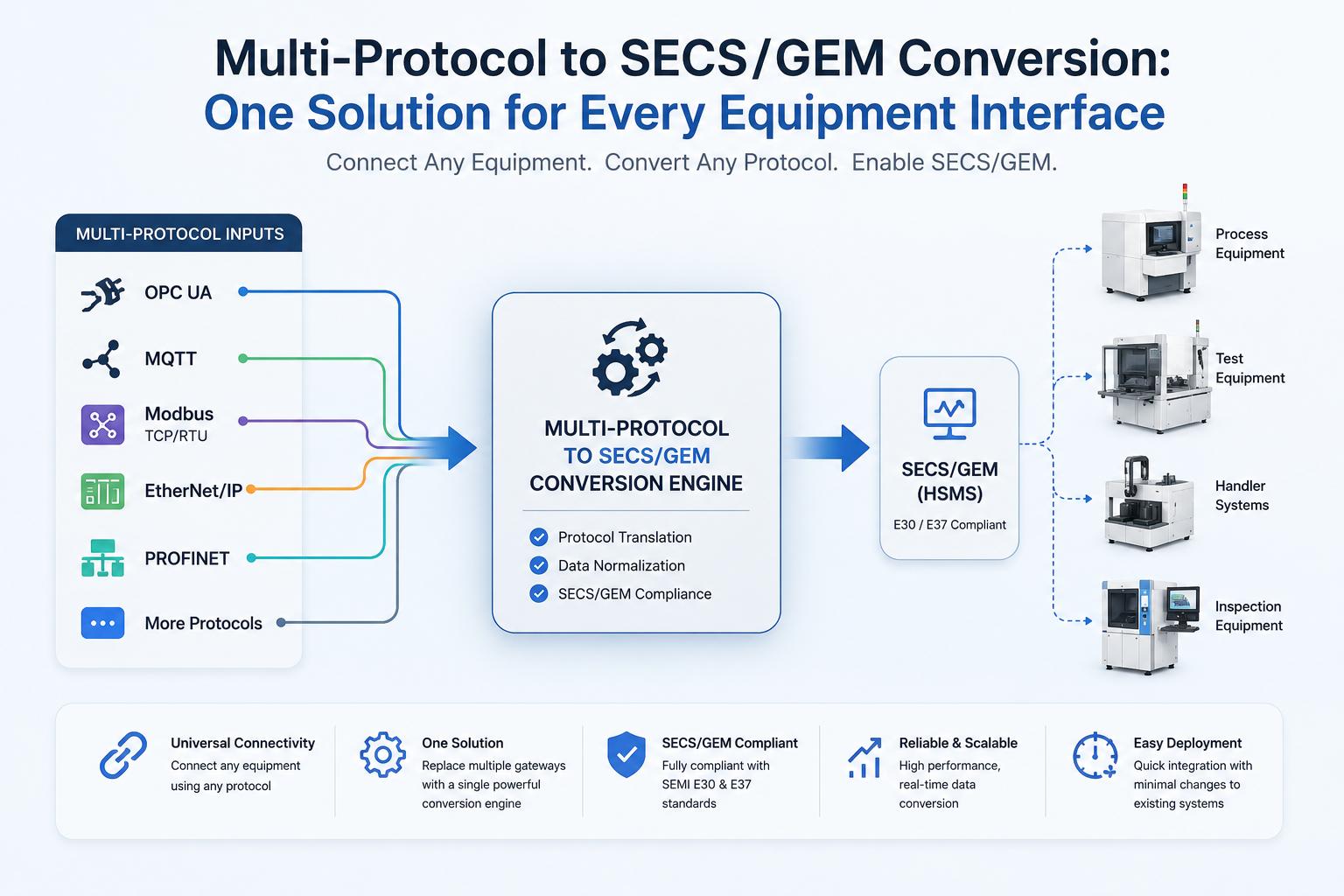
At its core, a protocol conversion gateway sits between your equipment and your host system. It listens to whatever protocol the machine already speaks, then repackages that data into standardized SECS/GEM messages the MES can understand — without touching the tool's original controller software.
A typical gateway needs to handle:
- OPC DA/OPC UA — pulling tag data, historical values, and alarm/event streams from equipment that already exposes an OPC server.
- MQTT — subscribing to topic-based messages from IoT-connected or cloud-linked devices.
- Modbus RTU/TCP — polling registers and coils from PLC-controlled stations, a common setup on older equipment.
- EtherCAT and Profinet — capturing cyclic, real-time data from industrial automation networks.
- Ethernet/IP — bridging general Ethernet-based controllers into the SECS/GEM message format.
Once the source data comes in, the gateway maps it against a configurable model: which register or tag corresponds to which SECS/GEM variable, which event triggers a collection event, and which alarm code maps to which GEM alarm ID. From there, it handles the equipment side of the conversation over HSMS (SEMI E37, the TCP/IP-based method) or SECS-I (SEMI E4, the RS-232 legacy method), depending on what the host expects.
Why "One Solution" Beats a Patchwork of Point Integrations
It's tempting to solve this tool by tool — write a Modbus bridge for one machine, an OPC bridge for another, and so on. That approach works until you have ten different bridges, each maintained differently, each with its own quirks, and each one a separate point of failure.
A unified conversion platform changes that math:
A single gateway approach means one interface to configure, one place to troubleshoot, and one vendor relationship to manage instead of five. It also means that when a new tool arrives on the floor with yet another protocol, you're adding a configuration, not commissioning a new development project.
eInnoSys' Approach: EIGEMLink
eInnoSys builds exactly this kind of gateway with EIGEMLink, a multi-protocol to SECS/GEM conversion platform designed for fabs and equipment manufacturers dealing with mixed-protocol environments. Rather than writing SECS/GEM code by hand, engineers configure the connection through a graphical interface — no programming and no deep SECS/GEM expertise required.
A few things stand out about how it's built:
- Drag-and-drop data mapping. You connect source data points — OPC tags, Modbus registers, MQTT topics — directly to SECS/GEM variables and collection events through a visual mapping tool.
- Concurrent multi-protocol handling. A single instance can manage several protocol conversions at once, so you're not deploying separate installations per machine type.
- SEMI compliance out of the box. Connections are built to align with E5, E30, and E37, so the resulting SECS/GEM interface behaves the way your MES already expects.
- Cross-platform deployment. It runs on Windows, Linux, and embedded systems, which matters when your equipment controllers span multiple operating environments.
The practical effect is that a tool with no native SECS/GEM support — regardless of whether it speaks Modbus, MQTT, OPC, EtherCAT, or Profinet — can join your factory automation network without OEM involvement or a hardware swap.
Where This Fits in a Real Fab
Picture a mixed line: a modern deposition tool with OPC UA built in, a decade-old etch station running Modbus over a PLC, and a wet bench feeding sensor data through MQTT. Historically, connecting all three to one MES meant three separate integration projects. With a multi-protocol conversion layer in place, each tool's native protocol gets mapped once, and all three show up to the host as standard SECS/GEM-compliant equipment.
This matters beyond simple connectivity. Once equipment data flows into SECS/GEM format, it feeds the same downstream systems, everything else does — production tracking, predictive maintenance models, yield analytics, and advanced process control. The equipment doesn't need to be new or homogeneous for the fab to benefit from real-time visibility across the line.
Getting Started
If you're evaluating this kind of gateway for your own equipment mix, a few questions are worth answering upfront:
- Which protocols are actually running on your floor today — and which are likely to show up as you add new tools?
- Does your host system expect HSMS, SECS-I, or both?
- How many concurrent connections will the gateway need to support as you scale?
- What's your team's comfort level with configuration-based setup versus custom development?
Getting clear answers to these questions before you commit to an integration approach saves considerable rework later — and it's usually the difference between a connectivity project that takes weeks versus one that takes months.
Wrapping Up
Mixed-protocol equipment isn't a temporary inconvenience — it's the default state of most fabs, and it's not going away as facilities add tools from different eras and vendors. A multi-protocol to SECS/GEM conversion platform like EIGEMLink turns that fragmentation into a non-issue: one gateway, one configuration process, and a factory floor that speaks a common language to your MES, regardless of what's actually running underneath.