SiC Semiconductors: Benefits, Applications, And Their Role In Power Electronics
Every electric vehicle, solar inverter, fast charger and industrial motor drive depends on power electronics, the circuits that convert, control and distribute electrical energy. For decades, silicon (Si) has been the foundation of these circuits. But as the world demands higher power, smaller systems and less wasted energy, silicon is reaching its physical limits. Silicon carbide (SiC) is the material taking its place in the most demanding applications.
This article explains what SiC is, why it outperforms silicon, where it is used, what makes it hard to manufacture, and how factory automation helps SiC producers scale.
What Is a SiC Semiconductor?
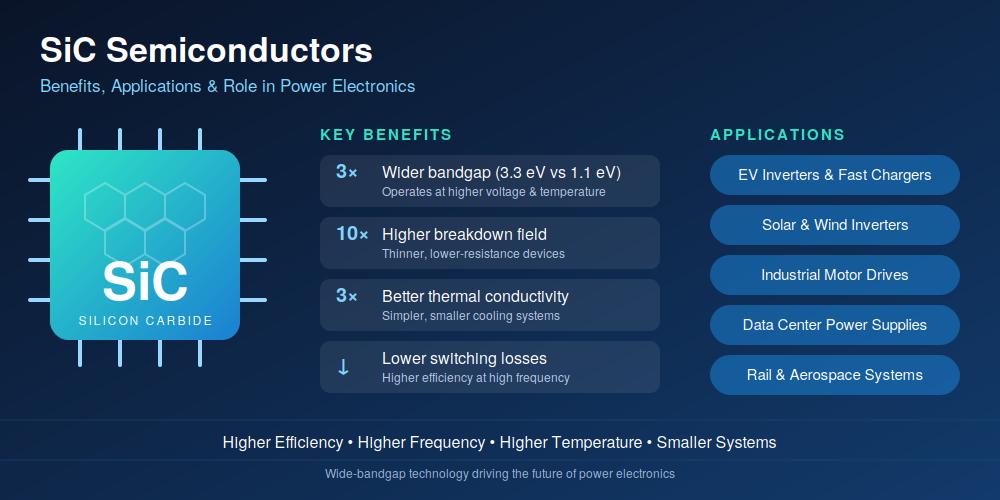
Silicon carbide is a compound semiconductor made of silicon and carbon atoms bonded in a very strong crystal lattice. It is called a wide bandgap (WBG) material. The bandgap is the energy needed to move an electron into a conducting state. SiC has a bandgap of about 3.26 eV, nearly three times silicon's roughly 1.12 eV.
This difference shapes everything about how SiC devices behave. Because electrons need much more energy to jump the gap, SiC devices:
- Block much higher voltages before breaking down
- Leak far less current at high temperatures
- Switch on and off faster with lower energy loss
- Stay stable in harsh thermal and electrical conditions
SiC is not new as a material. What is new is the ability to produce SiC wafers and devices at a quality and scale that makes them commercially practical for the mass market.
Key Benefits of SiC Semiconductors
1. Higher Energy Efficiency
In power conversion, energy is lost in two main ways: conduction losses (while a switch is on) and switching losses (each time it changes state). SiC MOSFETs have low on-resistance and very low switching losses compared with silicon IGBTs and MOSFETs. System-level efficiency improvements of a few percentage points may sound small, but at the scale of an EV battery, a solar farm or a data center, they add up to substantial energy savings.
2. Superior Thermal Performance
SiC conducts heat roughly three times better than silicon and can operate at much higher junction temperatures. Heat moves away from the device faster, and the system needs less cooling hardware. Smaller heat sinks and simpler cooling loops reduce weight, size and cost.
3. High-Voltage Capability
SiC's breakdown electric field is about ten times that of silicon. The layer that blocks voltage can therefore be much thinner, which lowers resistance at a given voltage rating. This is why SiC works well in 650 V, 1200 V, 1700 V and higher classes, and why it suits modern 800 V EV platforms.
4. Faster Switching Speeds
SiC devices can switch at much higher frequencies. This allows designers to use smaller inductors, capacitors and transformers, which are often the bulkiest and heaviest parts of a power converter. The result is higher power density: more power in less space.
5. Lower Total System Cost
A SiC device usually costs more than a silicon equivalent. However, savings in cooling, passive components, enclosure size, and energy use often reduce the total cost of the whole system. As wafer sizes grow and yields improve, device costs continue to decline.
SiC vs. Silicon: A Quick Comparison
| Feature | Silicon (Si) | Silicon Carbide (SiC) |
|---|---|---|
| Bandgap | ~1.12 eV | ~3.26 eV |
| Breakdown electric field | Lower | ~10x higher |
| Thermal conductivity | Lower | ~3x higher |
| Switching speed | Moderate | High |
| Operating temperature | Limited | Much higher |
| System size and weight | Larger | Smaller |
| Device cost | Lower | Higher, but falling |
Major Applications of SiC in Power Electronics
Electric Vehicles
This is the largest growth driver for SiC. In the traction inverter, SiC MOSFETs convert battery DC power into AC power for the motor with lower losses, which extends driving range or allows a smaller battery for the same range. SiC is also used in onboard chargers and DC-DC converters, and it supports 800 V architectures that enable faster charging.
EV Charging Infrastructure
DC fast chargers need to deliver high power while staying compact and efficient. SiC modules reduce heat and size, making high-power charging stations more practical and reliable.
Solar and Wind Energy
Solar inverters and wind turbine converters use SiC to improve conversion efficiency and reduce the size of their power stages. Higher efficiency means more usable energy is delivered to the grid.
Industrial Motor Drives and Power Supplies
Factories use large numbers of motors, and even small efficiency gains reduce operating costs. SiC is also used in server power supplies, telecom rectifiers and uninterruptible power supplies (UPS), where efficiency and density matter.
Energy Storage and Smart Grid
Battery energy storage systems need efficient bidirectional converters. At the grid level, SiC's high-voltage capability supports technologies such as solid-state transformers and high-voltage DC systems.
Rail, Aerospace and Defense
These sectors value light, compact and rugged power electronics that tolerate high temperatures and demanding conditions, which are all strengths of SiC.
Challenges in SiC Manufacturing
SiC delivers outstanding performance, but making it is far harder than making silicon:
- Difficult crystal growth: SiC boules are grown at extremely high temperatures (above 2,000°C) and grow slowly compared with silicon ingots.
- Material hardness: SiC is among the hardest materials used in semiconductors, which makes slicing, grinding and polishing slow and costly.
- Crystal defects: Defects such as micropipes, stacking faults and dislocations can reduce device yield and reliability.
- Wafer size transition: The industry is moving from 150 mm to 200 mm wafers, which requires new or upgraded equipment and tight process control.
- Mixed equipment environments: Many production lines combine brand-new tools with older equipment that was never designed for factory-wide connectivity.
Because SiC wafers are expensive, losing even a few of them to a process excursion or a recipe mistake has a real financial impact. This makes process stability, traceability and equipment data critical.
Why Fab Automation Matters for SiC
To scale SiC production, fabs, OSATs and equipment makers need every tool to communicate reliably with the factory host and the manufacturing execution system (MES). The industry standard for this is SECS/GEM (SEMI E5, E30, E37 and related standards), with GEM300 and AMHS standards for more advanced automation. With it, a factory can collect equipment data in real time, download recipes automatically, track lots and wafers, and react quickly to alarms.
einnosys provides software and hardware solutions for both sides of the industry.
For Fabs and OSATs: Connecting Existing Equipment
Many SiC process lines include older tools without SECS/GEM, and upgrading or replacing them can be expensive or impossible, especially when the original manufacturer no longer supports them.
- EIGEMBox is a plug-and-play solution that adds SECS/GEM capability to legacy equipment without installing software or hardware on the tool itself. It connects through the equipment's display output, so the tool's controller is never modified and recipes do not need to be re-qualified. It enables data collection, recipe download and remote monitoring, and can support AMHS integration such as E84/E87 in 200 mm fabs.
- EIGEMHMI brings SECS/GEM to equipment that is controlled through an HMI or PLC, helping fabs integrate these tools into their automation and MES environment.
For Equipment Manufacturers: Building Automation In from Day One
If you build SiC crystal growth, wafer processing, inspection or packaging equipment, your customers will expect host connectivity as a standard feature.
- The SECS/GEM SDK (EIGEMEquipment) lets OEMs add SEMI-standard host communication to new equipment faster, without building the protocol stack from scratch.
- The GEM300 SDK supports the GEM300 standards for equipment that needs advanced, fully automated factory integration.
- EIGEMLink helps connect equipment with host and factory systems.
- The E84 SDK enables the automated handoff of wafer carriers between equipment and transport systems such as OHT, AGV and RGV.
- The SECS/GEM Simulator (EIGEMSim) lets teams test and validate their SECS/GEM implementation without a live host, which shortens development time and helps avoid problems at the customer's site.
The Future of SiC
SiC demand is expected to keep growing as vehicles electrify, renewable energy expands and data centers consume more power. Larger wafers, better crystal quality and improved device designs are steadily lowering costs and widening the range of applications. Manufacturers that combine strong process technology with connected, automated and data-driven factories will be best positioned to compete.
Conclusion
Silicon carbide semiconductors deliver higher efficiency, better heat handling, higher voltage capability and faster switching than silicon. These advantages are transforming power electronics in automotive, energy, industrial and aerospace markets. Behind every SiC device is a precise and demanding manufacturing process, and connecting equipment, automating data flow and protecting yield are essential to making that process scalable.
Whether you need to modernize legacy tools or build SECS/GEM and GEM300 capability into new equipment, einnosys can help. Contact the team to discuss your SiC automation requirements.