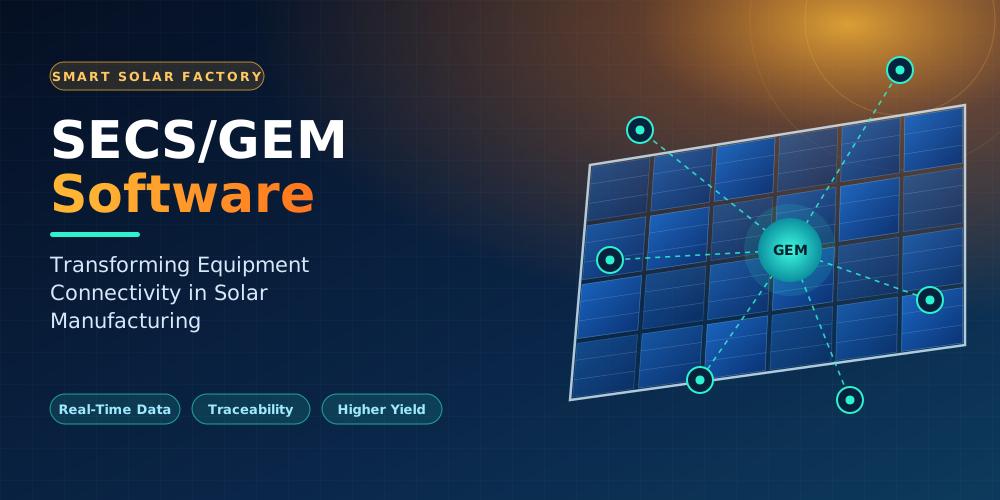
How SECS/GEM Software Is Transforming Equipment Connectivity In Solar Manufacturing
Solar manufacturing runs on speed, precision, and consistency. A modern PV line can include dozens of machines from different vendors, each with its own controller and data format. Without a shared language, these tools operate in isolation, leaving engineers with manual logs, scattered records, and slow troubleshooting.
SECS/GEM software solves this problem. SECS/GEM is a set of SEMI equipment communication standards. SECS defines how messages are exchanged between equipment and a host system, while GEM defines how equipment should behave and what information it should expose, including status, alarms, events, and recipes. Born in semiconductor fabs, the approach now serves photovoltaic production, where processes are closely related.
Why connectivity matters in solar production
Every solar cell passes through steps such as texturing, diffusion, deposition, screen printing, and firing, followed by module stringing, lamination, and testing. Each step affects efficiency and reliability. When equipment is connected through SECS/GEM, manufacturers gain:
- Real-time monitoring: Machines report status changes, alarms, and process events as they happen, so teams can respond faster.
- Automated data collection: Process parameters and production counts flow straight to the host system, replacing error-prone manual entry.
- Remote recipe management: Recipes can be uploaded, downloaded, and verified across tools, keeping settings consistent across shifts and lines.
- Stronger traceability: Equipment data tied to wafers, cells, or modules makes it easier to trace defects back to a specific step or batch.
- Easier MES integration: A standard interface shortens the work of linking shop-floor tools with MES, SCADA, and analytics platforms.
The equipment maker’s perspective
Equipment makers feel this shift too. Solar manufacturers increasingly list SECS/GEM compliance as a basic requirement, and building a compliant interface from scratch demands deep knowledge of message handling, state models, and testing. Ready-made software reduces development time and compliance risk. One example is EIGEMBox, a SECS/GEM solution from Einnosys that helps OEMs add standards-based host connectivity without building the full communication stack themselves.
To see how connectivity applies to cell and module production, explore Einnosys’s solar PV (photovoltaic) industry solutions.
What to look for in SECS/GEM software
When choosing a solution, check for solid standards compliance, clear documentation, flexibility across machine types, built-in testing and simulation tools, scalability from a single tool to a full line, and responsive vendor support.
Looking ahead
As solar capacity grows worldwide, competition will increasingly depend on manufacturing efficiency. Reliable equipment data is the foundation for predictive maintenance, yield analytics, and AI-driven optimization. SECS/GEM does not replace these technologies, but it makes them possible.
Conclusion
Equipment connectivity is no longer optional in solar manufacturing. SECS/GEM software gives factories a standard way to monitor machines, collect trustworthy data, and integrate with higher-level systems, while helping equipment makers meet customer expectations sooner. For any manufacturer building a smarter, more traceable solar line, it is a practical first step.