
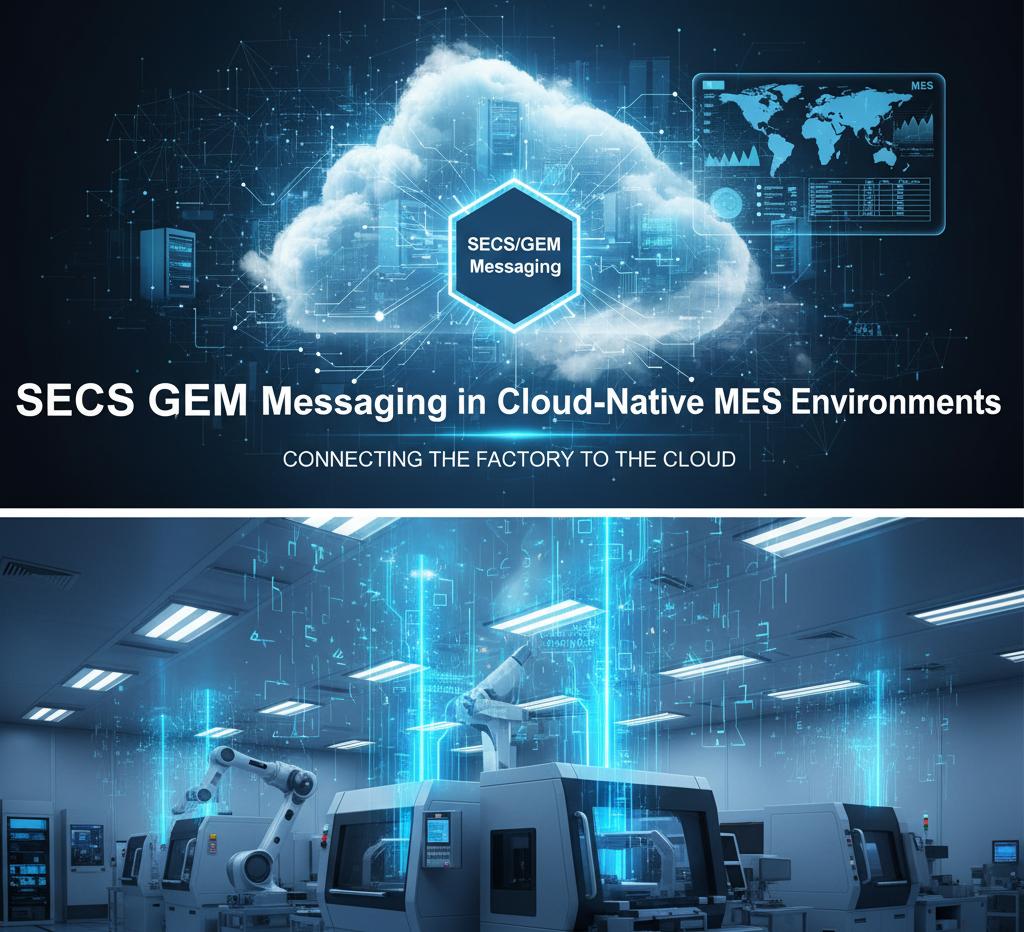
SECS GEM Messaging In Cloud Native MES Environments
Introduction
The semiconductor manufacturing landscape is experiencing a fundamental shift as factories embrace cloud technologies to modernize their operations. Traditional on-premise Manufacturing Execution Systems (MES) are giving way to cloud-native architectures that promise greater scalability, flexibility, and advanced analytics capabilities. Yet this transformation raises a critical question: how do time-tested communication protocols like SECS/GEM adapt to cloud environments while maintaining the reliability and real-time performance that semiconductor fabs demand?
SECS/GEM has served as the backbone of FAB equipment integration for decades, enabling standardized communication between manufacturing equipment and factory systems. As the industry moves toward equipment automation in the cloud, maintaining robust SECS/GEM host communication becomes both more challenging and more important. Cloud-native MES platforms must preserve the deterministic, low-latency characteristics essential for production environments while leveraging cloud capabilities for analytics, machine learning, and global visibility.
This convergence of legacy protocols with modern cloud architectures represents more than a technical migration—it's a reimagining of how semiconductor manufacturers can achieve the best of both worlds: proven reliability with transformative innovation.
The Challenge of Moving SECS/GEM to the Cloud
SECS/GEM was designed in an era when equipment communicated directly with on-premise host computers through dedicated network connections. The protocol assumes low-latency, reliable connections and synchronous message exchanges. Cloud environments introduce new variables—network latency, connection stability, security boundaries, and distributed architectures—that seem at odds with these assumptions.
Real-time equipment data acquisition presents particular challenges in cloud deployments. When a critical alarm occurs on the production floor, the MES must receive and act on that information within milliseconds, not seconds. Traditional cloud architectures with centralized processing can introduce latency that's unacceptable for time-sensitive manufacturing operations. Equipment waiting for host responses can stall production, and delayed alarm notifications can allow problems to escalate.
SEMI standards communication protocols like SECS/GEM also require connection state management, message sequencing, and timeout handling that become more complex when traversing cloud infrastructure. The question isn't whether SECS/GEM can work in the cloud—it's how to architect cloud-native systems that preserve protocol reliability while gaining cloud benefits.
Hybrid Architectures: The Bridge to Cloud-Native Manufacturing
The most successful implementations of SECS/GEM in Industry 4.0 environments adopt hybrid architectures that strategically position protocol handling components. Rather than forcing equipment to communicate directly with cloud-hosted MES platforms across the public internet, these designs place edge gateways on the factory floor that maintain local SECS/GEM host communication with equipment.
These edge components, often running SECS GEM SDK implementations, handle the time-critical aspects of equipment communication—message exchange, state management, alarm processing, and data collection. They maintain the low-latency, reliable connections that SECS/GEM requires while buffering and aggregating data for transmission to cloud-based analytics and management systems.
This approach transforms the relationship between equipment and cloud MES. Equipment continues communicating via proven SECS/GEM protocols without modification, while the edge gateway translates between the synchronous, connection-oriented world of SECS/GEM and the asynchronous, resilient patterns typical of cloud applications. Manufacturing data exchange protocol implementations at the edge handle connectivity interruptions gracefully, queuing messages during outages and resynchronizing when connections restore.
The cloud layer receives processed, contextualized data rather than raw protocol messages, enabling sophisticated analytics, machine learning models, and cross-facility comparisons without imposing cloud latency on critical equipment interactions.
Leveraging SECS GEM SDK for Cloud Integration
Modern SECS GEM SDK platforms have evolved to support cloud-native architectures explicitly. Rather than viewing cloud deployment as an afterthought, leading SDK providers now offer components specifically designed for distributed, scalable implementations.
These SDKs provide containerized services that can deploy across hybrid environments—running on edge hardware for equipment interfacing while exposing APIs that cloud applications can consume. Container orchestration platforms like Kubernetes manage scaling, failover, and resource allocation, bringing cloud-native operational benefits to MES equipment interfacing.
Advanced SDK implementations separate protocol handling from business logic, allowing developers to build microservices architectures where SECS/GEM communication services run independently from analytics engines, reporting systems, and user interfaces. This separation enables independent scaling—adding equipment communication capacity without affecting analytics processing, or vice versa.
APIs exposed by these SDKs translate SECS/GEM concepts into REST or GraphQL interfaces that cloud applications can consume naturally. Equipment state changes become event streams. Data variables become queryable resources. Commands become API calls. This abstraction lets cloud-native MES applications interact with equipment through modern interfaces while the SDK handles SECS/GEM protocol complexities underneath.
Real-Time Data Acquisition at Cloud Scale
Real-time equipment data acquisition in cloud environments requires rethinking traditional data flow patterns. Rather than polling equipment periodically or responding only to explicit requests, cloud-native architectures implement event-driven patterns where equipment data streams continuously to cloud processing pipelines.
Event streaming platforms like Apache Kafka or cloud-native equivalents provide the infrastructure for this transformation. Edge gateways running SECS/GEM protocol stacks publish equipment events—state changes, alarms, process completions, data collections—to event streams that multiple cloud services can consume independently.
This architecture delivers several advantages over traditional request-response patterns. Multiple applications can consume the same equipment data without multiplying the load on edge gateways or equipment. Historical data becomes available automatically through stream retention. Machine learning models can process data in real-time without interfering with operational systems. Cross-equipment correlations become feasible as data from hundreds of tools flows through unified pipelines.
Factory automation cloud solutions built on event streaming architectures achieve scalability impossible with traditional approaches. Adding new analytics capabilities, reports, or dashboards requires subscribing to existing data streams rather than implementing new equipment queries that could impact production systems.
Security Considerations for Cloud-Connected Equipment
Moving SECS/GEM host communication to cloud environments intensifies security requirements. Equipment that once operated on isolated factory networks now connects to systems accessible across the internet, creating attack surfaces that didn't previously exist.
Defense-in-depth strategies become essential. Edge gateways implement strict firewall rules, allowing only necessary outbound connections while blocking inbound traffic from the internet. Equipment networks remain isolated from corporate and cloud networks, with edge gateways serving as security boundaries that translate between domains.
Encryption protects data in transit between edge and cloud components. Mutual TLS authentication ensures that only authorized gateways can publish data to cloud services and only legitimate cloud applications can send commands to equipment. Certificate management systems automate rotation and revocation.
SEMI standards communication protocols themselves don't provide encryption or authentication—they were designed for trusted, isolated networks. Cloud architectures must wrap SECS/GEM connections in security layers that protect against modern threats while preserving protocol semantics that equipment expects.
Role-based access control in cloud MES platforms ensures that users and applications access only the equipment data and control functions their roles require. Audit logging tracks all equipment interactions, creating accountability and supporting incident investigation.
Performance Optimization and Monitoring
Maintaining performance in cloud-native SECS/GEM implementations requires continuous monitoring and optimization. Network latency between edge and cloud varies with internet conditions. Cloud service performance fluctuates with load. Understanding these dynamics is essential for reliable operations.
Comprehensive monitoring systems track key metrics: message roundtrip times, connection stability, data throughput, queue depths, and error rates. Dashboards provide visibility into communication health, alerting operations teams when degradation occurs.
Edge gateways implement intelligent buffering strategies that adapt to network conditions. During temporary outages or slowdowns, they queue data locally while continuing normal SECS/GEM communication with equipment. When connectivity improves, they transmit buffered data without overwhelming cloud services.
Performance testing under realistic conditions validates that equipment automation in the cloud meets production requirements before deployment. Load testing simulates hundreds of tools communicating simultaneously. Failure testing verifies that edge gateways handle cloud service outages gracefully. Latency testing confirms that critical paths maintain acceptable response times even during peak cloud usage.
The Future: Fully Cloud-Native Equipment Communication
While today's solutions rely on edge gateways to bridge between SECS/GEM and cloud environments, the future may bring more fundamental changes. Equipment manufacturers are beginning to build cloud connectivity directly into tools, implementing secure communication channels that bypass traditional protocol stacks.
Next-generation standards under development by SEMI and other organizations envision equipment that participates directly in cloud ecosystems. These tools would publish data to cloud platforms natively while maintaining the reliability and determinism that manufacturing requires.
However, the installed base of existing equipment ensures that SECS/GEM will remain relevant for decades. Hybrid architectures that bridge legacy protocols with modern cloud platforms will continue evolving, incorporating artificial intelligence, digital twins, and advanced analytics while preserving the proven reliability that keeps fabs running.
Conclusion
SECS/GEM messaging in cloud-native MES environments represents the semiconductor industry's pragmatic approach to digital transformation—embracing cloud innovation while preserving decades of protocol reliability and standards compliance. Through hybrid architectures, modern SECS GEM SDK implementations, and thoughtful system design, manufacturers are achieving outcomes that seemed contradictory: the scalability and analytics capabilities of the cloud combined with the deterministic, real-time performance that production environments demand.
Success requires more than technical implementation. It demands understanding the unique requirements of MES equipment interfacing, respecting the constraints of SEMI standards communication, and architecting systems that balance competing priorities—innovation with stability, flexibility with reliability, cloud capabilities with edge responsiveness.
As semiconductor manufacturing continues its Industry 4.0 journey, SECS/GEM evolves from a legacy protocol to a bridge technology—connecting proven factory automation practices with transformative cloud capabilities. Organizations that master this integration gain competitive advantages through better visibility, faster innovation, and operational excellence that spans from individual tools to global manufacturing networks.