
How MEMS Manufacturing Automation Enhances Microfabrication Accuracy And Yield
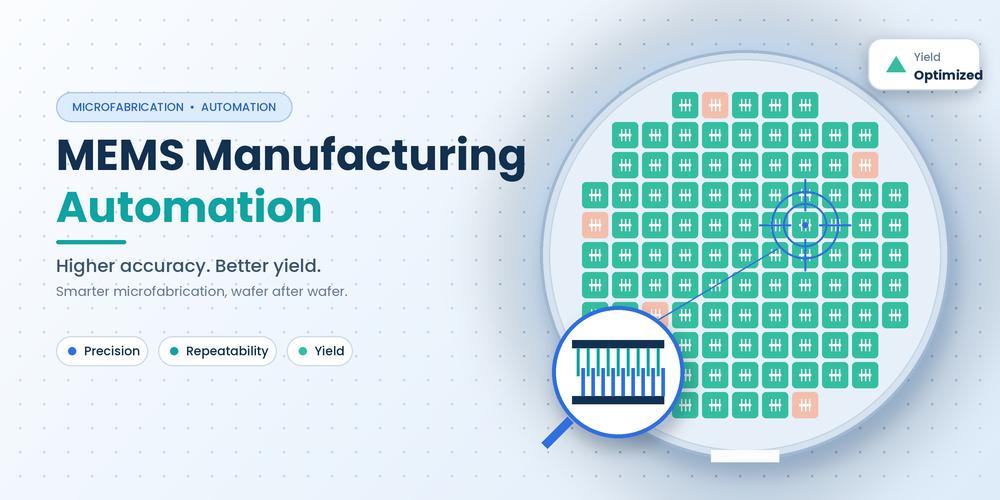
Micro-electromechanical systems (MEMS) power the accelerometers in phones, the pressure sensors in cars, and the microphones in earbuds. Each device places tiny moving parts on a silicon chip, and a small deviation in layer thickness or etch depth can make it fail. That is why automation now sits at the center of MEMS manufacturing. It improves accuracy, cuts waste, and raises yield, which is the share of working devices from each wafer.
Why Precision Is So Demanding in MEMS
Unlike standard chips, MEMS devices combine electrical and mechanical features. Their performance depends on beam thickness, gap width, and membrane stress, often controlled to within nanometers. Variation can enter at photolithography, deep reactive ion etching, thin-film deposition, and wafer bonding. Manual handling and operator-dependent adjustments add even more inconsistency.
Key Ways Automation Improves Accuracy
- Robotic wafer handling: Machines move thin, brittle wafers with repeatable motion, reducing breakage and particles.
- Closed-loop process control: Sensors adjust temperature, gas flow, and pressure in real time to keep each step stable.
- Inline metrology: Film thickness and critical dimensions are measured during production, so a drifting process is caught early.
- Data analytics and predictive maintenance: Equipment data reveals patterns, such as a slowly degrading chamber, before they cause defects.
- Cleaner cleanrooms: Fewer people on the floor means fewer particles and fewer defects.
The Foundation: Equipment Connectivity
Every benefit above depends on one thing: tools that can talk to the factory's host or MES (manufacturing execution system). The SEMI SECS/GEM standard defines how equipment reports data, events, and alarms, and how it receives recipes and commands. A tool without it is an island. A MEMS fab often mixes new tools with decades-old ones, so connecting them all is a real challenge.
Connecting Every Tool in the Fab
Legacy equipment. EIGEMBox adds SECS/GEM, Modbus, or OPC capability to older tools without installing software or hardware on the tool itself. It connects through the equipment's display cable, so the controller stays untouched and recipes do not need re-qualification.
PLC and HMI-based tools. EIGEM-HMI enables SECS/GEM on equipment controlled by PLCs or HMIs, including Siemens, Rockwell (Allen-Bradley), Mitsubishi, and Omron controllers, without changing the existing control logic.
Mixed protocols. EIGEMLink converts industrial protocols such as OPC, MQTT, Modbus, EtherCAT, Profinet, and Ethernet into SECS/GEM, so different tools can share one communication layer.
Equipment makers (OEMs). Builders of MEMS tools can embed connectivity from the start with the SECS/GEM SDK and the GEM300 SDK. The E84 SDK handles carrier handoff between equipment load ports and automated material handling systems such as OHT, AGV, and RGV. To test communication before a tool ships, EIGEMSim simulates SECS/GEM communication.
How Automation Boosts Yield
Yield is where accuracy turns into business value.
- Repeatability: Every wafer follows the same recipe, so variation between wafers and lots shrinks.
- Early detection: Problems are caught at the step where they occur, not at final test.
- Traceability: Connected tools link each wafer to its process history, so engineers find root causes faster.
- Less scrap and rework: Higher first-pass quality lowers material cost and speeds delivery.
Challenges to Plan For
Automation is not plug-and-play. Expect upfront investment, wide process differences between MEMS devices, and the need for skilled people to turn data into decisions. Older tools also need a retrofit path to connect with modern software, which is where non-invasive options help.
Best Practices for Getting Started
- Start with the steps that have the highest defect rates or the most manual handling.
- Record baseline yield and variation so you can prove improvement.
- Connect tools to a central system early so data flows between steps.
- Train operators and engineers to understand the system, not just run it.
- Pilot on one line, then scale.
Conclusion
MEMS devices demand extreme precision, and manual processes struggle to deliver it consistently. Automation closes the gap through gentle wafer handling, closed-loop control, inline inspection, and data-driven decisions. Reliable equipment connectivity ties it all together, whether the tool is brand new or decades old. Manufacturers that invest in connected, automated lines will be best placed to deliver dependable MEMS devices at scale.
To discuss your equipment, contact the eInnoSys team.