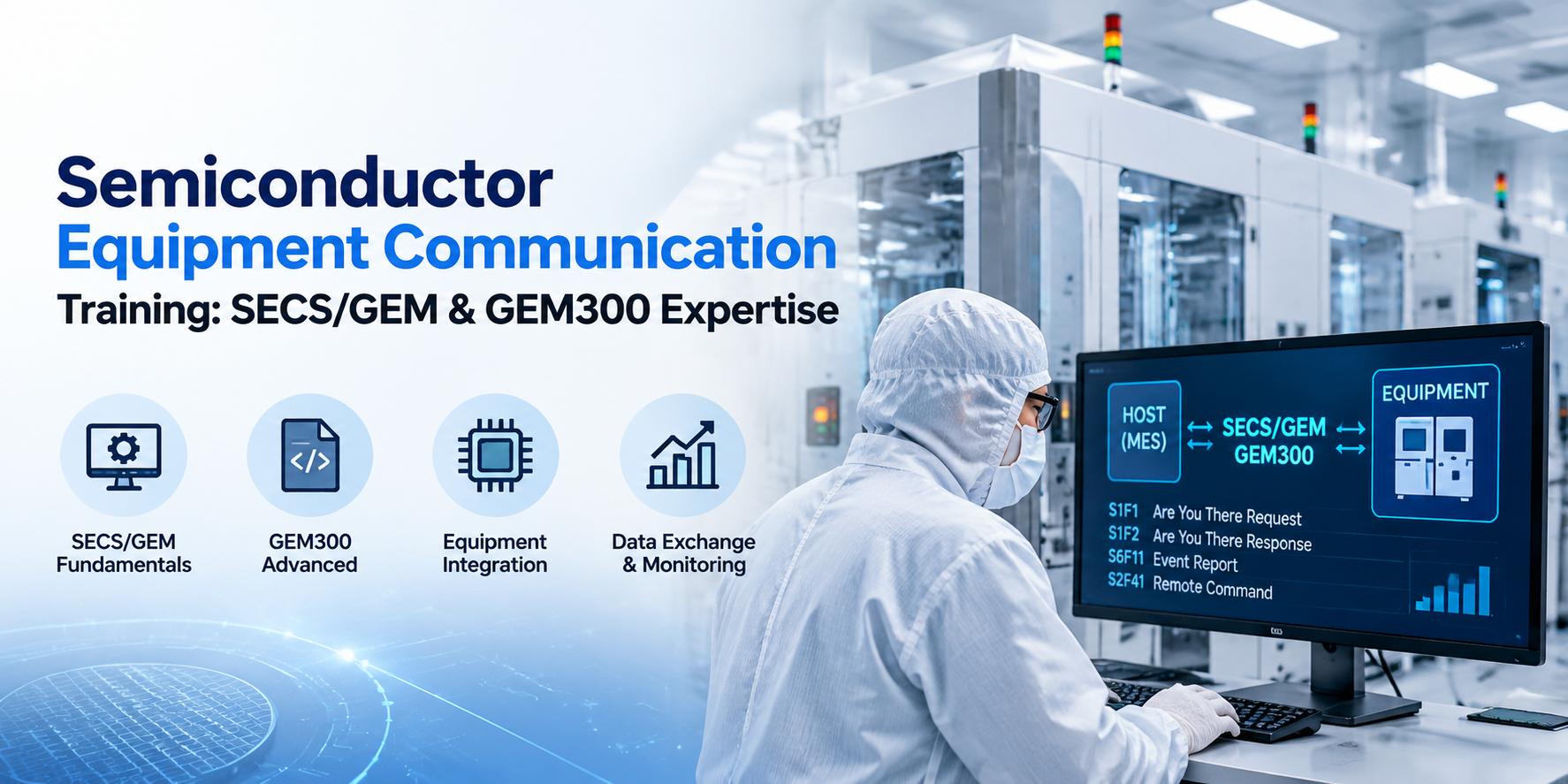
Semiconductor Equipment Communication Training: SECS/GEM & GEM300 Expertise
A process tool can run flawlessly and still be a black box to the factory if it cannot exchange information with the host. Engineers who connect equipment to fab systems need to understand how that exchange works, and the standards behind it are not always intuitive for newcomers. Semiconductor equipment communication training gives engineers a structured way to learn SECS/GEM, HSMS, and GEM300 before they face a live integration project.
Why Semiconductor Equipment Communication Matters
A fab runs equipment from many vendors, and each tool needs to report status, accept commands, and share data with host systems. Without a common interface, every connection becomes a custom project.
Standardized equipment communication addresses this. Depending on how it is implemented, it can help teams:
- Monitor equipment state and process events from a central system
- Collect data for analysis and traceability
- Send remote commands in a controlled way
- Reduce the effort of connecting tools from different suppliers
For equipment OEMs, supporting these standards is often a customer requirement. For fab automation and MES/IT teams, it determines how quickly new tools can be brought online.
What Is SECS/GEM?
SECS/GEM is a family of SEMI standards for equipment-to-host communication. It is best understood as layers with distinct roles:
- SECS-II defines the message format, organized into streams and functions.
- HSMS defines how those messages travel over a TCP/IP network.
- GEM defines how equipment should behave, including states, events, alarms, and data reporting.
One clarification helps beginners: SECS/GEM is not an MES. It is the interface through which a host, which may be an MES or another automation system, communicates with equipment. The MES handles production logic, while SECS/GEM carries the conversation with the tool.
Understanding HSMS and Host-Equipment Communication
HSMS, the High-Speed SECS Message Services standard, replaced the older serial approach with an Ethernet-based connection. One side acts as the active entity and initiates the TCP connection. The other is passive and waits for it.
Once connected, the two sides establish a communication session and exchange messages. Engineers also need to know the supporting mechanisms:
- Connection states and session selection
- Link test messages that confirm the connection is alive
- Timeout parameters that govern how long each side waits for a reply
Many early integration problems come from mismatched connection settings rather than faulty logic. Understanding HSMS makes these issues far easier to spot.
What Is GEM300?
GEM300 extends GEM for 300 mm fab environments, where more automation is needed around material handling and production control. In practical terms, it covers areas such as carrier management, substrate tracking, and job control.
Support for GEM300 is implementation-dependent. Which parts a tool needs depends on the equipment type, the fab's requirements, and the host system's design. That is why GEM300 training should focus on interpreting the standards for a given context, not just memorizing them.
What You Learn in SECS/GEM & GEM300 Training
Good SECS/GEM training builds a mental model first, then moves to detail. Typical topics include:
- How SECS-II messages are structured and read
- The GEM state models and required capabilities
- HSMS connection behavior and timers
- GEM300 concepts such as carrier and job handling
GEM300 training usually assumes this foundation, so engineers new to the field generally start with the base standards.
Practical Skills for Semiconductor Equipment Engineers
Messages, Events, and Alarms
Engineers learn to read and build messages, then connect them to equipment behavior. Events signal that something happened, such as a process step completing. Alarms report abnormal conditions and need clear handling on both sides.
Data Collection and Remote Commands
Data collection lets a host request specific variables or receive reports when defined events occur. Remote commands let a host start, stop, or direct equipment actions, so engineers must understand which commands are allowed in which states.
Troubleshooting and Integration Workflows
Reading message logs is one of the most valuable skills. A typical workflow runs from establishing communication, to verifying basic messages, to mapping events and data, to testing alarms and commands. Trainees who follow this sequence find problems earlier and with less guesswork.
Common Challenges in Equipment Communication
Even with standards, integration is rarely plug-and-play. Frequent challenges include:
- Different interpretations of optional or flexible parts of the standard
- Mismatched timers, device IDs, or connection roles
- Inconsistent event and variable definitions between tools
- Legacy equipment that lacks a native SECS/GEM interface
- Limited access to real equipment for testing
Each of these is manageable when engineers know where to look. Without that knowledge, teams can lose days chasing a setting that a trained engineer would check first.
Why Practical Training Matters
Real equipment is expensive and often unavailable for experimentation. Practicing with simulators and message logs lets engineers make mistakes safely and learn how a host and tool behave under different conditions.
Hands-on exposure also shortens the gap between knowing the standard and applying it. Companies such as eInnoSys, which work with semiconductor automation and SECS/GEM-related solutions, show how these skills fit into real integration work across equipment and factory systems.
Conclusion
Semiconductor equipment communication training helps engineers understand how SECS-II, HSMS, GEM, and GEM300 fit together, and how to apply them in real host-equipment projects. With a clear grasp of messages, events, alarms, data collection, and troubleshooting, teams can approach integration with more confidence and fewer surprises. For anyone working in fab automation or equipment integration, building these fundamentals early is a practical investment.