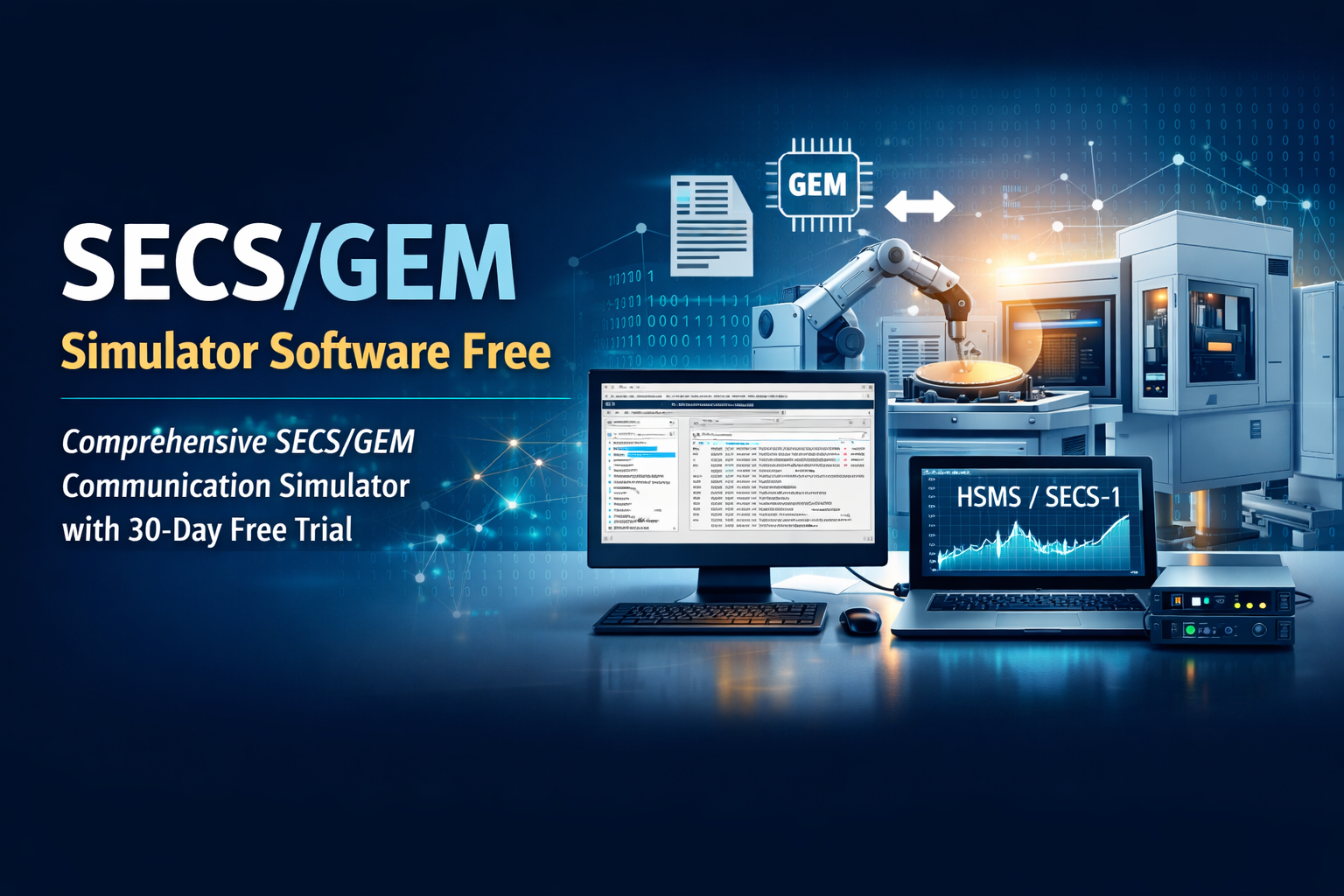
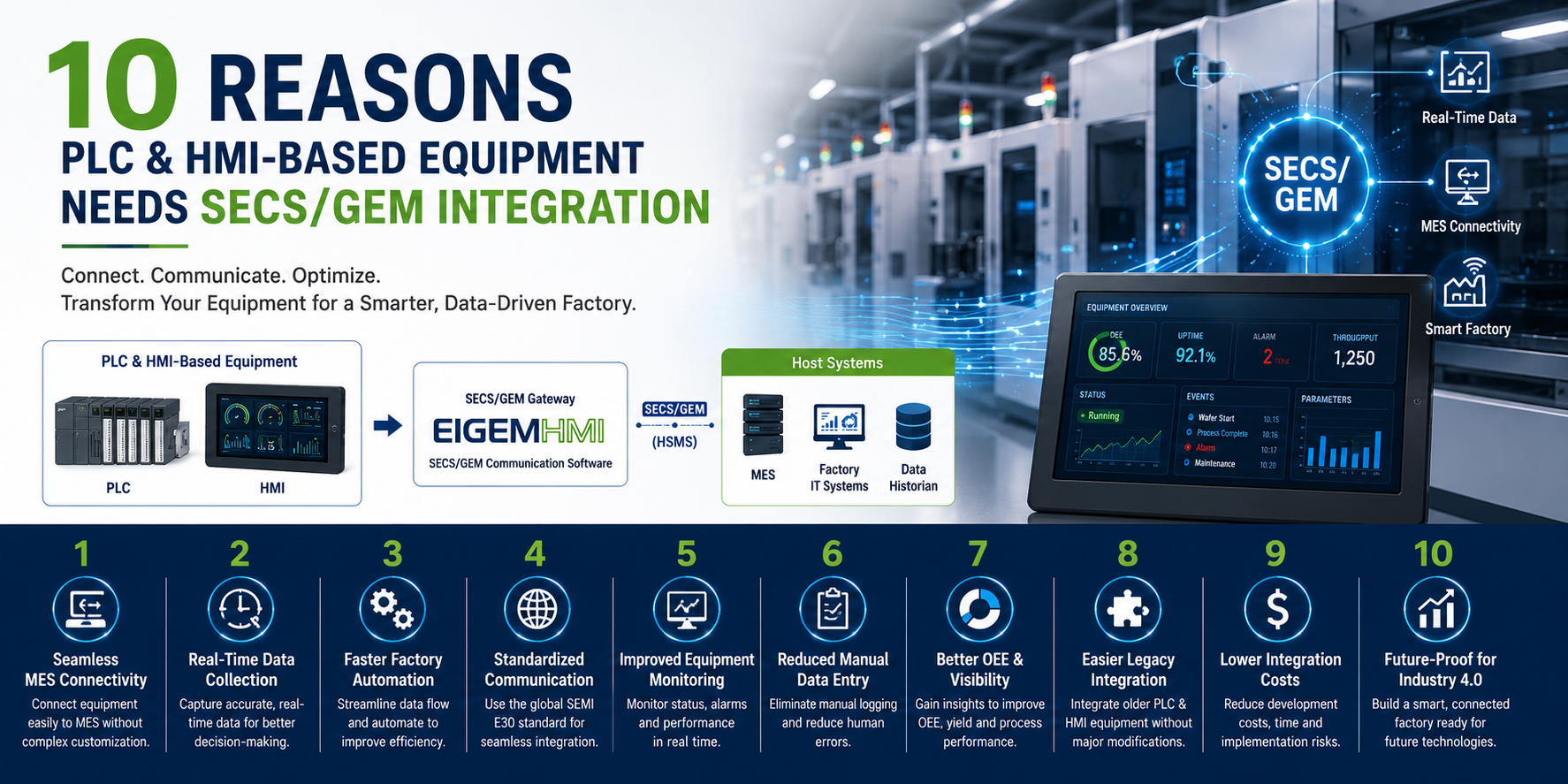
10 Reasons PLC & HMI-Based Equipment Needs SECS/GEM Integration
Walk the floor of almost any semiconductor fab and you'll find two very different populations of equipment living side by side. On one end are modern process tools built SECS/GEM-native from the factory. On the other are PLC- and HMI-controlled machines — some purpose-built subsystems, some older capital tools, some homegrown automation — that were never designed to speak the factory host's language at all. That second group is larger than most facilities would like to admit, and it's increasingly the group holding back fab-wide data visibility.
SECS/GEM (SEMI Equipment Communications Standard / Generic Equipment Model) exists precisely to solve this. It's the SEMI-defined protocol suite that lets semiconductor manufacturing equipment communicate with factory host systems, covering equipment state tracking, recipe management, alarm reporting, and process data collection— and a modern fab running 500 to 2,000 tools from dozens of vendors needs that common language, because building custom integration software for every individual tool would be an unmaintainable burden. The transport layer has also modernized: SECS-I's original RS-232 serial connection is largely obsolete, with HSMS (SEMI E37) now the standard TCP/IP Ethernet transport for most SECS/GEM deployments.
For PLC- and HMI-based equipment, though, none of that comes for free. These control systems were engineered for machine logic and operator interaction, not for exposing internal states and data points in a SEMI-compliant format. Here are ten reasons that gap is worth closing.
1. Data Trapped in the PLC Never Reaches the Factory Host
A common challenge in semiconductor manufacturing is that critical operational data remains trapped inside PLCs, inaccessible to factory automation platforms. Temperature, pressure, cycle counts, and fault codes may all exist inside the controller — but if there's no SECS/GEM interface, that data simply doesn't reach MES, the historian, or the engineers who need it for process control.
2. Most Fabs Require SECS/GEM as a Host Qualification Prerequisite
New equipment entering a production fab typically must pass a host qualification process before it's allowed on the line, and SECS/GEM compliance is usually part of that checklist. Equipment OEMs shipping PLC- or HMI-based tools into semiconductor accounts increasingly find that a missing SECS/GEM interface is a deal-blocker, not a nice-to-have.
3. Real-Time Equipment State Tracking Speeds Up Response
GEM's standard equipment states (per SEMI E30) give the factory host a live, standardized view of whether a tool is idle, running, in setup, or down — rather than relying on an operator to notice and report it. For PLC-driven subsystems, this state visibility is often the single biggest gap between "we have automation" and "we have factory-integrated automation."
4. Recipe Management Reduces Manual Setup Errors
Recipe download and verification through GEM lets the host push validated process parameters directly to the equipment, removing the manual re-entry step that's historically been a source of setup mistakes on PLC/HMI-controlled tools. For equipment running high product mix, this alone can materially cut recipe-related excursions.
5. Standardized Alarm Reporting Shortens Maintenance Response Time
Instead of a fault light on an HMI panel that only the operator standing in front of it can see, SECS/GEM alarm reporting pushes equipment faults directly into the factory's alarm management and maintenance workflow — often triggering a work order automatically. That's a meaningful shift for legacy tools where, historically, a fault condition sat unnoticed until the next scheduled check.
6. Better Traceability Supports MES and Yield Analysis
Wafer-level and lot-level traceability depends on capturing process data at the equipment level, tied to specific recipes, timestamps, and equipment states. PLC/HMI equipment without SECS/GEM connectivity is effectively a traceability blind spot — a gap that becomes a real liability the moment a yield excursion needs to be traced back to a specific tool and process window.
7. It Feeds the Predictive Maintenance Systems Fabs Are Already Investing In
PLC monitoring that continuously tracks parameters such as temperature, pressure, vibration, and motor current, when combined with predictive maintenance software, helps identify potential equipment failures before they cause costly downtime. None of that predictive capability is possible if the PLC's data never leaves the controller — SECS/GEM integration is the pipe that makes it usable at the factory level.
8. It Extends the Useful Life of Capital Equipment You Already Own
Legacy manufacturing equipment is often decades old, built for reliability and precision rather than Industry 4.0 connectivity — and retiring it is rarely an option given its high cost and proven performance Rather than facing a costly rip-and-replace decision, fabs can retrofit SECS/GEM connectivity onto existing PLC- and HMI-based tools and keep proven equipment productive for years longer.
9. It's Becoming a Competitive Requirement for Equipment OEMs
Fabs are standardizing their qualification checklists around SECS/GEM compliance, and OEMs building PLC- or HMI-controlled equipment — subsystems, test handlers, metrology add-ons, sub-fab support tools — are finding that a documented, SEMI-compliant interface is now a sales requirement across most major accounts, not just the largest customers. In 2026, mastering SECS/GEM has become a competitive necessity rather than a technical nicety for equipment automation architects.
10. It's the Foundation for Smart Manufacturing and Scalable Fleets
Whether a facility is layering in AI-driven process control, digital twins, or fab-wide analytics, all of it depends on equipment data being available in a standardized, host-consumable format. Connecting PLC- and HMI-based equipment via SECS/GEM turns every previously siloed machine into a participant in that broader smart-manufacturing data fabric, rather than a permanent exception that has to be worked around.
The Practical Problem: Most PLC/HMI Equipment Wasn't Built for This
Knowing you need SECS/GEM connectivity and actually adding it to a PLC- or HMI-based machine are two different challenges. Traditional approaches meant rewriting control logic, adding a PC-based interface layer, or engaging in a lengthy custom integration project — often disruptive enough that facilities put it off indefinitely.
That's the specific problem non-intrusive retrofit platforms are designed to solve. EIGEM-HMI, for example, is built to enable SECS/GEM connectivity on PLC and HMI-based equipment without modifying existing control logic, working directly at the PLC level with minimal engineering effort, and supporting protocols including OPC UA, TCP/IP, Modbus TCP, Modbus RTU, and Modbus ASCII. Because it doesn't require redesigning the control system, deployment is designed to be quick and require no complex modifications — making it a practical fit for retrofitting legacy tools rather than replacing them.
For equipment engineers weighing whether to pursue SECS/GEM for a PLC- or HMI-based tool, the calculation increasingly comes down to this: the data, traceability, and host-integration benefits are no longer optional extras, and non-intrusive retrofit paths mean the integration no longer requires the disruption it once did.
Getting Started
If your fab or OEM organization is running PLC- or HMI-based equipment that still sits outside your SECS/GEM environment, the starting point is an honest inventory: which tools are missing host connectivity, which protocols do their PLCs already speak, and which SEMI standards (E30, E37, E5, GEM300) your factory host requires. From there, a retrofit solution built specifically for non-PC-based equipment — like EIGEM-HMI — can bring those tools into full factory communication without a control-system rewrite, closing the data gap on equipment that's often too valuable to replace and too disconnected to leave as-is.