
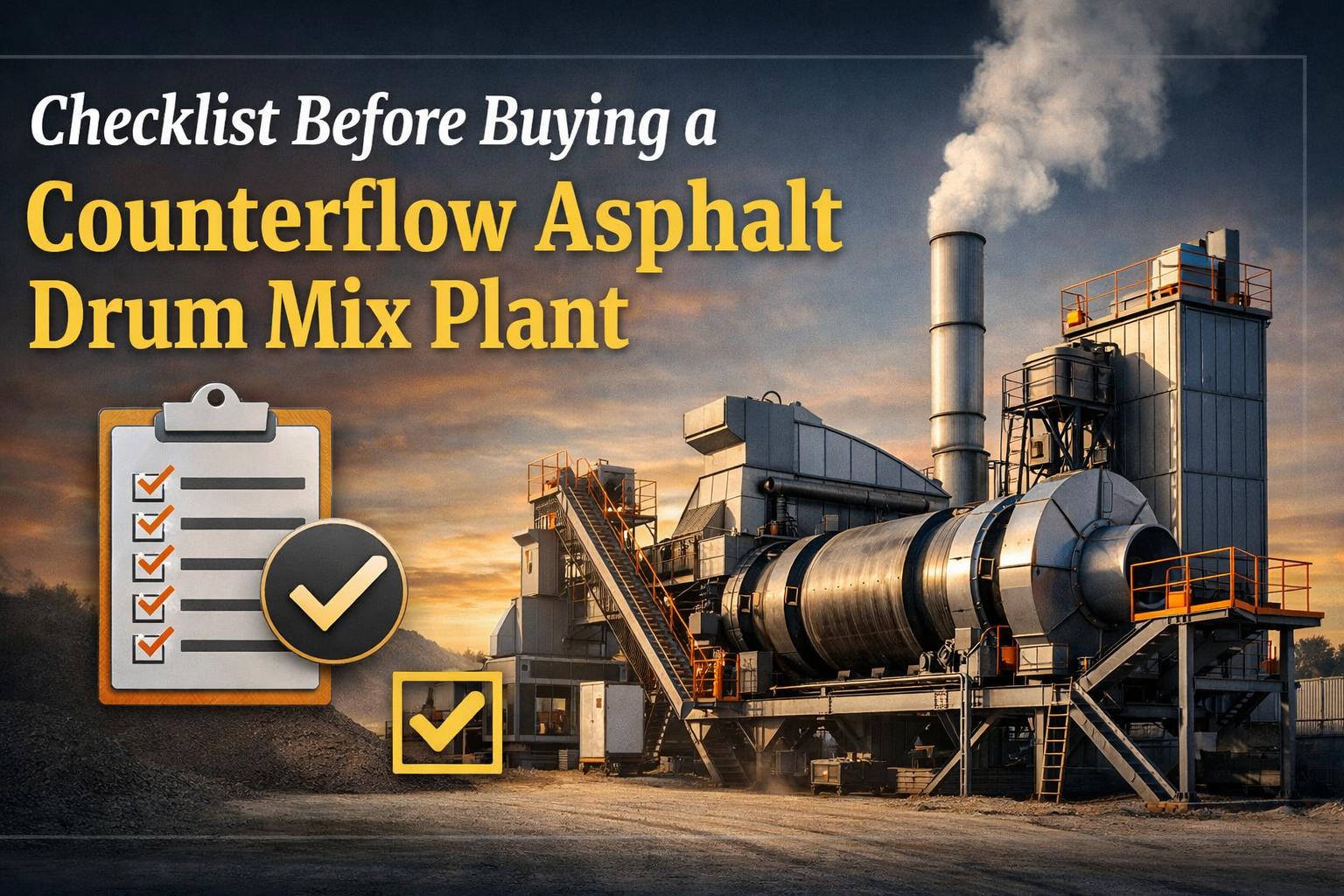
Checklist Before Buying A Counterflow Asphalt Drum Mix Plant
Investing in a Counter-flow asphalt mixer is a major decision for any road construction or infrastructure business. With increasing demand for high-quality roads and stricter environmental regulations, choosing the right counterflow asphalt mixing plant can directly impact your project efficiency, cost savings, and long-term profitability.
However, many buyers make the mistake of focusing only on price without evaluating performance, durability, and operational efficiency. Whether you are considering Counterflow asphalt drum mixers for large-scale highway projects or a Counterflow mobile drum mix plant for flexible operations, having a clear checklist can help you avoid costly mistakes.
This guide provides a complete checklist to ensure you select the right Counterflow asphalt drum plant that meets your business needs.
Why a Checklist is Important Before Buying
Purchasing a Counterflow asphalt plant drum involves significant capital investment. A structured checklist helps you:
- Avoid underperforming equipment
- Ensure compliance with environmental standards
- Maximize return on investment
- Reduce long-term maintenance costs
- Select the right configuration for your projects
1. Define Your Project Requirements
Before exploring options, clearly outline your needs:
- Type of projects (highways, rural roads, urban roads)
- Daily production requirement
- Project duration
- Location and mobility needs
For example, large infrastructure projects may require a high-capacity counterflow asphalt mixing plant, while smaller or temporary sites benefit from mobile solutions.
2. Choose the Right Production Capacity
Capacity is one of the most critical factors when selecting Counterflow asphalt drum mixers.
Common Capacity Options:
- 40–60 TPH (small projects)
- 60–90 TPH (medium projects)
- 100–150+ TPH (large projects)
Choosing the wrong capacity can either increase costs or limit productivity.
3. Evaluate Counterflow Drum Mix Plant Price
The Counterflow drum mix plant price should not be your only decision factor, but it is important to understand what influences it:
- Plant capacity
- Automation level
- Mobility (stationary vs mobile)
- Pollution control systems
- Brand and build quality
A slightly higher upfront investment often results in better durability and lower operational costs.
4. Check Mobility Requirements
If your projects require frequent relocation, consider a Counterflow mobile drum mix plant.
Benefits of Mobile Plants:
- Easy transportation
- Faster installation
- Reduced setup costs
- Ideal for remote locations
Stationary plants, on the other hand, are better suited for long-term projects.
5. Inspect Build Quality and Materials
Durability plays a crucial role in long-term performance.
Key Areas to Inspect:
- Drum thickness and material
- Burner quality
- Insulation system
- Structural strength
A robust Counterflow asphalt drum plant ensures fewer breakdowns and longer lifespan.
6. Analyze Fuel Efficiency
Fuel costs are a major operational expense. A well-designed Counterflow asphalt plant drum improves heat transfer efficiency, reducing fuel consumption.
Look for:
- Advanced burner systems
- Proper insulation
- Efficient heat exchange design
7. Check Pollution Control Systems
Environmental compliance is no longer optional.
Important Features:
- Baghouse filters
- Dust collectors
- Emission control systems
A modern counterflow asphalt mixing plant should meet local environmental regulations and reduce dust emissions.
8. Evaluate the Automation and Control System
Automation improves accuracy and reduces manual errors.
Key Features:
- User-friendly control panel
- Real-time monitoring
- Temperature control
- Fault detection system
Fully automated Counterflow asphalt drum mixers can significantly improve productivity.
9. Verify After-Sales Support and Service
Reliable support is essential for smooth operations.
Check for:
- Availability of spare parts
- Technical support team
- Installation assistance
- Maintenance services
Manufacturers like Atlas Industries are known for providing strong after-sales support, ensuring minimal downtime.
10. Compare Stationary vs Mobile opti

11. Assess Installation and Space Requirements
Ensure your site can accommodate the plant.
Consider:
- Land availability
- Power supply
- Raw material storage
- Accessibility for transport
12. Review Safety Features
Safety should never be compromised.
Essential Safety Features:
- Emergency shutdown systems
- Fire protection systems
- Temperature alarms
- Operator safety controls
Download Case Study : 90-120 tph mobile counterflow asphalt mixer
13. Check Manufacturer Reputation
Always choose a trusted manufacturer with proven experience.
Evaluate:
- Customer reviews
- Industry presence
- Project portfolio
- Certifications
A reliable brand ensures consistent quality and support.
14. Understand Maintenance Requirements
Maintenance impacts long-term costs and efficiency.
Checklist:
- Ease of cleaning
- Availability of spare parts
- Maintenance frequency
- Service cost
15. Future Scalability
Your plant should support future expansion.
Consider:
- Upgrade options
- Modular design
- Compatibility with new technologies
Common Mistakes to Avoid
- Choosing based only on price
- Ignoring environmental compliance
- Selecting incorrect capacity
- Overlooking after-sales service
- Not evaluating fuel efficiency
Why Choose Atlas Industries?
Selecting the right supplier is as important as choosing the right plant. Atlas Industries offers advanced solutions designed for efficiency, durability, and performance. Their plants are built to meet modern construction needs while ensuring long-term reliability.
FAQs
Q1. What should I check before buying a counterflow asphalt mixer?
A1. You should evaluate capacity, price, fuel efficiency, mobility, and environmental compliance.
Q2. What affects Counterflow drum mix plant price?
A2. Factors include plant capacity, automation, mobility, and pollution control systems.
Q3. Is a Counterflow mobile drum mix plant worth it?
A3. Yes, it is ideal for projects requiring flexibility and relocation.
Q4. How do Counterflow asphalt drum mixers improve efficiency?
A4. They enhance heat transfer and reduce fuel consumption.
Q5. What is the lifespan of a Counterflow asphalt drum plant?
A5.With proper maintenance, it can last many years with consistent performance.