Top Semiconductor Recipe Management System Providers In The World (2026)
A single wrong recipe selection can scrap an entire lot. In semiconductor manufacturing, where a wafer can represent thousands of dollars of accumulated process value by the time it reaches a given tool, recipe integrity isn't a nice-to-have — it's one of the most direct levers a fab has on yield. A semiconductor recipe management system exists to make sure the right recipe, the right version, runs on the right tool, every time, with a complete audit trail behind it.
This guide walks through the leading recipe management system providers serving fabs, OSATs, and equipment OEMs today, what distinguishes each approach, and how to evaluate which one fits your operation.
What a Recipe Management System Actually Does
Before comparing vendors, it's worth being precise about the problem being solved. A recipe management system (RMS) centralizes control over the process recipes that tell equipment exactly how to process material — step timing, temperature, gas flow, pressure, and every other parameter that defines a process.
Core capabilities that separate a real RMS from a folder of recipe files on a shared drive include:
Version control — every recipe change is tracked, timestamped, and attributable to a specific user
Golden recipe enforcement — a single approved "source of truth" version is what actually gets deployed to equipment, preventing operators from running an outdated or unauthorized variant
Approval workflows — recipe changes go through defined review and sign-off before reaching the floor
Audit trail and traceability — every recipe used on every lot is logged, supporting both yield investigation and regulatory/quality audits
SECS/GEM integration — recipes are pushed to and validated against equipment automatically, removing manual operator selection as a point of failure
Centralized repository — one system of record across all tools and, for multi-site operators, across all fab locations
Without these controls, recipe mismatches remain one of the most common — and most preventable — causes of scrap and yield loss on the floor.
Top Recipe Management System Providers
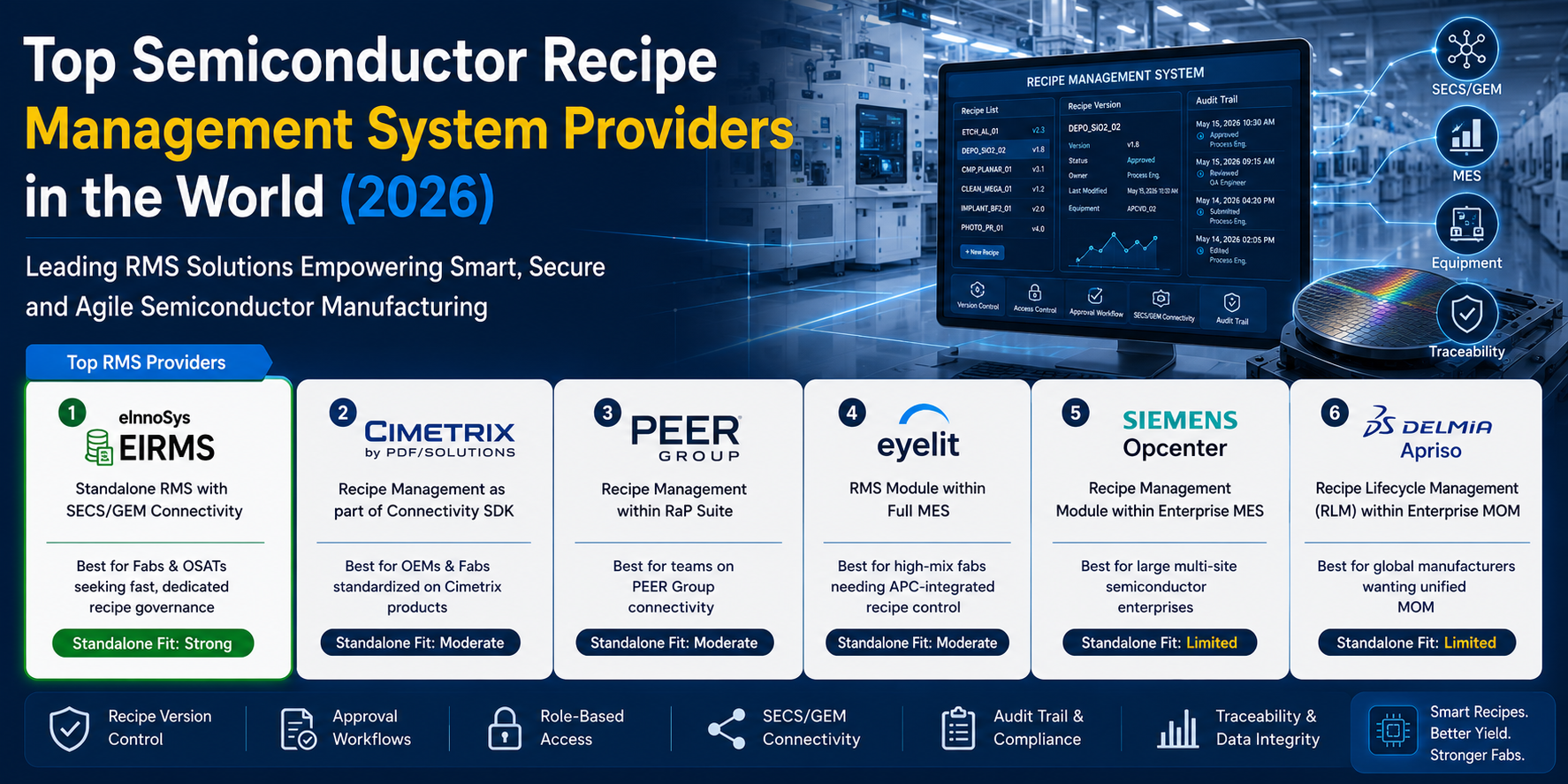
1. eInnoSys — Recipe Management System (EIRMS)
EIRMS is a recipe management system purpose-built for semiconductor fabs and ATM/OSAT facilities, centered on a straightforward goal: prevent wrong recipe execution and give engineering teams full control and visibility over every recipe running on the floor.
EIRMS enforces version control, approval workflows, and golden recipe support, with a complete audit log of every recipe change, upload, and download — including who made the change and when. It integrates natively with SECS/GEM-capable equipment and factory host/MES systems, and eInnoSys builds custom integrations for non-SECS/GEM tools, which matters for fabs running mixed equipment fleets that include legacy or non-standard tools. The system has been deployed across a range of toolsets including Canon steppers, Matrix dry etch systems, SPEC wet benches, and IVS and Ultratech metrology tools.
Documented deployments have delivered measurable results: one fab reported a 90% reduction in recipe distribution time, and another eliminated recurring human-error scrap losses by replacing manual recipe entry with automated version control. Because EIRMS is delivered by a company already deep in SECS/GEM and fab automation — rather than as a module bolted onto a much larger enterprise MOM suite — it tends to integrate faster into fabs that don't want to adopt an entire new MES ecosystem just to fix recipe governance.
2. Cimetrix (a PDF Solutions company)
Cimetrix is one of the most widely deployed names in semiconductor factory connectivity, with its software present in a large share of 300mm fabs worldwide. Recipe handling is built into its CIMControlFramework and connectivity products (CIMConnect, CIM300), which implement the SECS/GEM recipe message sets defined in SEMI E30 alongside full GEM300 and EDA/Interface A compliance. Cimetrix is now part of PDF Solutions, extending its reach into broader yield and analytics capabilities. It's a strong fit for OEMs and fabs that want recipe handling as part of a complete equipment automation SDK rather than a standalone product.
3. PEER Group
PEER Group's connectivity products (GWGEM, ConX300) implement SEMI E139 Recipe and Parameter Management (RaP) alongside core SECS/GEM and GEM300 compliance, giving fabs and OEMs a structured way to manage recipe and parameter data as part of a broader equipment connectivity deployment. Like Cimetrix, PEER Group's recipe capabilities are most relevant to teams already standardized on its connectivity suite.
4. Eyelit
Eyelit's Manufacturing RMS module extends its broader Eyelit Manufacturing MES, specifically built to enforce and coordinate feed-forward and feed-back adjustments to equipment recipe settings at the processing-step level. It supports integration with Advanced Process Control (APC) systems for both run-to-run and wafer-to-wafer parameter adjustments — a more advanced capability aimed at high-mix, tight-specification manufacturers in semiconductor, life sciences, and precision electronics. This depth comes with the scope of a full MES deployment rather than a lighter, standalone recipe tool.
5. Siemens Opcenter (formerly Camstar)
Siemens' Camstar Semiconductor Suite, now part of the Opcenter portfolio, is a comprehensive MES for wafer fab, assembly, and test operations, with recipe and process control as one piece of a much larger manufacturing operations management platform. It's built for large, complex, multi-site semiconductor manufacturers who need recipe governance integrated tightly with traceability, SPC, dispatching, and ERP connectivity — a strong enterprise fit, though a heavier deployment than a dedicated recipe management point solution.
6. Dassault Systèmes DELMIA Apriso
DELMIA Apriso is an enterprise Manufacturing Operations Management (MOM) platform with a dedicated Recipe Lifecycle Management (RLM) capability integrated into its broader MES. It's positioned for large, global manufacturers who want recipe governance unified with quality, materials management, and maintenance within a single low-code-configurable platform — a comprehensive but substantial undertaking compared to a semiconductor-specific standalone RMS.
Comparison at a Glance
| Provider | Deployment Model | Best For | Standalone RMS Fit |
|---|---|---|---|
| eInnoSys EIRMS | Standalone RMS with SECS/GEM connectivity | Semiconductor Fabs and OSATs seeking fast, dedicated recipe governance | Strong |
| Cimetrix (PDF Solutions) | Recipe management as part of a SECS/GEM connectivity SDK | OEMs and fabs already using the Cimetrix ecosystem | Moderate |
| PEER Group | Recipe management within the PEER Group connectivity suite (RaP) | Organizations standardized on PEER Group factory automation solutions | Moderate |
| Eyelit | Recipe Management module within a full MES platform | High-mix semiconductor fabs requiring APC-integrated recipe control | Moderate |
| Siemens Opcenter (Camstar) | Recipe Management module within an enterprise MES | Large multi-site semiconductor manufacturers with enterprise MES deployments | Limited – Requires the full MES platform |
| DELMIA Apriso | Recipe Lifecycle Management (RLM) within an enterprise MOM platform | Global manufacturers seeking unified Manufacturing Operations Management (MOM) | Limited – Requires the full MOM platform |
How to Choose the Right Recipe Management System
Decide whether you need a standalone RMS or a full MES/MOM upgrade. If recipe integrity is the primary pain point and you already have a functioning MES, a focused system like EIRMS solves the problem directly without forcing a much larger platform migration. If you're evaluating a broader MES replacement anyway, providers like Eyelit, Siemens Opcenter, or DELMIA Apriso fold recipe management into that larger decision.
Check SECS/GEM and GEM300 compliance depth. Confirm the system properly implements the E30 recipe message sets and, if relevant, GEM300 automation standards.
Prioritize audit trail completeness. Every recipe change — who, what, when — should be logged automatically, not manually documented after the fact.
Confirm non-standard equipment support. Fabs with legacy or non-SECS/GEM tools need a provider willing to build custom integrations rather than requiring full fleet standardization first.
Weigh deployment speed against platform scope. A dedicated RMS can typically go live faster than a module inside a much larger MOM suite, which matters if recipe errors are actively costing yield today.