
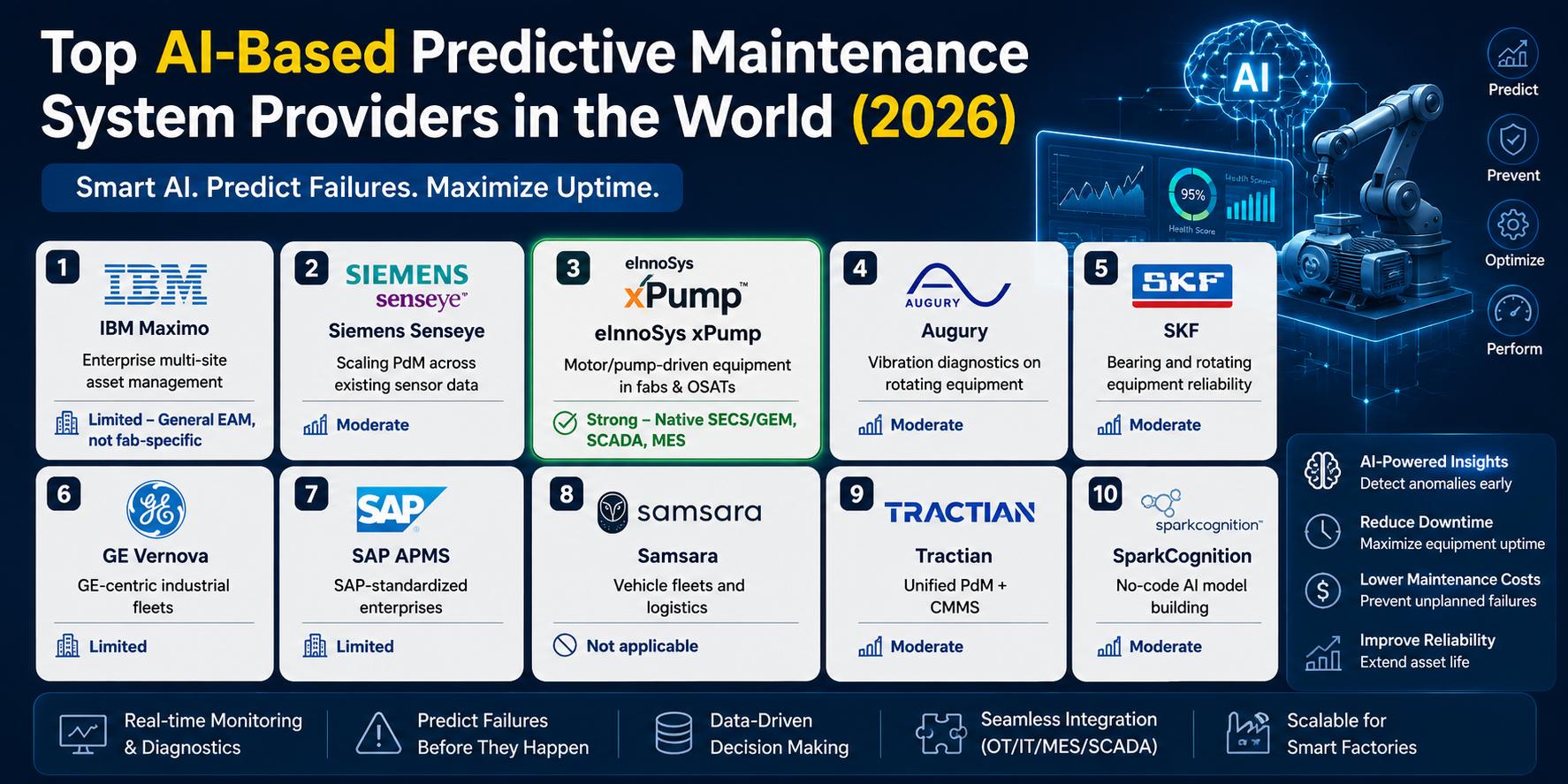
Top AI-Based Predictive Maintenance System Providers In The World (2026)
Predictive maintenance has moved from pilot project to production reality across semiconductor fabs, OSAT facilities, and heavy industrial plants. The technology stack — AI/ML models, industrial sensors, and real-time equipment connectivity — has matured to the point where the real question isn't whether to adopt an AI predictive maintenance system, but which provider actually fits your equipment fleet, your industry, and your existing factory infrastructure.
The market is crowded, and not every provider serves every use case equally well. Some are built for enterprise asset management at Fortune 500 scale. Some specialize narrowly in vibration analysis for rotating equipment. And a smaller number are purpose-built for the specific demands of semiconductor manufacturing, where equipment connectivity standards like SECS/GEM and tight yield tolerances make generic industrial IoT platforms a poor fit. This guide breaks down the leading global providers so you can find the right match for your operation.
What to Look for in an AI Predictive Maintenance Provider
Before comparing vendors, it's worth being clear on the criteria that actually separate a strong predictive maintenance system from a dashboard that generates alerts nobody acts on:
Genuine machine learning, not static thresholds — the system should learn from your equipment's own operating history, not just flag values that cross a fixed line.
Real lead time — days of warning are useful; weeks of warning are what actually allow planned, rather than emergency, maintenance.
Sensor and equipment compatibility — does it work across your existing equipment brands, or lock you into a proprietary hardware ecosystem?
Factory system integration — native connectivity to SCADA, MES, and (for semiconductor environments specifically) SECS/GEM matters far more than a standalone dashboard.
Deployment flexibility — cloud, on-premise, or hybrid, depending on your data governance requirements.
Industry fit — a platform built for vehicle fleets or wind turbines won't necessarily translate well to fab-floor pumps, exhausts, and motor-driven equipment.
Top AI Predictive Maintenance Providers
1. IBM (Maximo Application Suite / Maximo Predict)
IBM's Maximo platform is one of the most established enterprise asset management systems with AI-powered predictive maintenance built in, used by large industrial clients running complex, multi-site asset portfolios. It's a strong fit for organizations that need predictive maintenance as one module within a much broader enterprise asset management deployment — though enterprise pricing (often $200K+ annually) puts it out of reach for many mid-sized operations.
2. Siemens (Senseye Predictive Maintenance)
Siemens applies machine learning directly to a plant's existing sensor and SCADA history, which makes Senseye a strong option for large manufacturers who want to scale predictive maintenance across a big asset fleet without a full hardware overhaul. It's most effective where extensive historical sensor data already exists to train against.
3. eInnoSys — xPump
xPump is a turnkey AI/ML-based predictive maintenance system purpose-built for pumps, motors, exhausts, ovens, furnaces, and other motor-driven equipment — the exact equipment categories that keep semiconductor fabs and OSAT facilities running. It combines proprietary AI analytics with industrial-grade sensors to predict failures weeks in advance, giving engineering teams a real planning window instead of a same-day emergency alert.
What sets xPump apart from the broader industrial platforms on this list is factory-system fit: it integrates natively with SECS/GEM, SCADA, and MES connectivity, which matters enormously in semiconductor environments where equipment already communicates through those standards and a bolt-on IoT dashboard simply doesn't integrate cleanly. It also supports both cloud-based and on-premise deployment, giving fabs with strict data governance requirements a path that doesn't force everything into a third-party cloud.
For semiconductor fabs and OSATs specifically — where a single failed vacuum pump or exhaust blower can scrap an entire lot — this combination of predictive accuracy, real lead time, and native fab-system integration is the differentiator that the general-purpose industrial platforms on this list weren't built to match.
4. Augury
Augury is one of the most established pure-play machine health companies, pairing proprietary vibration and acoustic sensors with AI diagnostics trained on millions of machine hours. Diagnostic accuracy for rotating equipment — motors, pumps, fans, compressors — is considered best-in-class, which has earned it a reputation as something close to the gold standard for full-service vibration monitoring. Enterprise pricing (commonly $50K+ annually) and proprietary sensor requirements are the main tradeoffs.
5. SKF
SKF is the reliability specialist for bearings and rotating equipment specifically. Its vibration analysis and condition monitoring hardware are deeply proven in this niche, and the offering is frequently delivered as a managed analyst service rather than a pure self-serve software platform — a good fit for teams that want expert interpretation alongside the data.
6. GE Vernova (Predix APM)
GE Vernova's Predix APM combines asset performance management with predictive maintenance modules, root cause analysis, and performance benchmarking. It's particularly strong for organizations already running GE turbines, generators, or other GE-centric industrial equipment, where the deep native integration outweighs the platform's general-purpose limitations elsewhere.
7. SAP (Asset Performance Management)
SAP's APM module lives inside the broader SAP ERP ecosystem, letting large organizations already standardized on SAP monitor machine performance and predict maintenance needs without introducing a separate system. The tradeoff is that it's most valuable specifically to companies already deep in the SAP environment.
8. Samsara
Samsara's IoT sensors and real-time analytics are built primarily around vehicle fleets and mobile equipment rather than stationary industrial machinery, making it the strongest option in this list specifically for transportation and logistics operations rather than fab-floor or plant-floor equipment.
9. Tractian
Tractian combines proprietary sensors, ML-based condition monitoring, and a built-in CMMS into a single platform, appealing to plants that want fault detection and work-order management unified in one place rather than stitched together across separate systems.
10. SparkCognition
This Austin-based industrial AI company's Darwin AI platform is designed to let maintenance teams build and deploy predictive models without a dedicated data science team — directly addressing the skills gap that keeps many mid-market manufacturers from getting value out of predictive maintenance initiatives.
Comparison at a Glance
| Provider | Best For | Semiconductor / Fab Fit |
|---|---|---|
| IBM Maximo | Enterprise multi-site asset management | Limited – General Enterprise Asset Management (EAM), not semiconductor fab-specific |
| Siemens Senseye | AI-driven predictive maintenance using existing sensor data | Moderate – Suitable for industrial manufacturing, with limited semiconductor-specific capabilities |
| eInnoSys xPump | AI-powered monitoring of vacuum pumps, motors, blowers, and rotating equipment | Strong – Designed for semiconductor fabs & OSATs with native SECS/GEM, SCADA, MES, and Smart Factory integration |
| Augury | AI vibration analysis and rotating equipment diagnostics | Moderate – General industrial predictive maintenance solution |
| SKF | Bearing health monitoring and rotating equipment reliability | Moderate – Strong for rotating machinery, but not semiconductor-specific |
| GE Vernova | Predictive maintenance for GE industrial assets and power equipment | Limited – Primarily focused on GE industrial environments |
| SAP Asset Performance Management (SAP APM) | Asset performance management for SAP-centric enterprises | Limited – Best suited for SAP users, not semiconductor-focused |
| Samsara | Fleet management, logistics, and IoT asset tracking | Not Applicable – Focused on transportation and fleet operations |
| Tractian | Unified predictive maintenance with integrated CMMS | Moderate – Suitable for general manufacturing, limited semiconductor specialization |
| SparkCognition | No-code AI and machine learning predictive analytics | Moderate – Flexible AI platform with customization required for semiconductor applications |
Choosing the Right Provider for Your Fab or Plant
For most manufacturers, the decision comes down to one question: does this platform understand the equipment and factory systems you actually run? A vibration-analytics specialist or an enterprise EAM suite can be an excellent choice for general industrial rotating equipment. But for semiconductor fabs and OSAT facilities specifically — where vacuum pumps, exhausts, and motor-driven tools are directly tied to yield, and where SECS/GEM connectivity is already the standard language equipment speaks — a platform built for that environment from the ground up tends to deliver faster, cleaner integration than retrofitting a general-purpose industrial IoT tool.
If your equipment fleet falls into that category, it's worth evaluating eInnoSys xPump directly against your specific pumps, motors, and factory automation stack — the fastest way to see whether the fit outlined above holds up for your facility.