Best Industrial Protocol Converter For Semiconductor Factory Automation (2026)
Semiconductor factory floors run on a patchwork of communication standards. A single fab can have tools speaking OPC UA, MQTT, Modbus, EtherCAT, Profinet, and standard Ethernet — sometimes all within the same process bay. But the factory host, the MES, and the equipment automation layer that actually runs the fab expect one language above all others: SECS/GEM. That mismatch is exactly the problem an industrial protocol converter is supposed to solve — but not every protocol converter on the market actually solves it for semiconductor manufacturing specifically.
This is the detail that trips up a lot of factory automation teams: the broader industrial protocol converter market — the Anybus gateways, the Hilscher netTAP devices, the general-purpose fieldbus-to-Ethernet bridges — is built to translate between generic industrial networks like Profinet, EtherCAT, EtherNet/IP, and Modbus. That's genuinely useful for most manufacturing sectors. But it isn't what a semiconductor fab actually needs at the last mile, because none of those generic protocols is what your MES is listening for. What a fab needs is something that converts into SECS/GEM specifically. This guide breaks down the leading options — both the semiconductor-specific SECS/GEM conversion tools and the general industrial gateway vendors — so you can tell which category actually fits your integration problem.
1. Why Semiconductor Factory Automation Needs a Different Kind of Protocol Converter
Most industrial sectors solve equipment connectivity with fieldbus and Industrial Ethernet standards — Profinet, EtherCAT, EtherNet/IP, Modbus, CANopen. Protocol converters in that world exist to bridge between those standards: a PLC speaking EtherNet/IP needs to talk to a device that only speaks Profinet, and a gateway sits in between translating one to the other.
Semiconductor manufacturing added another layer on top of that. Since the 1980s, the industry standardized on SECS/GEM (SEMI Equipment Communication Standard / Generic Equipment Model) specifically for equipment-to-host communication — not because fabs don't also use Profinet, EtherCAT, or Modbus at the device level, but because SECS/GEM defines something those generic protocols don't: a standardized behavioral model for how equipment reports status, handles alarms, manages recipes, and responds to host commands. MES and factory host systems in semiconductor fabs are built to speak SECS/GEM, not raw Modbus registers or EtherCAT process data.
This creates a specific integration gap: a tool with a native OPC UA, MQTT, Modbus, EtherCAT, or Profinet interface — which describes a large share of process equipment, especially from non-semiconductor-native OEMs or newer IIoT-enabled devices — has no direct path into a SECS/GEM-based MES without something translating it. A generic industrial protocol converter that bridges Profinet to EtherCAT doesn't solve this problem, because neither side of that conversion is what the MES actually understands.
2. What to Look For in a Protocol Converter for Semiconductor Environments
- Native SECS/GEM output — the converter needs to produce genuinely SEMI-standards-compliant SECS/GEM messages (SECS-I, HSMS, GEM/E30), not just generic structured data.
- Broad source protocol support — OPC DA/UA, MQTT, Modbus RTU/TCP, EtherCAT, Profinet, and standard Ethernet coverage, since fab equipment fleets are rarely uniform.
- No or minimal custom programming — a converter that requires deep SECS/GEM software development defeats much of the purpose of a conversion layer.
- 200mm and 300mm SEMI standards compliance — including GEM300 considerations if the target environment requires automated material handling.
- Fast deployment — protocol conversion projects should be measured in hours or days, not months, for a purpose-built tool.
- Cross-platform and cross-vendor compatibility — the converter shouldn't lock you into a single equipment brand or a specific operating system.
- Reliability and support — this is infrastructure sitting between production equipment and the MES; downtime or instability in the converter itself becomes a factory-wide problem.
3. The Two Categories of Protocol Converter on the Market
Before comparing specific products, it's worth being explicit about a distinction that isn't always obvious from vendor marketing: there are two genuinely different categories of "protocol converter" relevant to a semiconductor fab, and they solve different problems.
Category A: General industrial fieldbus/Ethernet gateways. These are hardware devices — from vendors like HMS Networks (Anybus), Hilscher (netTAP), and Real Time Automation (RTA) — built to bridge between generic industrial networks: Profinet to EtherNet/IP, Modbus to EtherCAT, DeviceNet to PROFIBUS, and hundreds of similar combinations. They're excellent at what they do, widely deployed across manufacturing broadly, and often the right answer for device-level network integration. But as a rule, they do not output native SECS/GEM — that's simply outside their target protocol set.
Category B: SECS/GEM-specific conversion and connectivity software. These are tools purpose-built for semiconductor equipment communication — including semiconductor SDK vendors like Cimetrix and PEER Group, and dedicated protocol-to-SECS/GEM conversion software like eInnoSys EIGEMLink. This category exists specifically to solve the equipment-to-MES gap in fab environments, and is the category most directly relevant to the "best protocol converter for semiconductor factory automation" question.
Understanding this split up front saves a lot of wasted evaluation time — a fab automation team browsing general gateway vendors, however well-regarded those vendors are in broader industrial automation, is very likely to end up needing a second conversion step into SECS/GEM regardless of which one they pick.
4. Top Industrial Protocol Converters for Semiconductor Factory Automation
eInnoSys EIGEMLink
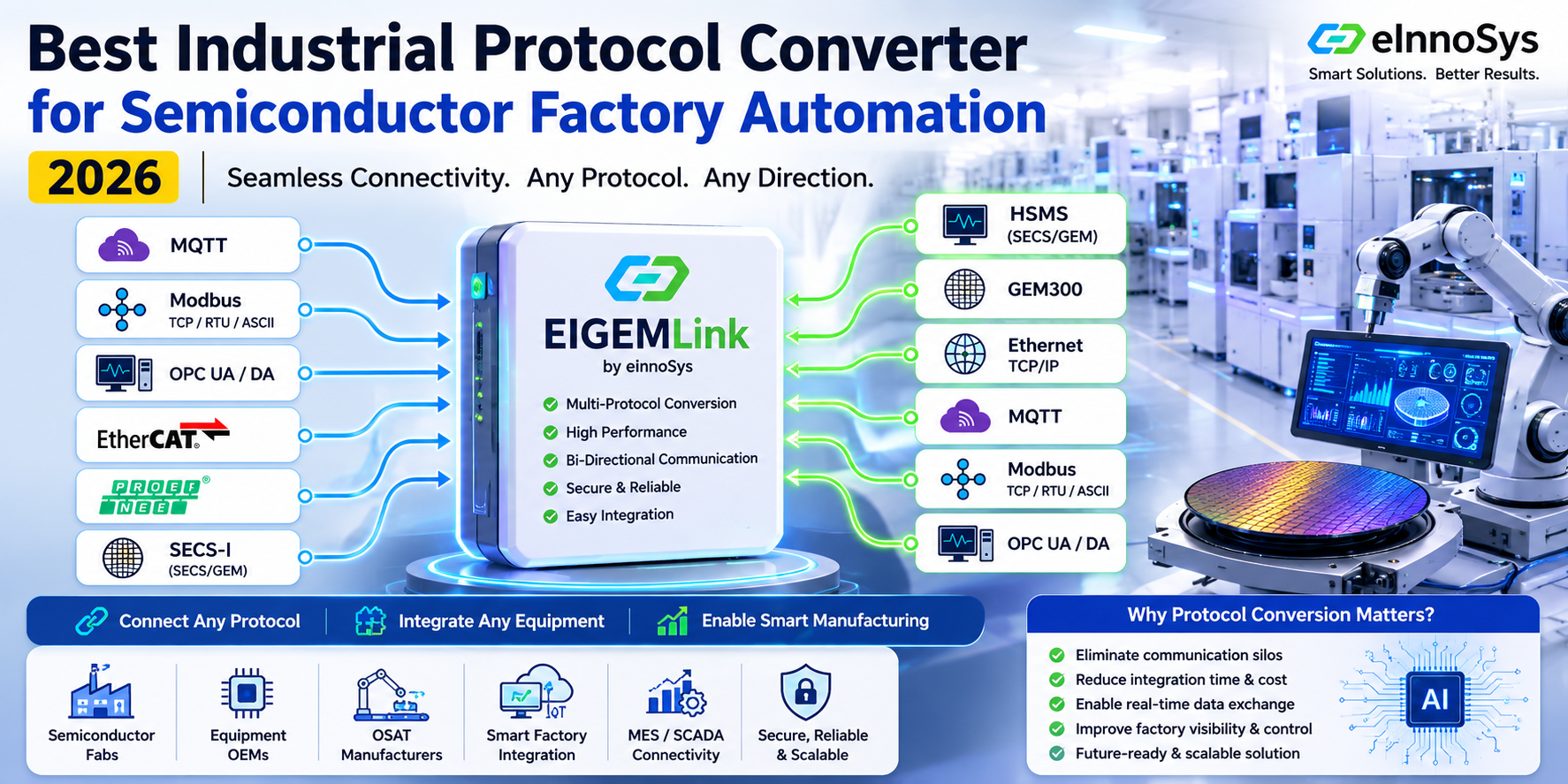
EIGEMLink is purpose-built to solve exactly the gap described above: converting OPC (DA and UA), MQTT, Modbus (RTU and TCP/IP), EtherCAT, Profinet, and standard Ethernet directly into fully SEMI-standards-compliant SECS/GEM. It's designed to require zero programming and no prior SECS/GEM expertise, with a drag-and-drop mapping interface for connecting source data points to SECS/GEM variables and collection events, and a guided setup wizard for HSMS connections and equipment models.
Cimetrix (a PDF Solutions company)
Cimetrix's connectivity products — CIMConnect, CIM300, and CIMControlFramework — are widely deployed SDKs for building SECS/GEM, GEM300, and EDA/Interface A compliant equipment interfaces. Rather than functioning as a plug-and-play converter, Cimetrix's tools are development frameworks: equipment OEMs and integrators use them to build a custom SECS/GEM interface into a tool's control software. This makes Cimetrix an extremely capable option for OEMs building SECS/GEM compliance into new equipment designs, but it's a software development undertaking rather than a configure-and-deploy conversion layer — a meaningfully different effort profile than a protocol converter aimed at fabs needing to connect existing, already-built equipment.
The stated deployment path — installation, source protocol configuration, data point mapping, SECS/GEM configuration, and testing — is designed to take under 30 minutes for a straightforward integration, compared to the weeks or months custom protocol conversion development typically requires. It's built to run across Windows, Linux, and embedded systems, and is positioned as fully compliant with both 200mm and 300mm SEMI standards. Because it sits specifically at the semiconductor equipment-to-MES boundary, it's the most direct fit among the options in this guide for fabs and OSATs that need standard industrial protocols talking to a SECS/GEM-based host, without a custom software development project.
PEER Group
PEER Group's GWGEM, ConX300, and EIB OEM products serve a similar role to Cimetrix — SDK-based tools for building SECS/GEM and GEM300 interfaces, including support for SEMI E139 Recipe and Parameter Management. Like Cimetrix, this is fundamentally a development toolkit for OEMs and integrators building custom equipment software, rather than a fast, no-code conversion layer for connecting existing non-SECS/GEM equipment.
HMS Networks (Anybus)
HMS Networks is one of the largest names in general industrial protocol conversion, with its Anybus product line covering more than 300 gateway models spanning Profinet, EtherNet/IP, EtherCAT, CANopen, DeviceNet, Modbus, and dozens of other fieldbus and Industrial Ethernet combinations. Anybus gateways are genuinely excellent for device-level network integration — connecting a serial device, VFD, or sensor into a PLC's native network — and are deployed broadly across manufacturing sectors. For semiconductor fab automation specifically, the important caveat is that Anybus's conversion set does not include native SECS/GEM output, meaning it solves device-to-network connectivity but not the equipment-to-MES SECS/GEM gap that fabs specifically need closed.
Hilscher (netTAP / netHOST)
Hilscher, a 35-year veteran of industrial communication technology, offers the netTAP and netHOST gateway families for converting between fieldbus, Real-Time Ethernet, and serial automation protocols — PROFINET, EtherCAT, EtherNet/IP, Sercos, PROFIBUS, and more, with I/O data conversion times as low as 10ms for real-time applications. Like Anybus, Hilscher's strength is deep, reliable fieldbus-to-fieldbus and Ethernet-to-fieldbus conversion for general industrial automation. It's a strong choice for motion control and robotics network bridging, but it isn't a SECS/GEM conversion tool, and doesn't address the specific equipment-to-MES translation semiconductor fabs need.
Real Time Automation (RTA)
RTA specializes in protocol gateways and embedded connectivity stacks — EtherNet/IP to Profibus, Modbus TCP to BACnet, and similar generic industrial protocol combinations, along with custom gateway development and source-code licensing for device manufacturers building native protocol support. RTA is a solid option for point-to-point industrial protocol bridging and custom embedded connectivity projects, but like the other general gateway vendors here, its product line isn't built around SECS/GEM.
5. How eInnoSys EIGEMLink Solves the SECS/GEM Conversion Problem
EIGEMLink's core value proposition is closing exactly the gap this guide has been describing: taking equipment that already speaks a standard industrial protocol and getting it talking SECS/GEM to your MES, without a custom software project.
Universal protocol support — OPC DA and OPC UA (including automatic tag discovery, real-time subscription, and alarm/event handling), MQTT (topic-based routing, QoS management, cloud connectivity), Modbus RTU and TCP/IP (register mapping to SECS variables, master/slave configuration), and EtherCAT/Profinet (cyclic data exchange, real-time synchronization).
Zero programming required — the drag-and-drop mapping tool and configuration wizards are designed so factory automation engineers, not software developers, can complete an integration.
Cross-platform compatibility — works across Windows, Linux, and embedded systems, and across equipment from any manufacturer.
100% SEMI standards compliant — built for both 200mm and 300mm compliance requirements.
Enterprise scalability — from single-machine deployments to enterprise-wide rollouts across a full fab.
Where this matters most in practice is exactly the equipment category that tends to create integration headaches: newer IIoT-enabled tools that ship with modern OPC UA or MQTT interfaces rather than native SECS/GEM, PLC-controlled subsystems using Modbus or EtherCAT, and non-semiconductor-native OEM equipment brought into a fab that was never built with SECS/GEM in mind. Rather than commissioning a custom SECS/GEM driver for each of these — the kind of project that can run into the tens of thousands of dollars and take weeks or months per tool — EIGEMLink is designed to close that gap directly.
Talk to eInnoSys about your protocol conversion project →
6. Common Integration Scenarios
- New equipment with a modern IIoT interface, no native SECS/GEM — increasingly common as equipment manufacturers build toward OPC UA and MQTT-based IIoT standards rather than semiconductor-specific ones by default.
- PLC-controlled subsystems — many auxiliary systems (exhausts, chillers, gas delivery skids) are controlled by standard industrial PLCs speaking Modbus or EtherCAT rather than exposing SECS/GEM directly.
- Multi-vendor fleets with inconsistent protocol support — larger fabs and OSATs often accumulate equipment from many manufacturers, each with a different native communication approach.
- Cloud and edge analytics initiatives — equipment already streaming data via MQTT to a cloud platform for analytics may still need a parallel SECS/GEM path into the on-premise MES.
7. Choosing the Right Protocol Converter for Your Fab
Start by identifying which category you actually need. If the problem is bridging two generic industrial networks (Profinet to EtherCAT, for instance) at the device level, a general gateway from HMS, Hilscher, or RTA may be exactly right. If the problem is getting equipment talking to a SECS/GEM-based MES, you need a converter in that specific category.
Decide between an SDK and a configure-and-deploy tool. OEMs building SECS/GEM compliance into new equipment designs from the ground up are well served by Cimetrix or PEER Group's development frameworks. Fabs and OSATs connecting already-built equipment are usually better served by a no-code conversion tool like EIGEMLink, since there's no equipment redesign involved.
Audit your actual source protocols first. Different converters support different combinations — confirm OPC UA, MQTT, Modbus, EtherCAT, and Profinet coverage matches what's actually running on your floor before committing.
Weigh deployment speed against long-term flexibility. A fast, no-code converter gets equipment connected quickly; an SDK-based approach offers deeper customization at the cost of development time.
Confirm GEM300 support if you're on 300mm. Not every conversion path handles the full GEM300 suite (E87/E90/E94/E116) — verify this explicitly if automated material handling integration is required.
Final Thoughts
The "best" industrial protocol converter for semiconductor factory automation depends entirely on which side of the integration gap you're standing on. If you're bridging generic industrial networks at the device level, established general-purpose gateway vendors like HMS Networks, Hilscher, and RTA are proven, reliable choices. But if the actual problem is getting equipment that speaks OPC, MQTT, Modbus, EtherCAT, or Profinet talking to a SECS/GEM-based MES — which is the specific challenge most semiconductor fabs and OSATs run into — that requires a converter built for that exact translation, not a generic industrial gateway.
For fabs and OSATs facing that gap, eInnoSys EIGEMLink is worth evaluating directly against your equipment's actual source protocols — it's purpose-built for exactly this translation, without requiring a custom SECS/GEM development project for every non-compliant tool on your floor.
Best Practices for Protocol Conversion Projects
- Inventory equipment by native protocol before selecting a tool, rather than assuming one converter covers everything.
- Pilot on one or two tools to validate mapping accuracy and SECS/GEM compliance before a fab-wide rollout.
- Involve your MES/EAP team early — the converter's output needs to match what your host system actually expects.
- Document data point mappings thoroughly, since these become part of your factory's long-term equipment integration documentation.
- Test against real production scenarios, not just static configuration, before trusting the converter in live production.