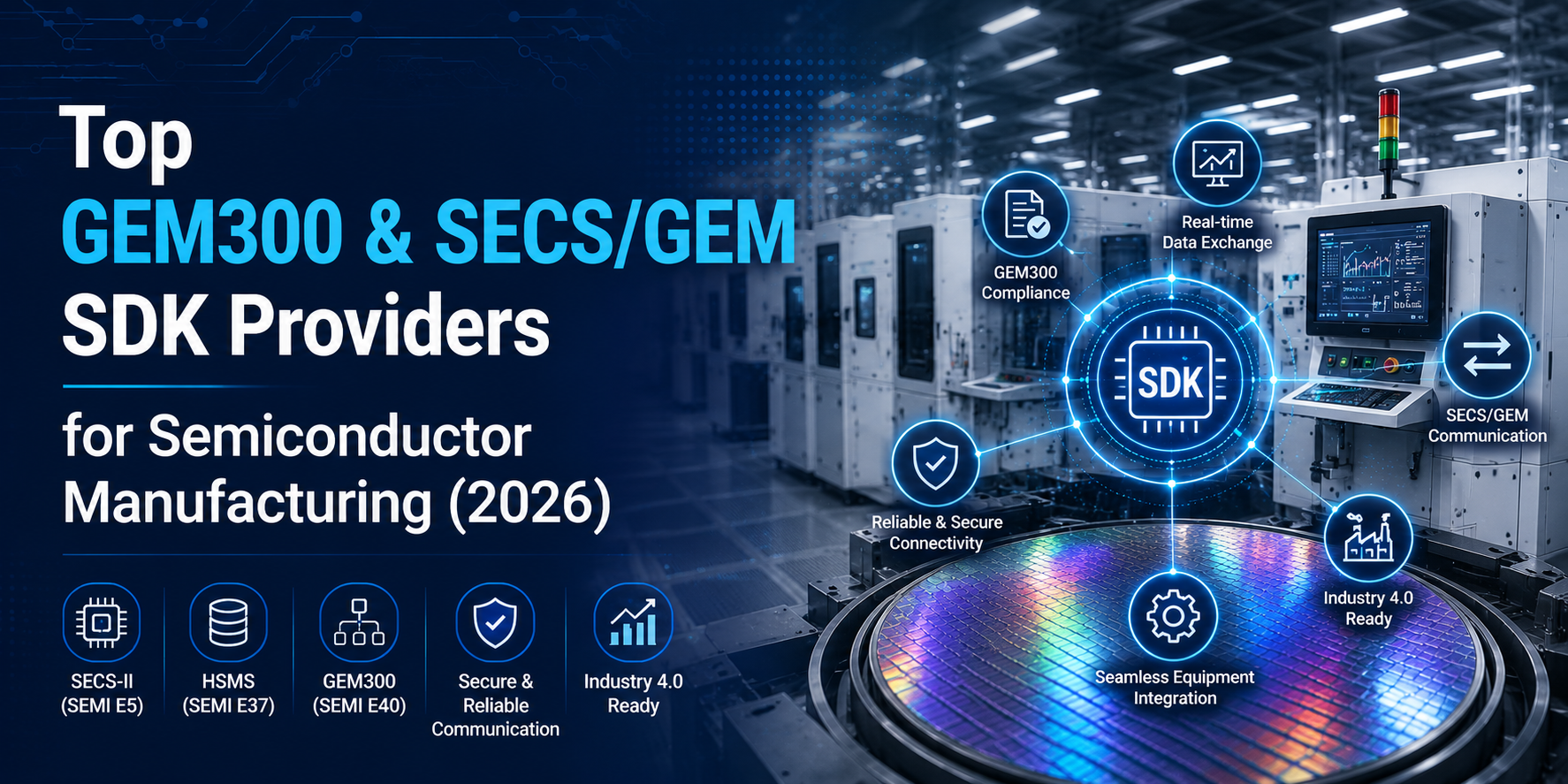
Top GEM300 & SECS/GEM SDK Providers For Semiconductor Manufacturing (2026)
If you're an equipment OEM building a new tool, or a fab/OSAT trying to get an existing tool connected to your host system, you already know the real question isn't "do we need SECS/GEM." It's "who do we build it with."
Building a SEMI E30-compliant interface from scratch — with correct SECS-II (E5) message structures, HSMS (E37) session handling, and full GEM300 support across E39, E40, E87, E90, and E94 — is a specialized, multi-month engineering effort even for experienced teams. That's why a distinct category of vendors exists: companies that build SDKs, drivers, and frameworks specifically so OEMs and fabs don't have to build the protocol layer themselves.
Here's a practical look at who the major GEM300 & SECS/GEM SDK providers are in 2026, what each one is actually built for, and how to think about choosing between them.
Why This Category Exists
SECS/GEM looks simple as a spec — a defined set of messages and state machines. In practice, it's unforgiving. A subtle timing issue in HSMS session handling, or a slightly non-standard GEM state transition, can cause a host connection that "mostly works" but fails intermittently in ways that are miserable to debug — often not surfacing until factory acceptance testing (FAT), when it's most expensive to fix.
On top of the base standard, GEM300 adds a whole additional layer for 300mm fabs: carrier management (E87), substrate tracking (E90), equipment performance history (E94), and object services (E39/E40). Add in the fact that fabs frequently layer their own proprietary interpretations on top of the SEMI standard, and it becomes clear why "just build it in-house" is rarely the fastest or cheapest path.
That's the gap these vendors fill — some through packaged SDKs, some through drag-and-drop development tools, some through full integration services.
The Providers
eInnoSys
eInnoSys builds SECS/GEM software specifically for both equipment OEMs and fabs, with a product line structured around reducing the time and cost of reaching SEMI compliance. Its core SECS/GEM SDK (EIGEMEquipment) and GEM300 SDK (EIGEM300Equipment) are built to SEMI E30, E4, E5, and E37, with the company stating that a large share of required functionality is available out of the box — the goal being to cut integration time meaningfully versus building the communication stack from zero.
What sets eInnoSys apart in this list is breadth: alongside the OEM-side SDKs, it also offers EIGEMBox and EIGEMHMI for retrofitting legacy or PLC/HMI-based equipment that was never built with SECS/GEM in mind, an EIGEMSim simulator for pre-FAT testing, an E84 SDK for carrier handoff, and MES migration and staff augmentation services for teams needing extra engineering capacity rather than just a product license. Few vendors in this space cover both the new-equipment SDK side and the legacy-retrofit/factory side under one roof.
Cimetrix (Cimetrix Connectivity Group, part of PDF Solutions)
Cimetrix is one of the longest-established names in semiconductor equipment connectivity, founded in 1989. Its flagship CIMConnect SDK is a widely deployed object-oriented SECS/GEM development kit, with CIM300 extending it for GEM300 compliance and CIMPortal Plus covering EDA/Interface A. The company has historically cited shipping over 10,000 GEM interfaces across the semiconductor, SMT, and photovoltaic industries — a track record that makes it a common default choice for OEMs prioritizing a mature, battle-tested SDK, particularly where EDA/Interface A is also on the roadmap.
PEER Group
PEER Group takes a broader factory-automation approach rather than positioning purely as an SDK vendor. Its EIB Factory product is a SEMI-standards-compliant communications framework for connecting host systems to equipment across 200mm and 300mm fabs, while PTO (PEER Tool Orchestrator) addresses the OEM/equipment-control side with a GUI-based tool designer. PEER Group is also notable for maintaining one of the industry's most extensive compliance testing suites (PFAT, CCS Envoy, SECSIM Pro+), making it a strong fit for organizations that want connectivity software and formal standards validation tooling from the same vendor.
ErgoTech
ErgoTech's TransSECS platform takes a distinctly tool-based approach: rather than a code-first SDK, it provides a visual editor for building both equipment- and host-side SECS/GEM interfaces, with built-in simulation for testing tool or host applications before going live. TransSECS interfaces can be deployed across Windows, Unix, Linux, and even embedded platforms like Raspberry Pi, and generated interfaces can plug into IoT/cloud platforms, OPC (UA and legacy DA), PLCs, REST, and MQTT alongside SECS/GEM. For teams that want to configure interfaces through a drag-and-drop editor rather than writing protocol code by hand — or that need SECS/GEM to coexist with broader IIoT/cloud connectivity — ErgoTech is a distinct alternative to the pure-SDK vendors on this list.
Focussia
Focussia, part of the France-based La Maison MGA group, specializes specifically in non-intrusive legacy equipment connectivity. Its SmartGem platform upgrades existing tools to GEM200/300 host communication, while SmartPassThrough taps into an equipment's existing SECS/HSMS line to extract data without touching the equipment's control software or automation layer at all. For fabs whose priority is modernizing an installed base of older tools without a control-software rewrite, Focussia's non-intrusive approach is one of the more focused options in the market.
LinkGenesis
LinkGenesis is a South Korea-based vendor with a strong regional footprint across Korean and broader Asian semiconductor and display manufacturing. Its XGem driver family (XGemPro, XGem300Pro, XGemEX) supports SEMI E30 with features like automatic GEM scenario generation and 64-bit API support, and it has historically partnered with global vendors — including distributing EDA/Interface A products regionally — reflecting how the SECS/GEM vendor landscape often blends global platforms with strong local specialists. For OEMs and fabs deploying primarily in Korea, Taiwan, or greater Asia, LinkGenesis's regional support model is a frequent consideration.
SDK, Drag-and-Drop Tool, or Legacy Gateway — Which Model Fits?
Looking across this list, providers tend to cluster around a few different delivery models, and matching your project to the right one matters more than any single feature comparison:
Code-first SDKs (eInnoSys, Cimetrix, LinkGenesis) are best for OEM engineering teams building SECS/GEM natively into new equipment, where deep control and long-term performance matter more than a visual builder.
Visual/configuration-based tools (ErgoTech's TransSECS) suit teams that want to define interfaces without writing extensive protocol code, or that need SECS/GEM to sit alongside a broader IIoT/cloud stack.
Factory-side frameworks with compliance tooling (PEER Group) fit organizations — often fabs themselves — that need host-side connectivity plus rigorous, standards-based test infrastructure.
Legacy/non-intrusive gateways (eInnoSys's EIGEMBox/EIGEMHMI, Focussia's SmartGem/SmartPassThrough) solve a fundamentally different problem: connecting equipment that predates SECS/GEM entirely, without re-engineering it.
What to Actually Evaluate
For technical decision-makers comparing these providers, a few things matter more than a feature checklist:
Standards coverage, precisely. Confirm SEMI E4, E5, E30, and E37 support, and separately verify GEM300-specific coverage (E39, E40, E87, E90, E94) if you're targeting 300mm fabs — not every vendor's "GEM300 support" covers the full set equally.
Equipment and protocol fit. A vendor strong in new-equipment SDKs isn't necessarily the right choice for a legacy retrofit project, and vice versa. Match the vendor's actual specialization to your equipment mix.
FAT track record. Ask for references involving factory acceptance testing at fabs similar in scale to your target customers — compliance on paper and a smooth FAT are not the same thing.
Regional support. For teams operating across the US, Taiwan, South Korea, Japan, Singapore, Malaysia, Germany, India, and China, support responsiveness across time zones is a real operational factor, not a nice-to-have.
Total engineering cost, not license cost alone. A lower-priced SDK that requires significantly more in-house development time to reach compliance isn't actually cheaper. Factor in implementation time and how much functionality genuinely works out of the box.
Path beyond the initial build. SEMI standards evolve, MES platforms get replaced, and equipment fleets grow. Vendors offering migration support and ongoing standards updates provide more value over the life of the equipment than a one-time SDK license.