
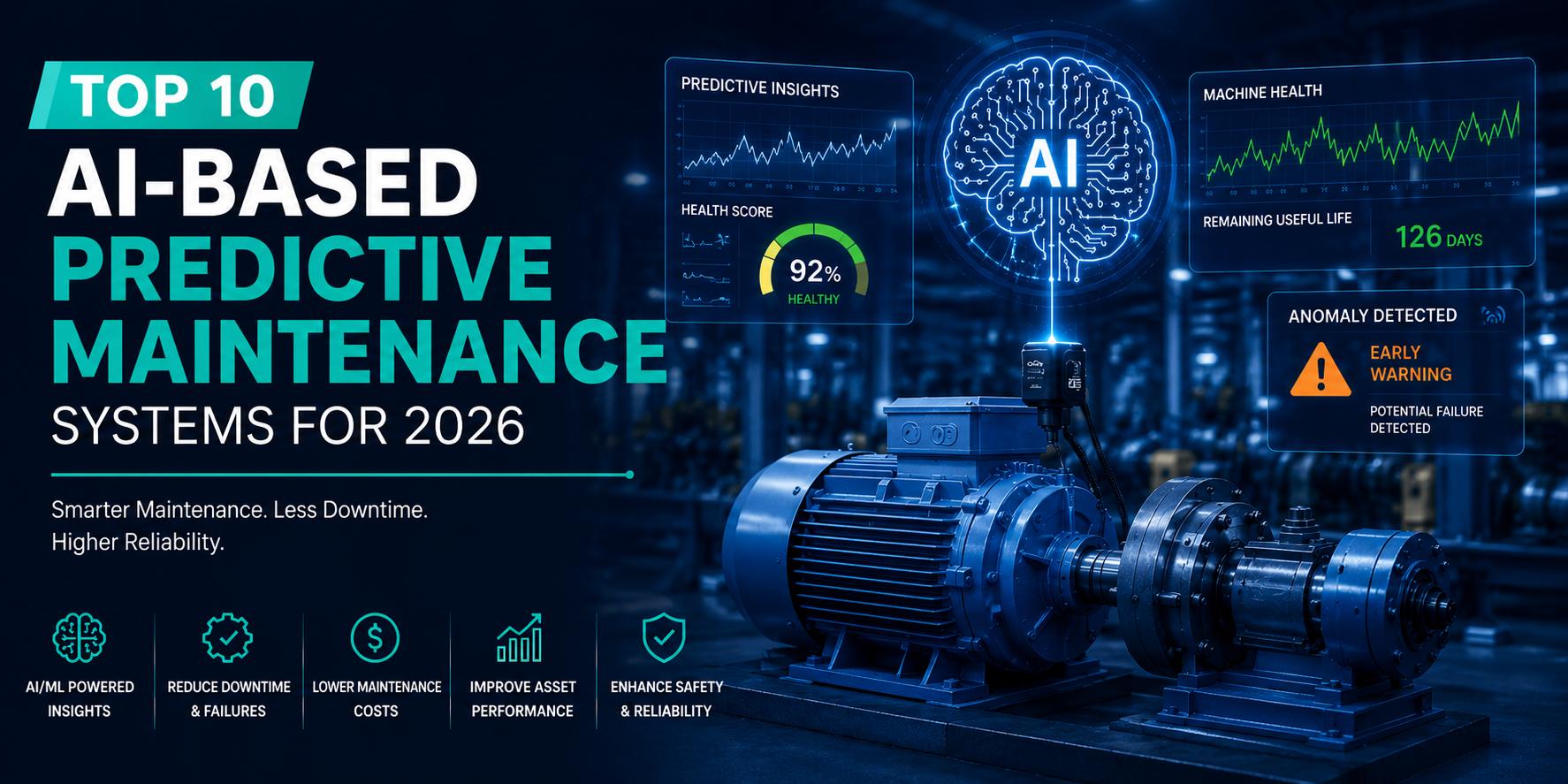
Top 10 AI-Based Predictive Maintenance Systems For 2026
For a semiconductor fab or OSAT, unplanned downtime rarely stays contained to one machine. A dry pump or turbopump failure on a process tool doesn't just take that tool offline — it can compromise chamber vacuum integrity, scrap wafers already in process, and cascade into a line-down event that costs far more than the pump itself. That's part of why predictive maintenance has moved from a "nice to have" to a core reliability strategy across fabs, OSATs, and the broader industrial base — and why AI-based systems, which learn what normal equipment behavior looks like and flag subtle deviations before a fixed threshold is crossed, have taken over from calendar-based preventive maintenance schedules.
The predictive maintenance software market in 2026 spans a wide range of approaches: large enterprise asset management (EAM) platforms with AI layered on top, sensor-first specialists built around vibration and acoustic analysis, and newer entrants focused on specific equipment types — including pumps and motors, which represent some of the highest-frequency failure points on any fab floor. This article walks through ten of the systems manufacturing leaders, reliability engineers, and fab equipment teams are evaluating in 2026, with particular attention to what matters for semiconductor and electronics manufacturing environments specifically.
What Makes a Predictive Maintenance System "AI-Based"
- It's worth being precise about the distinction before comparing platforms:
- Traditional condition monitoring flags an alert when a sensor reading crosses a fixed threshold — a vibration amplitude, a temperature limit.
- AI-based predictive maintenance builds a model of normal behavior from historical and real-time data, detects subtle deviations before any fixed threshold is crossed, and in more mature systems, estimates remaining useful life or classifies the likely fault type.
That distinction matters because "AI-powered" is used loosely across the market. Some platforms apply genuine machine learning to raw sensor data; others apply simpler statistical rules and market the result as AI. For fabs specifically, the more useful differentiator is often equipment specificity: a system trained broadly across many asset types will rarely match the failure-mode accuracy of a system trained specifically on the pumps and motors that make up the bulk of a fab's rotating and vacuum equipment fleet.
The Top 10 Systems
xPump is purpose-built for exactly the equipment category that causes the most disruptive downtime on a fab floor: vacuum pumps, motors, exhausts, ovens, furnaces, and other motor-driven equipment. Rather than applying a generalized industrial AI model, xPump combines industrial-grade vibration, temperature, voltage, and current sensors with machine learning models trained specifically for pump and motor failure modes, and has been validated across dry pumps, turbomolecular pumps, and cryopumps from major vacuum equipment manufacturers including Edwards, Pfeiffer Vacuum, EBARA, Busch, Atlas Copco, ULVAC, and KNF. Two features stand out for semiconductor and electronics manufacturing environments specifically: native SECS/GEM alarm integration, which lets predicted failures surface directly inside existing fab host and MES workflows rather than a separate dashboard, and a turnkey deployment model that bundles sensors, software, and configuration together rather than requiring a custom analytics build. For fabs and OSATs whose downtime risk concentrates in pumps and motors rather than a broad mix of asset types, that combination of equipment-specific training data and fab-native integration is a meaningful differentiator over general-purpose platforms.
2. IBM Maximo Application Suite (Maximo Predict)
IBM Maximo is one of the most widely deployed enterprise asset management platforms in heavy industry, and its Maximo Predict module extends that foundation with AI-driven failure prediction and remaining-useful-life estimation. Because Maximo already serves as the asset system of record for many large manufacturers, predictions surface inside the same system that manages work orders, spare parts, and asset history. It tends to suit large enterprises already standardized on Maximo that want to extend an existing EAM investment rather than introduce a separate platform.
3. Siemens Senseye Predictive Maintenance
Senseye, now part of Siemens, focuses on machine learning models built to start learning from whatever sensor and process data is already available, minimizing the manual configuration typically required to stand up a predictive model. Since joining Siemens, its predictive maintenance capability has been positioned alongside Siemens' broader industrial automation ecosystem, making it a natural fit for manufacturers already running Siemens controls and automation hardware.
4. ABB Ability Genix Asset Performance Management Suite
ABB's Genix APM Suite combines condition monitoring, predictive maintenance, and asset integrity insights in a single enterprise application built on ABB's Genix industrial analytics and AI platform. It's designed for process, utility, and transportation industries with complex, high-value rotating and static assets, and emphasizes a maturity path from reactive to preventive to predictive and prescriptive maintenance.
5. Augury Machine Health
Augury built its reputation on high-fidelity vibration and acoustic sensing paired with machine learning models trained specifically for rotating equipment — motors, pumps, compressors, and fans. It's frequently cited as a strong choice for large enterprises seeking deep diagnostic accuracy on critical rotating assets, typically paired with dedicated sensor hardware and enterprise-level pricing.
6. SKF Enlight / SKF Aptitude
SKF's decades of expertise in bearings and rotating equipment give its Enlight condition-monitoring sensors and Aptitude analytics software a natural depth advantage for the failure modes bearings experience specifically: misalignment, imbalance, lubrication issues, and fatigue. For manufacturers whose downtime risk is concentrated in general rotating machinery, SKF's bearing-specific failure data is a meaningful advantage over broader platforms.
7. PTC (ThingWorx + Kepware, with ServiceMax)
PTC's approach runs through its broader industrial IoT stack: Kepware for connecting to a wide range of PLCs and industrial protocols, ThingWorx for building analytics on top of that data, and ServiceMax for field service management. This makes PTC less a single predictive maintenance product and more a toolkit for organizations with the internal engineering resources to configure a platform tailored to their specific equipment fleet.
8. GE Vernova / GE Digital APM
GE's asset performance management offering, built on the legacy Meridium platform, targets power generation, oil and gas, and other heavy-asset industries where a single unplanned outage is extraordinarily costly. It combines condition-based maintenance strategy, reliability-centered maintenance workflows, and predictive analytics, with particular strength in industries GE has deep domain expertise in through its turbine and generator businesses.
9. SAP Predictive Asset Insights
For manufacturers already running SAP as their ERP backbone, SAP Predictive Asset Insights extends that ecosystem with anomaly detection and failure prediction tied directly into SAP's asset management and supply chain modules. Its main advantage is integration depth with an ERP a company already depends on for procurement, inventory, and financials.
10. Tractian
Tractian combines its own wireless vibration and temperature sensors with AI-based fault diagnostics and a mobile-first CMMS layer, aiming for fast multi-site deployment without a lengthy IT integration project. It's positioned toward mid-sized industrial teams that want an execution-first platform — one that converts a prediction into a work order a technician can act on directly from a mobile device.
Choosing Between Them: What Matters Most for Fabs and OSATs
With ten credible platforms taking different approaches, a few practical questions tend to matter more than which vendor has the most AI buzzwords:
Is the primary failure risk concentrated in pumps and motors, or spread across a broad asset mix? Equipment-specific platforms like xPump (pumps/motors) or SKF (bearings) generally out-perform generalist APM suites on the exact failure modes they were trained for. Broader platforms (ABB, GE, IBM) are built to span more asset types across an entire facility.
Does the system need to speak SECS/GEM natively? For semiconductor and electronics manufacturing environments, a predictive maintenance system that surfaces alerts directly through existing SECS/GEM host and MES connections avoids adding yet another standalone dashboard for operators to monitor — a meaningful operational difference for fabs already running lean on floor headcount.
Does this need to live inside an existing system of record? If the fab already runs Maximo, SAP, or Siemens automation, extending that ecosystem often reduces integration friction more than introducing a new best-of-breed tool.
Do predictions need to convert into action automatically? Some platforms stop at an alert or dashboard; others route a prediction directly into a work order, technician assignment, and parts list. For maintenance teams already stretched thin, that last step often determines whether predictions actually change behavior on the floor.
Is this a turnkey deployment or a build-your-own toolkit? Platforms like xPump and Tractian bundle sensors, software, and configuration together for faster time-to-value; toolkit-style platforms like PTC's stack offer more flexibility but require more internal engineering effort to stand up.
Why Pump- and Motor-Specific Coverage Matters in a Fab
General-purpose asset performance management suites are built to monitor a wide variety of equipment — turbines, transformers, compressors, generators — and that breadth is exactly why they often lack deep, equipment-specific training data for the vacuum pumps and motor-driven systems that dominate a semiconductor fab's rotating equipment fleet. A dry pump failure and a cryopump failure don't look like a bearing failure in a power turbine; the vibration signatures, degradation curves, and typical failure precursors are different.
That's the gap purpose-built systems like xPump are designed to close: models trained specifically on pump and motor behavior across the vacuum equipment brands most common in fabs, paired with the SECS/GEM, SCADA, and MES connectivity that lets predictions plug directly into existing fab automation rather than requiring a parallel monitoring system.