How An MES (Manufacturing Execution System) Improves Production Efficiency
Every manufacturer wants more output, fewer defects, less downtime, and faster delivery. Yet many plants still rely on spreadsheets, paper travelers, and manual logs. The ERP system knows what was ordered, and the machines know what they are doing, but no one has a reliable, real-time view of what happens on the shop floor in between. A Manufacturing Execution System (MES) closes that gap.
An MES is software that manages, monitors, and documents production as it happens. It sits between enterprise systems such as ERP and the equipment on the factory floor. While ERP decides what should be made, the MES controls and records how it is made, including which work order is running on which machine, which materials were used, which operator did the work, and whether every step met specification.
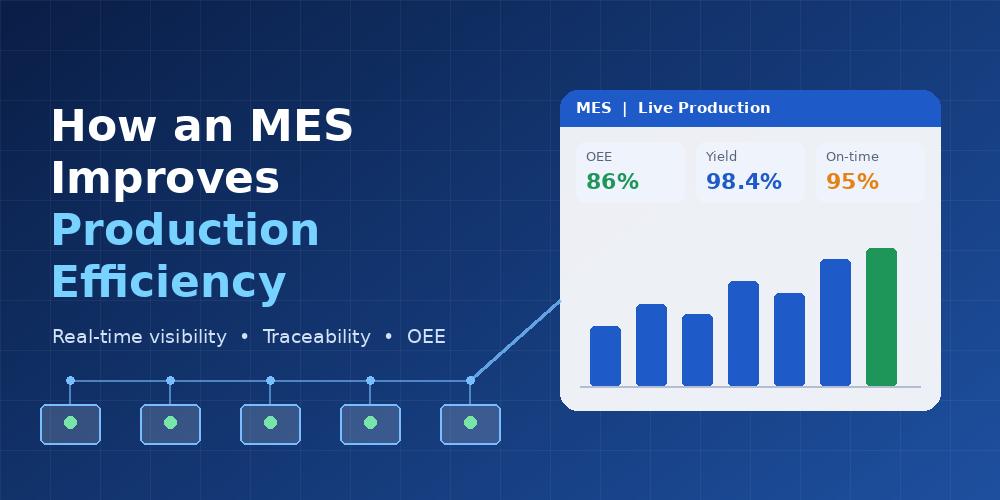
An MES improves production efficiency in several ways. Real-time dashboards give supervisors instant visibility into line status, work-in-progress, and bottlenecks, so problems are fixed within minutes instead of being discovered at the end of a shift. Smarter scheduling and dispatching reduce idle time, shorten queue times, and improve on-time delivery. Built-in quality checks, process enforcement, and statistical process control catch defects early, which cuts scrap and rework. Automatic traceability records the materials, machines, operators, and test results behind every product, so investigations are faster and recalls are limited to the units actually affected. Accurate downtime and performance data supports OEE improvement and predictive maintenance, while paperless operations remove transcription errors and make audits far easier.
However, an MES is only as good as the data it receives. In many factories, older equipment lacks standard communication interfaces, leaving valuable data trapped on a local screen. Replacing these tools is expensive and may require re-qualifying recipes and processes, so many manufacturers choose to connect their existing machines instead. EIGEMBox from Einnosys is a plug-and-play solution that adds SECS/GEM, Modbus, or OPC connectivity to legacy equipment without installing software or hardware on the tool itself. It connects through the equipment’s display output and optional keyboard and mouse ports, enabling data collection and host communication with the MES. Einnosys reports that it has been deployed on more than 80 fab and OSAT tools. Because it is based on SEMI standards, it is best suited to semiconductor and related precision-manufacturing environments.
For a successful MES rollout, start with clear goals such as improving OEE, cycle time, yield, or traceability. Map and simplify your current processes before digitizing them, since automating a broken process only makes it fail faster. Plan equipment connectivity early, involve operators and supervisors from the start, and phase the rollout with a pilot line before expanding. Keep master data such as materials, routings, and recipes accurate, and budget for training, maintenance, and future upgrades.
An MES turns the factory floor from a black box into a transparent, measurable, and controllable operation. With real-time visibility, smarter scheduling, built-in quality control, and full traceability, and with legacy machines connected to the system, manufacturers can produce more with the resources they already have and build a data-driven operation that is ready for what comes next.