Centralized Recipe Management System For Semiconductor Manufacturing: A Complete Guide
Introduction
Semiconductor manufacturing depends on precision. Every process step — deposition, etch, lithography, diffusion — runs on a recipe that defines exact parameters like temperature, pressure, gas flow, and timing. Even a small deviation from the approved recipe can introduce process variation, and process variation on a wafer worth thousands of dollars is rarely a minor problem.
As fabs and OSAT/ATM facilities scale up, the number of tools, recipe versions, and product variants grows quickly. When recipes are managed manually — copied between machines, tracked in spreadsheets, or left to operator judgment — the risk of running an outdated or unauthorized recipe increases. That risk can translate into scrap, rework, yield loss, or production delays.
This is where a centralized recipe management system for semiconductor manufacturing becomes valuable. Rather than treating recipes as files scattered across individual tools, a centralized approach establishes one controlled environment for creating, approving, distributing, and tracking recipes across the factory. This article looks at what centralized recipe management actually involves, why it matters for modern fabs, and what to consider when evaluating a system.
What Is a Centralized Recipe Management System?
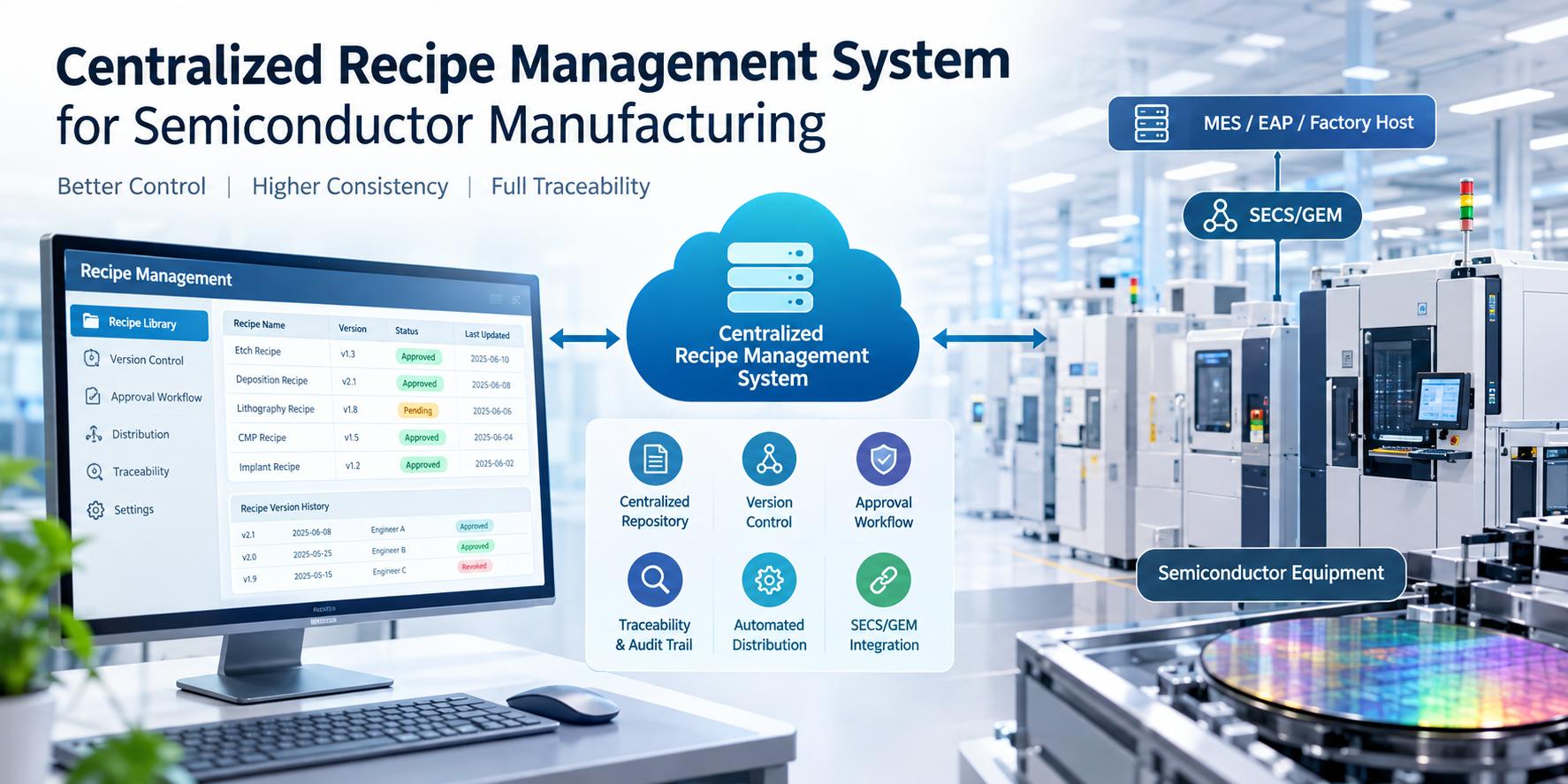
A centralized Recipe Management System (RMS) is software that provides a single, controlled environment for managing production recipes across multiple tools and process areas. Instead of recipes living independently on each piece of equipment, they are stored, versioned, and distributed from one authoritative source.
At a basic level, a semiconductor recipe management system supports:
- Storing recipes in a central repository
- Managing recipe versions as they evolve
- Reviewing and approving changes before release
- Distributing approved recipes to production equipment
- Tracking which recipe was used, where, and when
- Maintaining historical records for later reference
- Supporting recipe traceability across the process flow
This is different from the traditional approach, where recipes are manually transferred between machines — often by USB drive, shared folder, or direct operator entry. Manual transfer methods work at small scale, but they leave little visibility into who changed what, when a recipe was last updated, or whether the version running on the tool floor actually matches the approved version.
Why Semiconductor Fabs Need Centralized Recipe Control
Most fabs don't run into recipe problems because of a single bad file — they run into problems because of accumulated complexity. A few common patterns illustrate why:
- Multiple tools running similar processes. The same process step may run on several tools from different vendors, each expecting its own recipe format.
- Multiple recipe versions in circulation. Engineering teams revise recipes for yield improvement or new product introduction, and older versions can persist on equipment if not properly retired.
- Manual recipe selection. When operators choose recipes by hand, human error becomes a real possibility, especially during shift changes or high-mix production.
- Changes made without formal approval. A recipe adjusted informally to solve an immediate problem can remain in place long after the root cause is fixed.
- Limited historical visibility. Without a central log, it's difficult to answer basic questions like "which recipe version ran on this lot" during an investigation.
- No centralized view across the factory. Engineering and quality teams may lack a single place to see recipe status across all tools.
These issues tend to grow, not shrink, as fabs scale production, add product variants, and move toward smart manufacturing and Industry 4.0 practices. What worked with a handful of tools becomes harder to manage across dozens or hundreds.
Key Features of a Semiconductor Recipe Management System
Not every RMS implementation includes every capability below — feature sets vary by vendor and by how a fab configures its deployment. That said, these are commonly associated with centralized recipe management.
Centralized Recipe Repository A single, controlled location where recipes are stored acts as the source of truth for production. This reduces the risk of conflicting copies existing across different tools or teams.
Recipe Version Control Every revision to a recipe can be tracked, so engineers can see what changed, when, and by whom. This makes it easier to roll back to a previous version if a new recipe causes unexpected results.
Golden Recipe Management A "golden recipe" is the approved reference version of a recipe for a given process step. Maintaining a clearly designated golden recipe helps prevent equipment from running an outdated or unofficial variant.
Approval Workflows Before a recipe reaches production, it typically passes through a review step. Approval workflows let authorized engineering or quality personnel sign off on changes before release, adding a layer of governance to the recipe lifecycle.
Recipe Traceability and Audit Trails Recording recipe changes, approvals, uploads, downloads, associated users, and timestamps creates an audit trail. This is useful both for internal quality processes and for external compliance or customer audits.
Automated Recipe Distribution Rather than manually copying files to each tool, approved recipes can be distributed through factory communication systems, reducing the chance of human error during transfer.
SECS/GEM Integration Many recipe management systems are designed to communicate with SECS/GEM-capable equipment and factory host or MES systems, connecting recipe governance with equipment execution.
How Centralized Recipe Management Works with MES and SECS/GEM
A simplified view of the architecture looks like this:
MES / EAP / Factory Host → Recipe Management System → Central Recipe Repository → SECS/GEM Communication → Semiconductor Equipment
The MES or factory host layer typically initiates production and job scheduling decisions. The recipe management system sits underneath, holding the approved recipe logic and version history. The central repository is where that data actually lives. SECS/GEM provides the standardized communication layer that allows the approved recipe to be transferred to and executed on the equipment itself.
It's worth being precise here: SECS/GEM is a communication framework, not a recipe management system in itself. SECS/GEM defines how equipment and host systems exchange data and commands, including recipe transfer, but it doesn't provide the governance, version control, or approval workflow that a dedicated RMS does. The two are complementary — an RMS handles recipe control and lifecycle, while SECS/GEM handles the equipment-level communication needed to deliver that recipe to the tool.
Benefits for Semiconductor Manufacturing
When implemented well, centralized recipe management can support:
- Reduced manual recipe handling and fewer transfer errors
- Better process consistency across similar tools
- Improved recipe traceability for quality and audit purposes
- Faster recipe deployment across the factory
- Lower risk of equipment running an outdated recipe
- Stronger engineering control over the recipe lifecycle
- Easier root-cause investigation when process issues occur
- Better audit readiness for internal or customer reviews
- More consistent standardization across a mixed equipment fleet
- A stronger foundation for broader factory automation initiatives
These benefits depend heavily on how the system is implemented and how consistently it's used across the organization — an RMS is a tool for enabling better recipe governance, not a guarantee of it.
Where Recipe Management Systems Can Be Used
Recipe management needs vary depending on the manufacturing environment, but centralized recipe control is relevant across several areas:
- Wafer fabrication, where multiple process modules require tightly controlled parameters
- Process equipment such as deposition, etch, and diffusion tools
- Metrology and inspection, where measurement recipes also require version control
- Semiconductor assembly, where equipment-specific settings affect packaging quality
- Test and packaging / OSAT environments, where recipe accuracy affects final product quality
- Multi-tool production environments, where consistency across similar tools matters most
- Multi-site manufacturing, where recipe standards need to be maintained across different locations
Requirements differ depending on equipment type, existing factory architecture, and whether tools are SECS/GEM-capable or legacy systems.
EIRMS as an Example of Centralized Recipe Management
eInnoSys EIRMS (Enterprise Recipe Management System) is one example of a semiconductor-focused recipe management solution built around these principles. It's not the only option in the market, but it illustrates how the concepts discussed above can be applied in practice.
EIRMS is designed to support centralized recipe management, recipe version control, and golden recipe handling, along with recipe traceability and approval workflows. It also supports SECS/GEM integration for connecting recipe governance with equipment-level execution, and is built with semiconductor fabs and ATM/OSAT environments in mind. You can review the centralized recipe management system capabilities in more detail, including how the system fits into a broader factory automation environment.
For a real-world example of how centralized recipe distribution has been applied, the centralized recipe distribution case study describes how a semiconductor manufacturer addressed recipe distribution challenges across multiple production tools.
How to Evaluate a Recipe Management System
Choosing a recipe management system is a technical and organizational decision. A practical evaluation checklist should include:
- Compatibility with existing equipment types and vendors
- SECS/GEM integration capability
- MES/EAP integration options
- Depth of version control functionality
- Approval workflow configurability
- Support for golden recipe designation
- Audit trail and traceability features
- Ability to compare recipe versions
- Security and role-based access control
- Scalability across tools, product lines, and sites
- Support for legacy or non-SECS/GEM equipment
- Multi-site deployment and standardization support
Weighing these factors against a fab's specific equipment mix and process maturity helps ensure the chosen system fits actual operational needs rather than a generic feature list.
Conclusion
As semiconductor manufacturing becomes more automated, connected, and data-driven, centralized recipe control is increasingly seen as a foundational element of factory automation rather than an optional add-on. Fabs and OSAT/ATM facilities operating multiple tools, product variants, and recipe versions face real risks when recipe management is handled manually.
Effective recipe management is not simply about storing recipe files in one place. It's about controlling the full recipe lifecycle — from creation and approval, through distribution and execution, to revision and traceability. Systems like EIRMS represent one approach to addressing this, but the underlying principle applies broadly: as complexity grows, centralized, well-governed recipe management becomes an important part of maintaining process control and product quality.