7 Features Every SEMI-Compliant Station Controller Should Have
With that context in mind, here are seven features that engineering teams commonly look for when evaluating a Station Controller for semiconductor equipment automation.
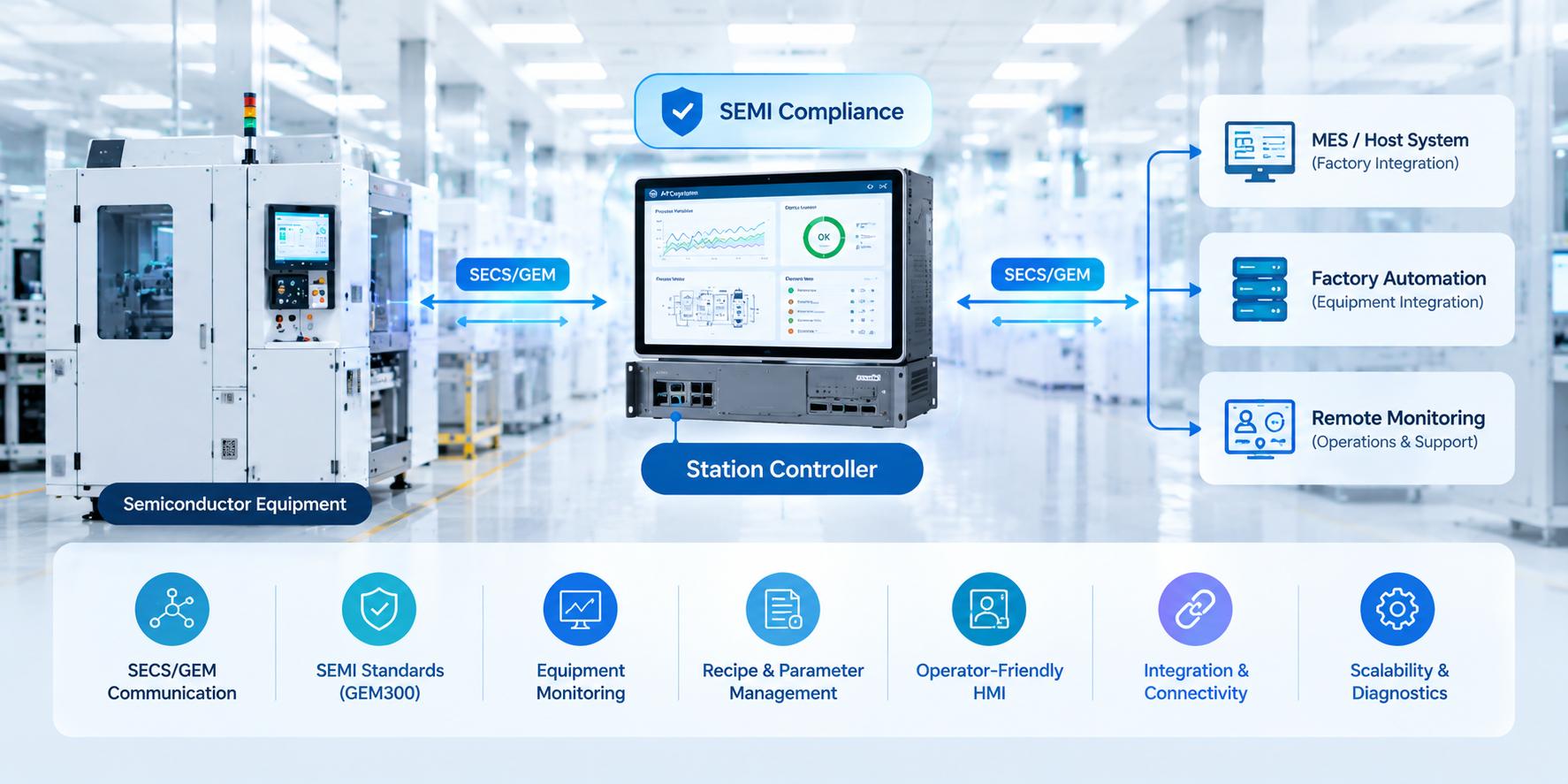
Feature 1: Reliable SECS/GEM Communication
Communication reliability is the foundation everything else depends on. If host communication drops, delays, or misreports equipment data, the fab loses visibility into that tool — affecting scheduling and troubleshooting. A capable SECS/GEM Station Controller should manage stable host communication with proper connection-state handling, accurate reporting of equipment data, events, and alarms, consistent handling of variables and remote commands, and clean recovery from interruptions — behaving predictably from the host's point of view.
Feature 2: Support for SEMI Standards and GEM300 Requirements
Because fabs vary in automation maturity, a Station Controller should be flexible enough to support the SEMI standards relevant to its deployment and, where applicable, scale toward GEM300-related requirements such as carrier management or job coordination. This doesn't mean every Station Controller needs every GEM300 capability out of the box — requirements differ by equipment type and the fab's automation roadmap. What matters is whether the architecture can accommodate additional standards as needs evolve, without a ground-up rebuild.
Feature 3: Real-Time Equipment Monitoring
Engineers troubleshoot faster when they can see what's happening on the equipment as it happens, rather than reconstructing events after the fact. Real-time monitoring typically covers equipment state and process status, alarms as they're triggered, sensor values and equipment variables, and events and production information. Centralizing this information in one place — rather than scattering it across multiple tools or logs — helps engineers spot developing issues before they escalate into downtime.
Feature 4: Recipe and Parameter Management
Process consistency depends on the equipment running the correct recipe with the correct parameters every time. A Station Controller's recipe management capabilities generally support recipe selection and organized storage, parameter control tied to each recipe, version tracking, and safeguards against loading an incorrect or outdated recipe. The depth of this functionality varies by vendor, so it's worth confirming what a given Station Controller actually supports rather than assuming a standard feature set.
Feature 5: Operator-Friendly HMI
Equipment engineers and operators interact with the tool primarily through its interface, so a cluttered or confusing HMI slows everyone down. A well-designed interface typically presents equipment status, active alarms distinguished by severity, manual controls, process and diagnostic information, and role-based user permissions — turning complex equipment data into something an operator or engineer can interpret quickly.
Feature 6: Flexible Integration and Connectivity
Modern semiconductor equipment rarely operates in isolation. A Station Controller often needs to connect with PLCs and motion controllers, sensors and subsystems, MES and other host systems, SECS/GEM interfaces, and broader factory automation systems. Depending on the equipment architecture, protocols such as OPC UA, Modbus, or EtherCAT may come into play for subsystem-level communication. There's no one-size-fits-all connectivity stack — what matters is whether the architecture is flexible enough to support the specific integration points a given tool requires.
Feature 7: Scalability, Diagnostics, and Maintainability
Equipment stays in service for years, often well beyond its original software requirements. A Station Controller should be built with the long term in mind: modular architecture, built-in diagnostics and logging, clear error handling, remote troubleshooting support, manageable software updates, and room to scale. These capabilities won't eliminate engineering effort, but they can meaningfully reduce it as a fab's requirements evolve.
Why These Features Matter to Semiconductor Equipment OEMs
For OEMs, these seven features translate into practical benefits: faster equipment integration during customer qualification and ramp-up, easier factory deployment through standardized communication, better equipment visibility for faster troubleshooting, improved maintainability, reduced integration complexity across fabs with different host systems, and stronger support for future automation requirements. None of this guarantees a specific reduction in downtime or a fixed return on investment — outcomes depend on the equipment and the fab environment. But a solid foundation in these areas can meaningfully reduce friction during integration and support.
How to Evaluate a Station Controller
A practical checklist for comparing options: Does it support the SEMI standards required for this equipment and fab? Does it provide reliable SECS/GEM communication? Can it integrate with the equipment's existing controls and subsystems? Is the HMI intuitive? Can it handle equipment data, events, and alarms accurately? Does it support the recipe management workflow this equipment needs? Can it integrate with MES and other factory systems? Is the architecture scalable, and is troubleshooting straightforward? Can it accommodate future requirements such as GEM300 extensions? Working through these questions during evaluation, rather than after deployment, tends to surface gaps early, when they're far less costly to address.
Station Controllers and the Future of Smart Manufacturing
As fabs invest further in Industry 4.0 and smart-manufacturing initiatives, the Station Controller's role is likely to expand. Connected equipment, real-time data collection, and factory-wide analytics all depend on equipment-level software that can reliably capture and share data. Station Controllers may increasingly feed data into factory analytics platforms, support AI/ML applications, enable predictive maintenance based on equipment condition trends, and serve as a foundation for broader digital manufacturing initiatives — functioning as an important equipment-level layer within a much larger automation architecture.
Conclusion
Choosing or designing a Station Controller isn't just a software decision — it shapes how well equipment integrates, communicates, and holds up over its operating life. The seven features covered here are a useful starting point for that evaluation:
- Reliable SECS/GEM communication
- Support for applicable SEMI and GEM300 requirements
- Real-time equipment monitoring
- Recipe and parameter management
- Operator-friendly HMI
- Flexible integration and connectivity
- Scalability, diagnostics, and maintainability
Companies with deep experience in SECS/GEM implementation and equipment software, such as eInnoSys, work with these considerations regularly. Regardless of which Station Controller a team ultimately chooses, a well-designed, SEMI-compliant Station Controller can help equipment OEMs build tools that are more connected, easier to maintain, and better prepared for the automation requirements fabs will expect going forward.