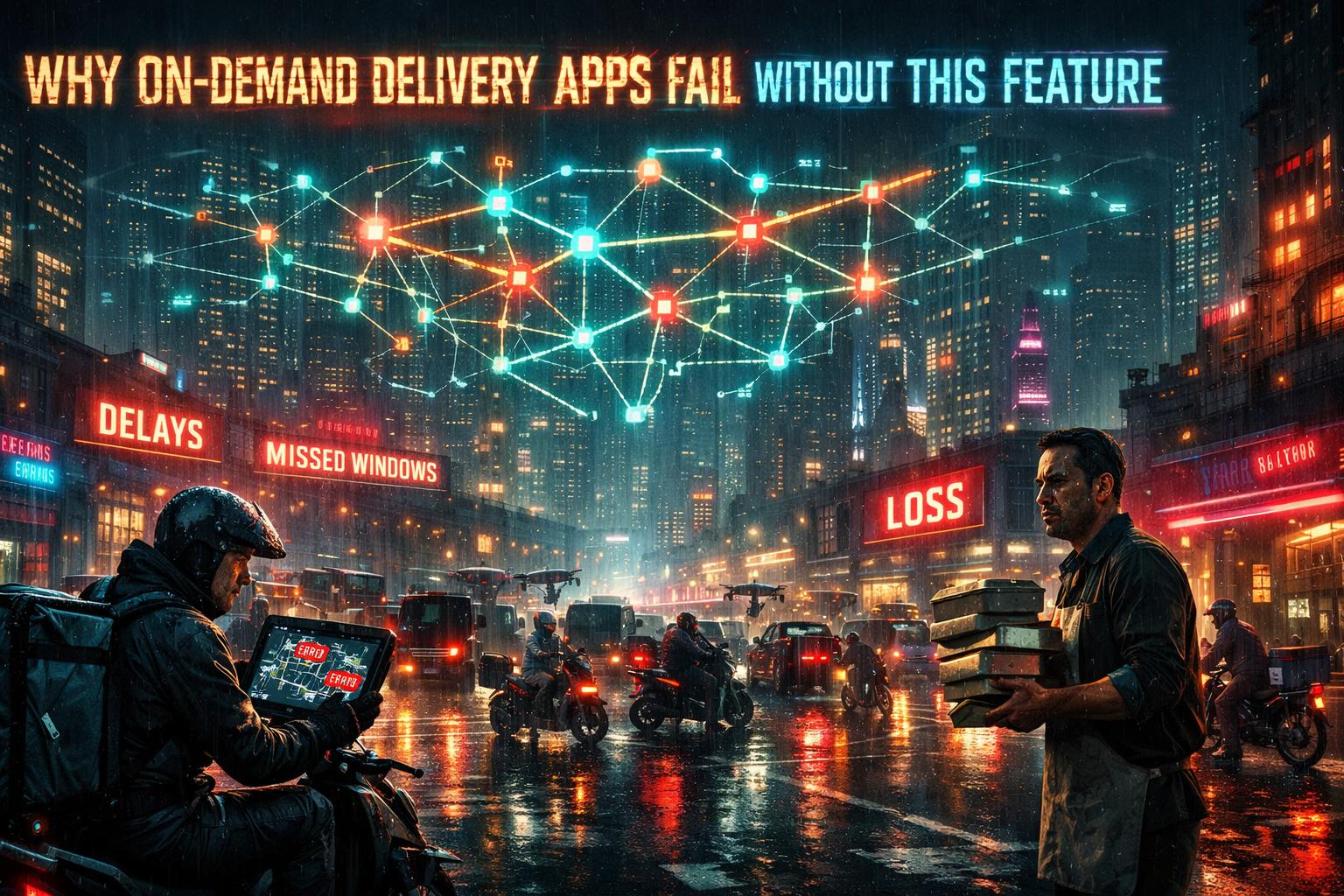
Why On-Demand Delivery Apps Fail Without This Feature
The on-demand delivery market in 2026 has moved past the "growth at all costs" phase. Today, profitability is the only metric that matters to stakeholders and venture capital firms. For founders and product managers, the stakes are higher than ever: a 2025 industry report by McKinsey & Company noted that delivery platforms with optimized route density see up to 30% higher margins than those using traditional point-to-point models.
The primary reason Why On-Demand Delivery Apps Fail Without This Feature—specifically Dynamic Multi-Node Routing (DMNR)—is that without it, the cost of fulfillment eventually exceeds the lifetime value of the customer. As we navigate the complexities of 2026 logistics, simply connecting a driver to a store is no longer enough to survive.
The 2026 Delivery Landscape: Friction and Fragmentation
In 2026, the "instant" economy is no longer a novelty; it is a utility. However, consumer expectations have shifted toward sustainability and precision rather than just speed. The current problem context involves a "Density Trap" where increasing order volume actually leads to higher losses if the software cannot intelligently batch and re-route in real-time.
Many legacy apps still rely on static dispatching. This outdated belief—that more drivers solve more problems—is causing massive burn rates. In reality, driver oversupply increases idle time and reduces individual earnings, leading to high churn. To combat this, sophisticated
The Essential Feature: Dynamic Multi-Node Routing (DMNR)
Dynamic Multi-Node Routing is the architectural ability of an app to recalculate an entire delivery cluster’s logic every time a new variable enters the system. It isn't just a "feature"; it is a survival mechanism.
How DMNR Works
Unlike standard GPS tracking, DMNR treats every driver as a mobile node in a fluid network.
Continuous Batching: The system identifies orders with overlapping "last-mile" trajectories in real-time, even if the orders were placed 10 minutes apart.
Predictive Latency: The system uses 2026 traffic data patterns to predict delays before they happen, shifting pickup windows dynamically.
Inter-Modal Flexibility: It accounts for different vehicle types (e-bikes, drones, cars) and their specific speed/access constraints within the same route.
Real-World Evidence of Implementation
In early 2026, a mid-sized grocery delivery startup in the Midwest implemented DMNR after facing a 15% month-over-month increase in fuel and labor costs. By shifting from a "one-order-one-driver" model to a "multi-node cluster," they achieved:
22% reduction in total miles driven per delivery.
14% increase in driver hourly earnings due to higher throughput.
Customer Satisfaction: Late deliveries dropped by 40% because the system accounted for "hidden" delays like apartment complex navigation and parking.
Contrast this with a competitor that prioritized UI/UX over backend routing logic. That company shuttered operations in late 2025 because their "Cost Per Delivery" remained $2.00 higher than their "Delivery Fee" revenue—a gap they expected to close with volume, only to find that volume scaled their losses linearly.
Practical Application: Implementing DMNR in Your App
If you are building or pivoting an on-demand platform in 2026, follow this implementation logic:
Step 1: Data Normalization
Ensure your app collects high-frequency telemetry. You cannot route what you cannot measure. You need sub-second updates on driver location and accurate "time-at-node" (how long the driver is actually inside the store).
Step 2: The "Cluster" Logic
Instead of assigning Order A to Driver 1, your algorithm should look at the "Cluster Probability." What is the likelihood that another order will appear within a 2-mile radius of the current pickup in the next 300 seconds? If high, the system should "hold" the dispatch briefly to allow for batching.
Step 3: Feedback Loops
Modern 2026 systems use "Arrival Offset" data. If a driver consistently takes 4 minutes longer at a specific Starbucks than the app predicts, the DMNR must automatically adjust the "node weight" for that location to prevent downstream delays for other customers in the batch.
AI Tools and Resources
Google Maps Platform: Mobility Services — Specialized APIs for on-demand routing and fleet tracking.
Best for: Companies needing enterprise-grade geolocation and traffic prediction.
Why it matters: It integrates "Last Mile Fleet Solution" which specifically handles the DMNR logic mentioned above.
Who should skip it: Small-scale local apps with fewer than 10 active drivers (cost may outweigh benefits).
2026 status: Fully operational with enhanced 2026 predictive AI layers for urban "micro-mobility."
LogiNext Mile — An automated delivery management software.
Best for: MOFU-stage businesses looking to optimize existing fleets without building custom math models.
Why it matters: It provides ready-to-use batching algorithms that handle multi-stop routing out of the box.
Who should skip it: Highly specialized niche deliveries (e.g., medical organs) that require bespoke security protocols.
2026 status: Updated with 2026 "Green Routing" features to prioritize low-emission vehicle paths.
Risks, Trade-offs, and Limitations
While DMNR is the "Holy Grail" of delivery efficiency, it is not without significant risk.
When DMNR Fails: The "Efficiency-Frustration" Paradox
In highly dense urban environments, an algorithm might decide to add a third order to a driver's route because it is "mathematically optimal." However, if the first customer sees their delivery time move from 15 minutes to 35 minutes via the live tracker, they may cancel the order or never return.
- Warning signs: High order cancellation rates immediately after a driver accepts a "batched" second or third order.
- Why it happens: The algorithm prioritizes system efficiency over individual customer experience.
- Alternative approach: Implement "Premium Delivery" tiers where customers pay more to opt-out of the multi-node batching, ensuring their order is a direct-point delivery.
Key Takeaways for 2026
Unit Economics Rule: If your cost per delivery is static regardless of volume, your app will fail. You must decouple growth from cost through intelligent routing.
The Feature is Mandatory: DMNR is no longer an "extra." It is the engine that allows for competitive pricing and driver retention.
Human-Centric Guardrails: Never let the algorithm push "efficiency" so far that it breaks the user's trust. Always cap the maximum delay a batched order can cause to the original customer.