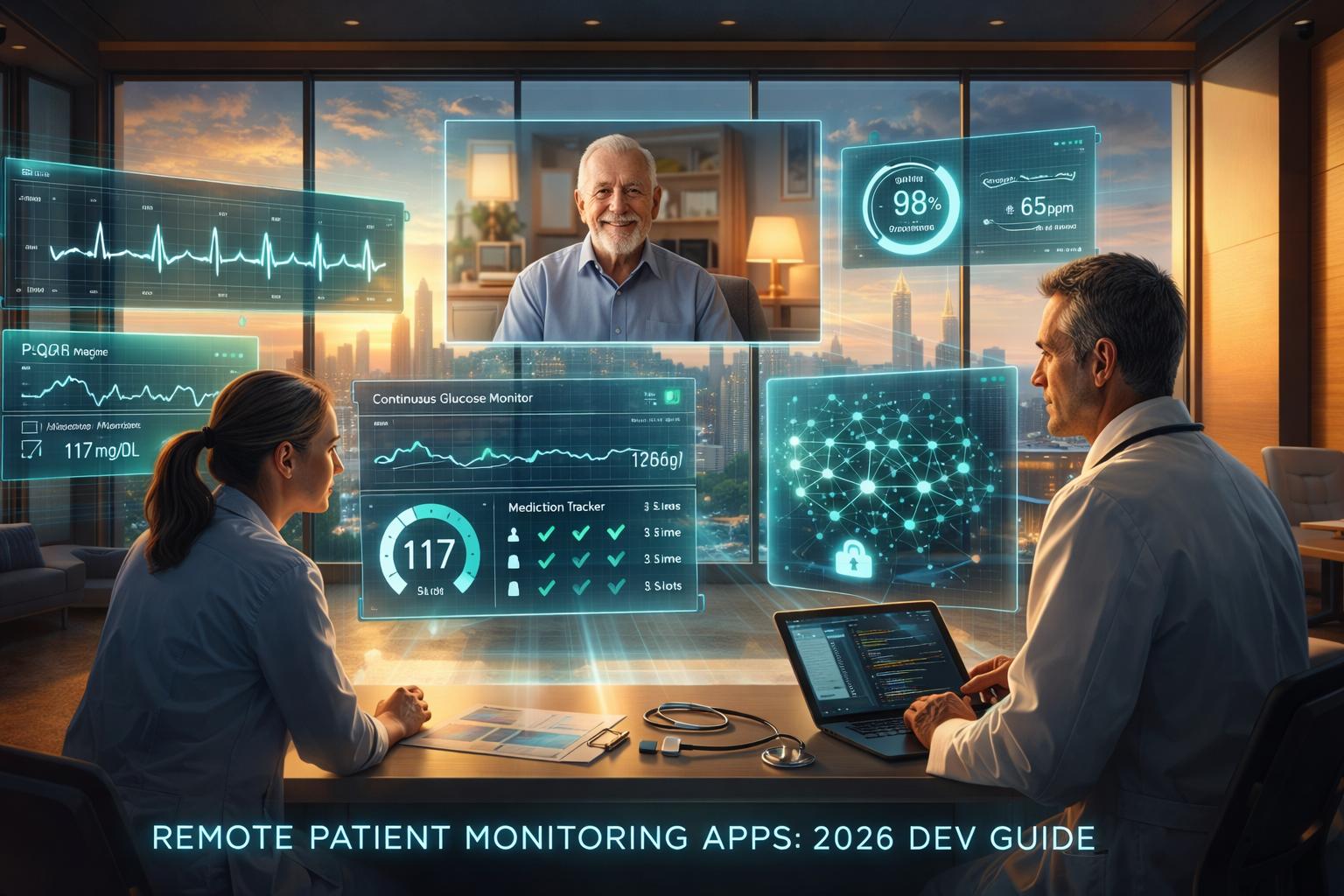
Remote Patient Monitoring Apps: 2026 Dev Guide
The landscape of healthcare has shifted from reactive clinical visits to continuous, data-driven oversight. For developers and healthcare organizations, Remote Patient Monitoring Apps are no longer a luxury but a fundamental requirement for managing chronic diseases and post-operative recovery. As of 2026, the success of these applications depends on the seamless bridge between consumer wearables and clinical-grade diagnostic tools.
This guide provides a technical and strategic framework for building and deploying Remote Patient Monitoring (RPM) solutions. Whether you are an independent developer or part of a health system, understanding the interplay between data latency, regulatory compliance, and user experience is critical for 2026 adoption.
The 2026 State of Remote Patient Monitoring
In 2026, the RPM market has moved beyond simple heart rate and step tracking. We are seeing a "clinicalization" of consumer hardware. Modern smartphones and smartwatches now feature sensors capable of multi-lead ECGs, continuous glucose monitoring (CGM) without interstitial fluid sampling, and advanced pulse oximetry that meets ISO 80601-2-61 standards.
However, a significant challenge remains: Data Fragmentation. While the hardware is advanced, many platforms struggle to normalize data from disparate sources into a format that a physician can actually use during a 10-minute consultation. Building an RPM app today requires a focus on interoperability, specifically utilizing FHIR (Fast Healthcare Interoperability Resources) R5 standards to ensure that data flows correctly into Electronic Health Records (EHRs).
Core Framework for RPM Development
Building a robust RPM application requires a three-tier architecture: the Data Acquisition Layer, the Analysis Layer, and the Clinical Dashboard.
1. Data Acquisition and Edge Processing
Your app must handle data from various peripherals—Bluetooth Low Energy (BLE) blood pressure cuffs, Wi-Fi-enabled scales, and wearable patches. In 2026, best practices dictate that initial data filtering happens on the device (Edge Computing). This reduces the "noise" sent to the server and preserves battery life.
2. The Analysis Layer (The Intelligence)
Raw data is rarely helpful to a doctor. If a patient’s heart rate spikes, the system needs context. Was the patient exercising? Did they just take medication? Your backend must correlate physiological data with patient-reported outcomes (PROs) to generate actionable alerts.
3. The Clinical Dashboard
Physicians are experiencing higher rates of "alert fatigue" than ever before. Your dashboard must prioritize patients based on risk scores rather than chronologically. Successful implementations in 2026 use "Exception-Based Reporting," where clinicians only see data that falls outside of pre-defined, patient-specific thresholds.
For organizations looking to build these complex ecosystems, partnering with specialized firms like
Implementation Steps: From Concept to Clinical Launch
Building a Remote Patient Monitoring app involves more than just coding; it requires a rigorous adherence to the "Quality Management System" (QMS) frameworks.
Define the Clinical Use Case: Are you monitoring heart failure, diabetes, or COPD? Each requires different sampling frequencies and hardware integrations.
Hardware Selection & SDK Integration: Choose devices with open APIs. By 2026, most manufacturers have moved away from proprietary "walled gardens" toward standard GATT profiles for BLE.
Security-First Architecture: Implement end-to-end encryption (E2EE). In 2026, the industry standard has shifted toward "Zero Trust" architecture, where every data request is verified, even those from within the clinic's internal network.
EHR Integration: Use SMART on FHIR protocols. This allows your RPM app to run natively inside platforms like Epic or Cerner, reducing the friction for doctors who don't want to log into a separate portal.
AI Tools and Resources
Google Cloud Healthcare API — A managed service for bridging the gap between care systems and apps.
Best for: Storing and managing healthcare data in FHIR, HL7 V2, and DICOM formats.
Why it matters: Automates the de-identification of patient data for research or AI training purposes.
Who should skip it: Small-scale apps with very limited data storage needs.
2026 status: Highly stable; now includes advanced multimodal generative AI features for clinical summarization.
TensorFlow Lite for Microcontrollers — Enables AI inference on low-power wearable devices.
Best for: Real-time arrhythmia detection or fall detection directly on the wearable.
Why it matters: Reduces latency and improves patient privacy by processing sensitive data locally.
Who should skip it: Apps that primarily act as "data pipes" without the need for real-time analysis.
2026 status: Version 3.0 offers 40% better power efficiency for always-on sensors.
Risks, Trade-offs, and Limitations
While RPM offers immense benefits, it is not a silver bullet. Development teams must account for human and technical failures that can compromise patient safety.
When the Solution Fails: The "Connectivity Gap" Scenario
In many rural or underserved areas, consistent high-speed internet is not guaranteed.
- Warning signs: Persistent "Data Out of Sync" errors on the clinical dashboard or large gaps in the patient's physiological timeline.
- Why it happens: Most RPM apps are designed with an "always-on" assumption. When a patient enters a dead zone, the app may fail to cache data locally or fail to prioritize critical alerts over routine data.
- Alternative approach: Implement a "Store-and-Forward" architecture. Critical alerts (like a dangerously high blood sugar reading) should trigger an automated SMS or phone call backup if the primary data sync fails.
Key Takeaways
Prioritize Interoperability: Use FHIR R5 standards from day one to ensure your app can talk to hospital systems.
Focus on the User: Patients in 2026 expect a consumer-grade experience. If the app is hard to use, they will stop wearing the devices.
Safety Over Speed: In the healthcare domain, a bug isn't just an inconvenience; it can be a clinical risk. Invest in automated testing for data accuracy.
Local Expertise Matters: Utilize regional development partners who understand the specific regulatory nuances of your market.