Station Controller Software For Semiconductor Manufacturing: Features And Benefits
Semiconductor equipment no longer operates in isolation. A single tool on the fab floor needs to communicate with operators, factory host systems, MES/EAP platforms, and other automation layers, often at the same time. As fabs push toward tighter automation and faster data turnaround, the software running at the equipment level matters as much as the equipment itself.
Station Controller software is one of the key pieces in this picture. It is an equipment-level software layer that helps manage communication, monitoring, control, and integration between a semiconductor tool and the systems around it. This article looks at what Station Controller software actually does, how it fits into equipment architecture, and what manufacturers should weigh when choosing one.
What Is Station Controller Software?
A Station Controller is software that runs close to the equipment, acting as the point where equipment-level signals and data get organized before they reach factory systems. It typically sits in the middle of a simple chain:
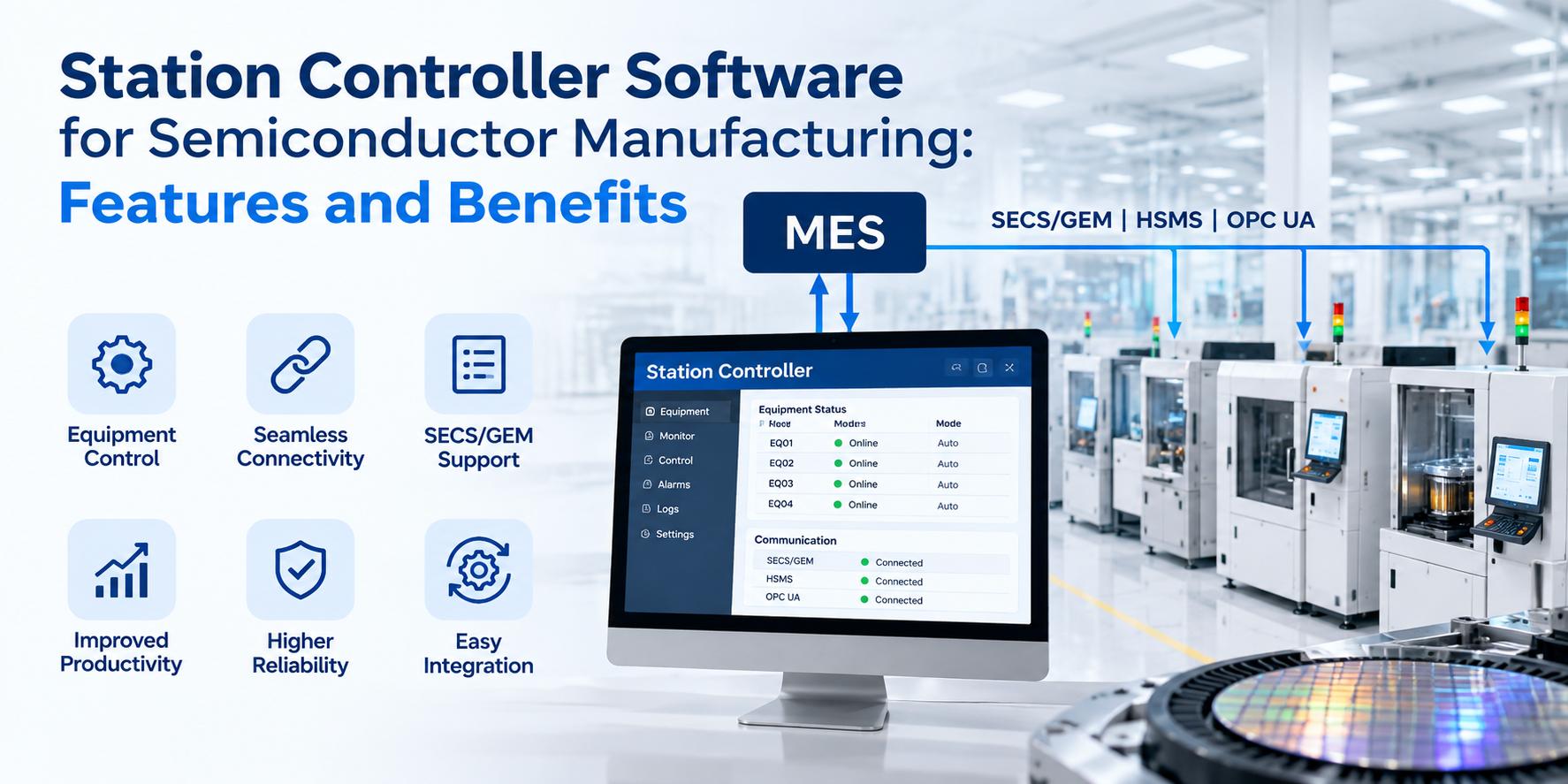
Semiconductor Equipment → Station Controller → Host / EAP / MES / Factory Automation Systems
In practice, this means the Station Controller reads data from the equipment, formats it appropriately, and passes it upstream. It also receives commands or recipe instructions from the host side and delivers them to the equipment in a format the tool can act on. However, the exact architecture varies depending on the equipment model, the fab's automation maturity, and the communication standards already in use.
How Does a Station Controller Work in Semiconductor Manufacturing?
The practical communication flow generally looks like this: Equipment → Station Controller → Host/EAP → MES/Factory Systems. At each step, specific types of information move in both directions.
On the equipment side, the Station Controller handles equipment data collection, tracking equipment status, and capturing alarms and events as they happen. In addition, it can manage remote commands sent from the host, along with recipe-related communication that keeps the tool running the correct process parameters.
On the factory side, the Station Controller passes production information upward so that host and MES systems have current data to work with. Meanwhile, it is worth being clear about scope here: a Station Controller does not replace MES. Instead, it supports equipment-level connectivity and automation, giving the MES a more consistent and structured stream of information to work with.
Key Features of Station Controller Software
Equipment Connectivity. This is the foundational capability — without a reliable connection to the equipment itself, none of the other features matter. It establishes the communication channel that everything else depends on.
SECS/GEM Communication. Many semiconductor tools expose their data and control points through SECS/GEM, so the Station Controller needs to speak this language to interact with equipment in a standardized way.
HSMS Support. Since SECS/GEM messages typically travel over HSMS, support for this TCP/IP-based transport is necessary for the connection to actually function over a network.
Equipment Data Collection. Beyond simple connectivity, the Station Controller needs to organize and structure equipment data as it comes in, so downstream systems receive something usable rather than raw signal noise.
Alarm and Event Management. Fast, accurate alarm handling helps engineering and operations teams respond to issues before they affect yield or throughput, rather than discovering them after the fact.
Equipment Status Monitoring. Continuous visibility into equipment state — running, idle, down, in maintenance — gives teams a clearer picture of utilization without needing to physically check each tool.
Recipe and Parameter Handling. As a result of managing recipe communication, the Station Controller helps reduce the risk of a tool running with outdated or mismatched process parameters.
HMI / Operator Interface. Operators on the floor still need a practical way to view equipment status and interact with it directly, so a usable interface remains an important part of the software.
MES and EAP Integration. For the data collected at the equipment level to be useful factory-wide, it has to integrate cleanly with MES and EAP systems rather than staying siloed at the tool.
Diagnostics and Communication Logging. Finally, when something does go wrong, detailed logs of communication activity make it far easier to trace the source of the problem instead of guessing.
Role of SECS/GEM in Station Controller Software
Station Controller software and SECS/GEM are related, but they are not the same thing. SECS/GEM is a set of communication standards; a Station Controller is a piece of software that can implement or support those standards as part of a broader equipment integration architecture.
SECS-II defines semiconductor equipment messages and message structures — the actual format and content of what gets exchanged. HSMS provides TCP/IP-based communication for host-equipment communication, serving as the transport that carries SECS-II messages across the network. GEM, in turn, defines a standardized equipment communication model and capabilities, describing the behaviors equipment should support to be considered compliant.
A Station Controller can implement or support these communication capabilities, but it is the software layer, not the standard itself. Understanding this distinction matters when evaluating vendors, since some solutions handle only part of this stack.
Benefits of Station Controller Software for Semiconductor Equipment
Manufacturers adopt Station Controller software for several practical reasons. Equipment integration becomes easier when a common software layer handles communication instead of custom point-to-point solutions for every tool. In addition, better equipment visibility gives engineering teams a clearer, more current view of what is happening across the fab floor.
Automated data collection reduces manual monitoring, which in turn frees up operator and engineering time for higher-value work. Faster troubleshooting follows naturally from better logging and diagnostics, since teams can trace issues to their source more directly. Meanwhile, more consistent factory communication reduces the friction that comes from equipment reporting data in inconsistent formats.
Station Controller software can also support equipment modernization efforts and make integration with MES/EAP systems more straightforward. Finally, a well-architected solution can improve scalability as a fab adds more tools over time. These are meaningful operational benefits, though outcomes will vary by fab and equipment mix — no responsible vendor should promise guaranteed downtime reduction or fixed percentage improvements.
Station Controller Software for Legacy Semiconductor Equipment
Legacy equipment presents a particular challenge because older tools were often not designed with modern factory connectivity in mind. Some may lack a standard communication interface entirely, while others support only limited or outdated versions of SECS/GEM.
However, this does not necessarily mean legacy equipment needs to be replaced. A suitable Station Controller or equipment connectivity layer can often modernize older equipment by adding or translating communication and data interfaces, giving the tool a path into current factory automation systems. This approach is generally more cost-effective than a full equipment swap, though the amount of engineering work required depends heavily on what the existing equipment already supports.
What Should Manufacturers Consider When Choosing Station Controller Software?
Selecting Station Controller software involves evaluating it against the fab's actual equipment and automation requirements rather than a generic checklist. Required SEMI communication standards should be confirmed first, along with the level of SECS/GEM and HSMS support the software actually provides.
Equipment compatibility is another practical concern, as is how well the software integrates with existing MES/EAP systems. HMI requirements, data collection needs, and how the software handles alarms and events all affect day-to-day usability. Recipe management needs, along with diagnostics and logging capabilities, determine how much visibility engineering teams will have once the system is running.
Scalability and maintainability matter for the long term, particularly as a fab's equipment count grows. Finally, support for legacy equipment is worth checking closely if the fab operates a mixed fleet of newer and older tools. No single vendor is objectively "best" for every situation — the right choice depends on matching these criteria to the specific fab environment.
eInnoSys Station Controller Solution
eInnoSys offers a Station Controller solution, the EIStationController, designed to support semiconductor equipment connectivity within a broader factory automation context. Based on information available on the eInnoSys website, the solution is positioned to help with equipment-level communication, factory host integration, and equipment monitoring.
As with any Station Controller evaluation, manufacturers should assess how a given solution fits their specific equipment types, communication standards, and integration requirements before making a decision.
Conclusion
Station Controller software functions as an equipment-level connectivity and automation layer, sitting between semiconductor tools and the factory systems that depend on their data. It supports communication, monitoring, and integration without taking over the broader coordination role that MES performs. Choosing the right Station Controller software comes down to matching it against the fab's equipment architecture, required communication standards, and long-term automation plans, rather than assuming any one solution fits every environment.