
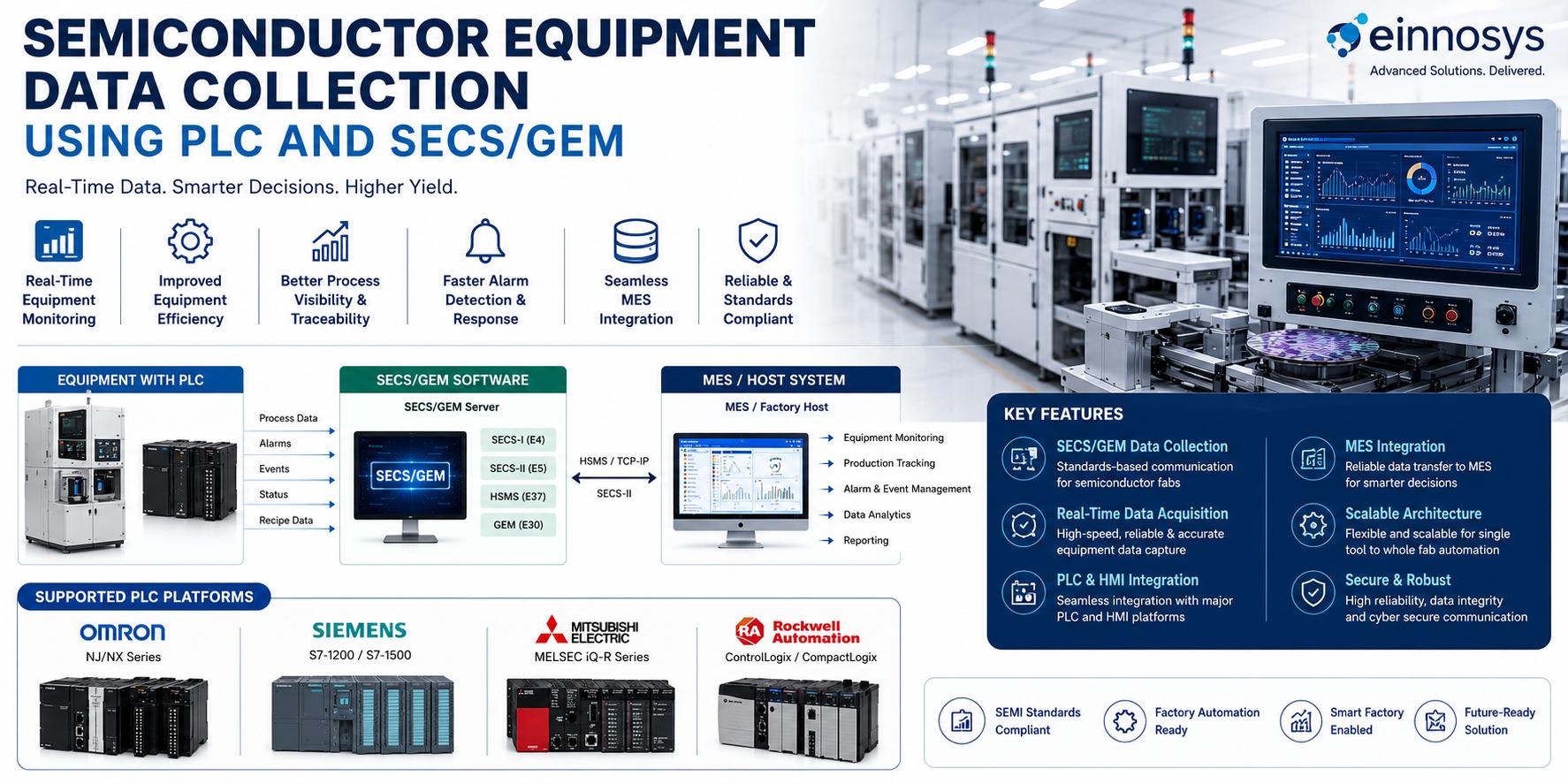
Semiconductor Equipment Data Collection Using PLC And SECS/GEM
In today’s semiconductor manufacturing environment, data is one of the most valuable operational assets. Every wafer movement, process parameter, equipment alarm, and production event generates critical information that fabs use to improve yield, reduce downtime, and optimize production efficiency. As semiconductor factories continue moving toward Industry 4.0 and smart manufacturing, Semiconductor Equipment Data Collection has become a core requirement for modern automation systems.
Most semiconductor equipment today relies on industrial PLCs such as Omron, Siemens, Mitsubishi, and Rockwell controllers for machine control and process automation. However, simply operating the equipment is no longer enough. Manufacturers need Real-Time Equipment Monitoring, MES connectivity, traceability, and centralized analytics. This is where SECS/GEM Data Collection and advanced PLC Data Collection Software play a major role.
At Einnosys, we help semiconductor OEMs and fabs implement scalable SECS/GEM Software solutions that enable reliable communication between PLC-controlled equipment and factory host systems.
Why Semiconductor Equipment Data Collection Matters
Semiconductor manufacturing processes involve highly sensitive production environments where even a minor deviation can affect yield and equipment utilization. Without a reliable Equipment Data Acquisition System, fabs struggle with incomplete traceability, delayed alarm reporting, and inconsistent production visibility.
Modern Semiconductor Equipment Monitoring systems collect data such as:
- Equipment operating status
- Process parameters
- Alarm conditions
- Recipe information
- Production counts
- Wafer tracking data
- Temperature and pressure values
- Equipment utilization metrics
This data is essential for predictive maintenance, process optimization, OEE improvement, and Semiconductor MES Integration.
Traditional manual data logging methods are no longer practical in high-speed semiconductor fabs. Automated Semiconductor equipment data collection using PLC systems ensures accurate, real-time visibility across production lines while minimizing human error.
The Role of PLC and SECS/GEM Integration
Industrial PLCs are widely used inside semiconductor equipment because of their reliability, deterministic control behavior, and high-speed I/O processing capabilities. However, PLCs alone are not designed to communicate directly with semiconductor host systems or MES platforms.
This is where PLC and SECS/GEM Integration becomes critical.
SECS/GEM is a collection of SEMI standards that standardizes communication between semiconductor equipment and factory systems. It allows equipment to exchange real-time production data, alarms, events, and remote commands with the host system.
A properly designed SECS/GEM equipment data collection software solution bridges the gap between industrial PLCs and semiconductor MES environments.
At Einnosys, our SECS/GEM Software architecture supports:
- SECS-I (SEMI E4)
- SECS-II (SEMI E5)
- GEM (SEMI E30)
- HSMS (SEMI E37)
- GEM300 standards
Using Industrial PLC data collection for semiconductor fabs, manufacturers can standardize communication across different equipment vendors while improving factory-wide automation visibility.
How PLC-Based Semiconductor Equipment Monitoring Works
A modern PLC-based semiconductor equipment monitoring system typically includes:
- Industrial PLC controller
- SECS/GEM middleware server
- MES or host communication interface
- Equipment data acquisition engine
- Alarm and event management system
- Real-time dashboard and reporting tools
The PLC controls the equipment operation while the SECS/GEM layer manages communication with the semiconductor factory host system.
For example, an Omron PLC controlling a wafer inspection tool may continuously generate process data and equipment status updates. The Einnosys SECS/GEM server collects this information and transmits it to the MES system using standardized SECS/GEM messaging.
This Real-time semiconductor equipment data collection approach enables:
- Faster production decisions
- Reduced downtime
- Immediate alarm notifications
- Improved traceability
- Better yield analysis
- Centralized reporting
The ability to perform Semiconductor equipment communication using SECS/GEM also ensures that fabs can integrate tools from multiple OEMs into a unified automation environment.
Benefits of SECS/GEM Data Collection in Semiconductor Fabs
Implementing Factory automation data collection software provides several operational and business advantages.
1. Real-Time Equipment Monitoring
Continuous monitoring helps engineers identify equipment abnormalities before they impact production. Real-Time Equipment Monitoring enables faster troubleshooting and predictive maintenance strategies.
2. Improved MES Connectivity
Reliable Semiconductor MES Integration ensures production systems receive accurate equipment status and process data in real time. This improves scheduling, dispatching, and lot tracking capabilities.
3. Better Equipment Utilization
By analyzing equipment data, fabs can improve Overall Equipment Effectiveness (OEE), reduce idle time, and optimize throughput.
4. Enhanced Traceability
SECS/GEM Data Collection provides detailed historical records for every process step, which is critical for semiconductor quality control and compliance requirements.
5. Reduced Manual Data Entry
Automated Equipment Data Acquisition System solutions eliminate human error and improve reporting accuracy.
6. Scalable Smart Factory Integration
A Smart factory equipment monitoring system enables future-ready automation architectures that support AI analytics, predictive maintenance, and Industrial IoT integration.
PLC Platforms Supported by Einnosys
Einnosys supports Semiconductor Equipment Data Collection solutions across major industrial PLC platforms used in semiconductor manufacturing.
Omron PLC Integration
Omron NJ/NX and CJ-series PLCs are commonly used in wafer handling and packaging systems. Einnosys integrates these controllers using EtherNet/IP and OPC-UA communication.
Siemens PLC Integration
Siemens S7-1200 and S7-1500 PLCs are widely used in European semiconductor equipment. Our PLC to MES communication software supports efficient SECS/GEM integration using S7 communication protocols and OPC-UA.
Mitsubishi PLC Integration
Mitsubishi MELSEC PLCs are common in Japanese OEM equipment. Einnosys supports MC Protocol communication for reliable SECS/GEM equipment data collection software deployment.
Rockwell Automation Integration
Allen-Bradley ControlLogix and CompactLogix platforms are widely used in North American semiconductor automation systems. Einnosys enables full Semiconductor Equipment Monitoring and remote command support using EtherNet/IP integration.
Challenges in Semiconductor Equipment Communication
While SECS/GEM implementation provides significant advantages, successful deployment requires deep technical expertise.
Some common challenges include:
- PLC memory mapping complexity
- Event synchronization issues
- Alarm handling reliability
- Network latency management
- MES communication validation
- GEM state model implementation
- Recipe management synchronization
At Einnosys, we use a middleware-based architecture that separates PLC control logic from SECS/GEM communication. This improves maintainability, simplifies qualification, and ensures long-term scalability.
Our engineering teams also implement deterministic synchronization mechanisms that prevent equipment state mismatches after power failures or network interruptions.
Future of Semiconductor Factory Automation
As semiconductor manufacturing becomes increasingly automated, data-driven decision-making will continue to grow in importance. AI-powered analytics, predictive maintenance, digital twins, and smart manufacturing systems all depend on accurate Semiconductor Equipment Data Collection.
Modern fabs are no longer looking for simple machine connectivity. They require intelligent automation platforms capable of delivering:
- Real-time production insights
- Predictive maintenance data
- Equipment health monitoring
- Automated process optimization
- Centralized factory analytics
- Smart equipment communication
SECS/GEM Software combined with advanced PLC Data Collection Software forms the foundation of this next-generation semiconductor automation ecosystem.
Conclusion
Reliable Semiconductor Equipment Data Collection is essential for modern semiconductor manufacturing operations. By combining industrial PLC control systems with SECS/GEM Data Collection standards, fabs can achieve improved automation, enhanced traceability, and real-time production visibility.
A properly implemented PLC and SECS/GEM Integration solution allows semiconductor equipment to communicate seamlessly with MES and factory host systems while supporting advanced automation requirements such as GEM300, predictive maintenance, and smart factory analytics.
At Einnosys, we provide production-ready SECS/GEM Software solutions for Omron, Siemens, Mitsubishi, and Rockwell PLC-based semiconductor equipment. Our expertise in Semiconductor Equipment Monitoring, Semiconductor MES Integration, and Industrial PLC data collection for semiconductor fabs helps OEMs and fabs accelerate qualification, improve operational efficiency, and build scalable smart factory environments.
If your organization is planning Semiconductor equipment communication using SECS/GEM or needs a reliable Factory automation data collection software partner, Einnosys can help deliver a proven, standards-compliant solution tailored for semiconductor manufacturing.