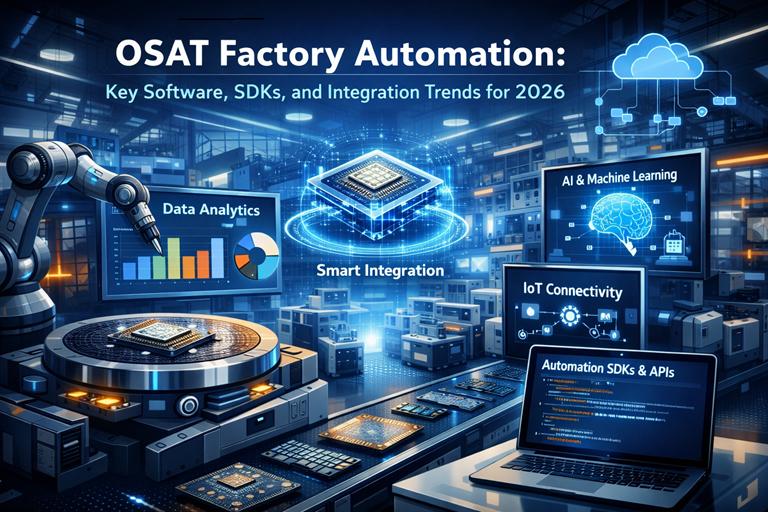
OSAT Factory Automation: Key Software, SDKs, And Integration Trends For 2026
Introduction
The semiconductor industry continues to evolve rapidly, and backend manufacturing is no exception. OSATs (Outsourced Semiconductor Assembly and Test providers) are under increasing pressure to deliver higher throughput, better yield, full traceability, and faster turnaround times. In this environment, OSAT Factory Automation has become a strategic priority rather than an operational enhancement.
As advanced packaging, chiplets, heterogeneous integration, and high-mix production grow in complexity, OSAT Automation Software and scalable OSAT Manufacturing Automation frameworks are essential for sustainable competitiveness. Modern Semiconductor OSAT Automation is no longer limited to simple equipment connectivity—it now encompasses intelligent scheduling, AI-driven analytics, predictive maintenance, and closed-loop control.
In 2026, OSAT Equipment Integration and robust OSAT Factory Automation Solutions will define leaders in the backend ecosystem. Organizations adopting OSAT Industry 4.0, OSAT Smart Manufacturing, and structured OSAT Digital Transformation programs are seeing measurable improvements in yield, OEE, and cycle time. Meanwhile, OSAT Production Automation is enabling lights-out operations and real-time factory visibility across global sites.
This blog explores the key software layers, SDK strategies, and integration trends shaping OSAT factories in 2026.
1. The Foundation of OSAT Factory Automation
At the core of modern OSAT Factory Automation lies a layered architecture that integrates shop-floor equipment with enterprise systems. Historically, OSAT facilities relied on fragmented tools and manual processes. Today, scalable OSAT Automation Software platforms orchestrate equipment, operators, and materials in real time.
Effective OSAT Manufacturing Automation includes:
- MES-driven lot tracking
- Equipment-to-host communication
- Automated recipe management
- Real-time SPC and yield analytics
- Integrated material handling systems
In advanced Semiconductor OSAT Automation, data flows seamlessly from die attach, wire bond, molding, singulation, and final test tools into centralized analytics platforms. This requires standardized OSAT Equipment Integration frameworks and reliable communication protocols such as SECS/GEM and GEM300.
Leading OSAT Factory Automation Solutions providers now offer modular platforms that support multi-site deployments, hybrid cloud environments, and integration with ERP, PLM, and quality systems. These platforms enable structured OSAT Industry 4.0 Implementation, where data becomes a strategic asset rather than a byproduct.
By aligning OSAT Smart Manufacturing strategies with digital KPIs, OSATs accelerate OSAT Digital Transformation and enhance OSAT Production Automation maturity across backend operations.
2. Key Software Layers Powering OSAT Automation
In 2026, successful OSAT Factory Automation depends on a tightly integrated software stack:
a) Manufacturing Execution System (MES)
OSAT MES Integration plays a central role in coordinating OSAT Manufacturing Automation workflows. MES ensures lot genealogy, process control, dispatching logic, and quality enforcement. Integrated MES platforms drive standardized Semiconductor OSAT Automation across multiple production lines.
b) Equipment Automation Platform (EAP)
An OSAT Equipment Automation Platform (EAP) acts as middleware between tools and MES. It standardizes communication, manages alarms, validates recipes, and enables closed-loop automation. Strong OSAT Equipment Integration Services ensure seamless deployment of EAP systems across diverse tool vendors.
c) SECS/GEM Communication
OSAT SECS/GEM Integration remains critical for reliable tool connectivity. Modern OSAT Automation Software platforms extend traditional SECS/GEM with advanced data collection, event filtering, and remote command capabilities—enhancing overall OSAT Production Automation reliability.
d) Advanced Analytics & AI
AI-driven yield optimization and predictive maintenance are central to next-generation OSAT Smart Manufacturing. When integrated into broader OSAT Factory Automation Solutions, analytics engines reduce downtime and improve first-pass yield.
Organizations often rely on specialized OSAT Software Development Company partners or OSAT Automation Solutions Providers to design scalable, secure automation architectures tailored to backend complexity.
3. The Role of SDKs in OSAT Equipment Integration
As OSAT environments incorporate equipment from multiple OEMs, SDK-based integration strategies are becoming essential. SDKs accelerate OSAT Equipment Integration by enabling standardized communication modules, custom control logic, and enhanced data acquisition.
Through Custom OSAT Automation Software Development, engineering teams can:
- Build equipment adapters for legacy tools
- Enable advanced event tracking
- Implement recipe validation logic
- Integrate edge computing capabilities
SDK-driven OSAT Manufacturing Automation improves flexibility and reduces vendor dependency. Instead of relying solely on OEM firmware, OSATs can deploy customized extensions aligned with specific process requirements.
Modern OSAT Factory Automation architectures leverage SDK frameworks to enable:
- High-speed traceability
- Smart material movement
- Integrated SPC dashboards
- Secure API-based connectivity
Professional OSAT Factory Automation Services and OSAT Factory Automation Consulting teams help evaluate SDK compatibility, cybersecurity risks, and scalability before implementation. This structured approach strengthens OSAT Digital Transformation efforts while ensuring seamless OSAT Industry 4.0 Implementation across backend facilities.
4. Integration Trends Shaping OSAT Production Automation in 2026
The next wave of OSAT Production Automation focuses on autonomy, interoperability, and intelligence. Several integration trends are defining the future of Semiconductor OSAT Automation:
1. Unified Equipment Connectivity
Standardized OSAT Equipment Integration Services are enabling unified connectivity across die bonders, testers, and inspection systems. Centralized dashboards improve decision-making and enhance overall OSAT Smart Manufacturing performance.
2. Cloud-Enabled OSAT Automation Software
Hybrid cloud deployments support global OSAT Factory Automation Solutions, enabling remote monitoring, multi-site benchmarking, and scalable analytics.
3. Closed-Loop Process Control
Integration between MES, EAP, and AI analytics creates automated feedback loops—an essential element of advanced OSAT Manufacturing Automation.
4. Digital Twin & Simulation
Digital twin technologies enhance OSAT Industry 4.0 initiatives by simulating production scenarios before real-world deployment, reducing risks during OSAT Digital Transformation programs.
5. Cybersecurity-First Architecture
As OSAT Equipment Integration increases connectivity, cybersecurity becomes a critical pillar of sustainable OSAT Factory Automation.
Companies seeking to accelerate modernization often partner with an experienced OSAT Automation Solutions Provider that offers end-to-end OSAT Industry 4.0 Implementation, ensuring strategy, execution, and long-term scalability.
5. Strategic Roadmap for OSAT Digital Transformation
To achieve scalable OSAT Factory Automation, organizations should follow a phased roadmap:
- Assess current automation maturity
- Define integration architecture
- Deploy modular OSAT Automation Software
- Implement OSAT MES Integration and EAP frameworks
- Enable advanced analytics and AI
Expand toward predictive and autonomous operations
Structured OSAT Factory Automation Consulting ensures that investments align with business goals such as yield improvement, cost reduction, and faster NPI ramp-up.
As backend processes grow more complex, robust OSAT Manufacturing Automation becomes essential for maintaining competitive margins. A future-ready Semiconductor OSAT Automation strategy requires scalable OSAT Equipment Integration, reliable OSAT Factory Automation Solutions, and a clear OSAT Industry 4.0 vision.
Conclusion
In 2026, OSAT Factory Automation will no longer be optional—it will be the backbone of backend semiconductor competitiveness. From advanced OSAT Automation Software and SDK-driven OSAT Equipment Integration to scalable OSAT Manufacturing Automation platforms, the transformation is reshaping how OSATs operate.
By embracing intelligent Semiconductor OSAT Automation, deploying integrated OSAT Factory Automation Solutions, and executing structured OSAT Industry 4.0 Implementation, organizations can unlock new levels of efficiency, visibility, and profitability.
Ultimately, the convergence of OSAT Smart Manufacturing, OSAT Digital Transformation, and AI-powered OSAT Production Automation will define the next generation of high-performance OSAT factories—driving resilience, scalability, and sustained growth in an increasingly competitive semiconductor landscape.