
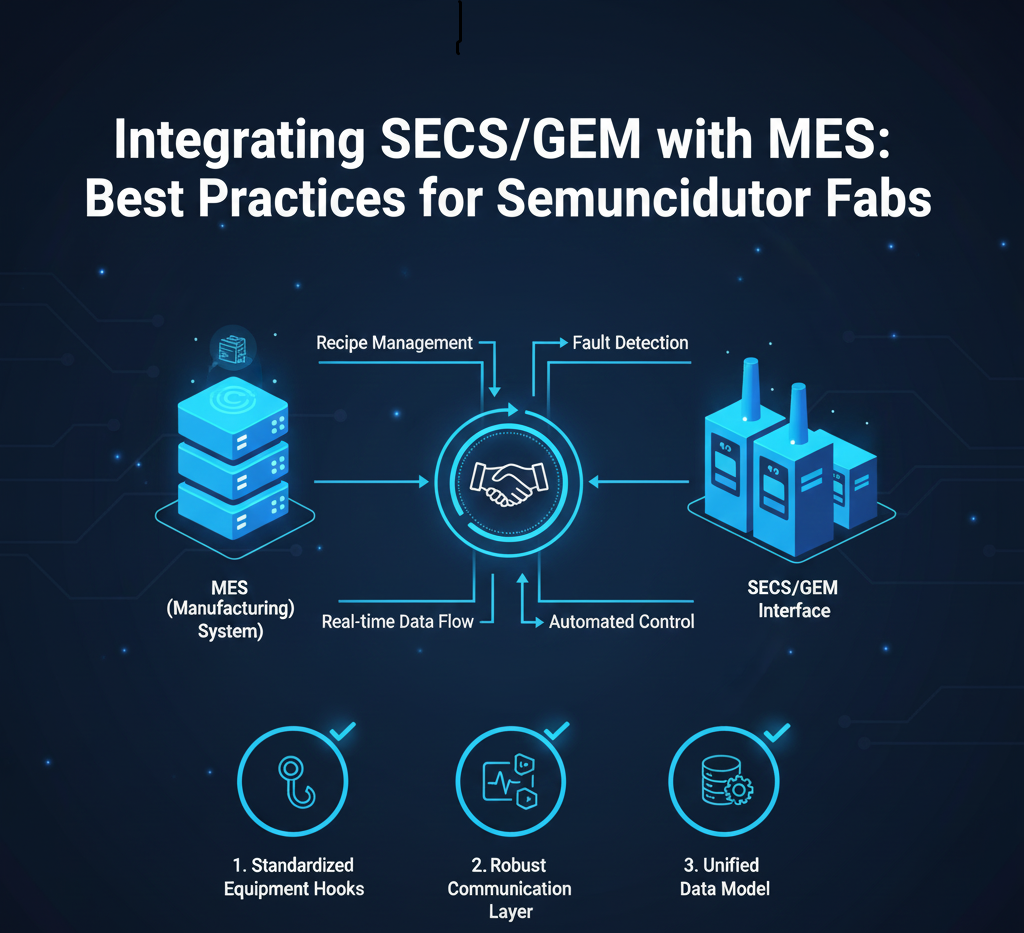
Integrating SECS/GEM With MES | Best Practices For Semiconductor Fabs
In modern semiconductor manufacturing, automation and real-time data exchange are critical for maintaining efficiency, quality, and traceability. A key enabler of this automation is the integration of SECS/GEM with the Manufacturing Execution System (MES). When implemented correctly, this integration allows semiconductor fabs to operate smarter, reduce manual intervention, and achieve consistent process control.
At Einnosys, we help semiconductor manufacturers and equipment suppliers implement reliable SECS/GEM–MES integrations aligned with SEMI standards and Industry 4.0 objectives.
Understanding SECS/GEM and MES Integration
SECS/GEM is a SEMI standard communication protocol that enables equipment to exchange structured data and commands with factory host systems. MES manages and coordinates manufacturing operations such as lot tracking, scheduling, quality control, and reporting.
By integrating SECS/GEM with MES, fabs gain:
- Real-time equipment status visibility
- Automated control of processing operations
- Accurate data collection for analysis and reporting
- Improved coordination between tools and factory systems
Why SECS/GEM–MES Integration Is Important
Without proper integration, fabs often rely on manual processes that increase the risk of errors and delays. A well-designed SECS/GEM–MES interface enables:
- Automation of equipment operations
- Improved data accuracy and traceability
- Reduced downtime and faster response to issues
- Better decision-making through real-time insights
This integration forms the foundation of smart manufacturing and digital transformation in semiconductor fabs.
Best Practices for SECS/GEM and MES Integration
1. Ensure SECS/GEM Compliance
Before integration, confirm that equipment complies with SEMI standards such as GEM (E30) and HSMS (E37/E37.1). Standards compliance ensures consistent communication behavior and smoother MES interaction.
2. Define Clear Communication Scope
Clearly identify the data and commands exchanged between equipment and MES, including:
- Equipment status variables
- Process and measurement data
- Alarms and events
- Recipe and parameter management
A well-defined scope helps avoid gaps and future integration issues.
3. Standardize Event and Alarm Handling
Consistent handling of alarms, events, and state transitions is essential. Standardized reporting allows MES to respond quickly to abnormal conditions and maintain production continuity.
4. Implement Controlled Recipe Management
Recipe control is a critical MES function. Best practices include:
MES-driven recipe selection
- Version control and validation
- Secure recipe download and verification using SECS/GEM
This reduces human error and ensures process consistency.
5. Enable Real-Time Data Collection
Real-time data collection via SECS/GEM allows MES to monitor performance, analyze trends, and support yield improvement initiatives. Accurate and timely data is essential for advanced analytics and continuous improvement.
6. Focus on Reliability and Security
SECS/GEM communication must be reliable and secure, especially when using TCP/IP networks. Proper timeout handling, error recovery, and network stability are crucial for uninterrupted fab operations.
7. Perform Thorough Testing Before Deployment
Before production rollout:
- Validate all SECS/GEM message flows
- Test alarm and event scenarios
- Simulate MES-driven commands
- Verify recovery from communication failures
Comprehensive testing ensures stable and predictable operations.
How Einnosys Helps
At Einnosys, we provide end-to-end SECS/GEM and MES integration services, including interface development, SEMI standard compliance, performance optimization, and long-term support. Our solutions help semiconductor fabs achieve scalable, reliable, and future-ready factory automation.
Integrating SECS/GEM with MES is essential for building efficient, automated, and data-driven semiconductor fabs. By following best practices and working with experienced automation partners, manufacturers can improve productivity, quality, and operational visibility.
Einnosys remains committed to helping semiconductor manufacturers seamlessly connect equipment to factory systems.
More Information: https://www.einnosys.com/introduction-secs-gem/