10 Reasons To Hire A Contract SECS/GEM Engineer
Semiconductor and electronics manufacturers depend on SECS/GEM (SEMI Equipment Communications Standard / Generic Equipment Model) to keep fab tools communicating with host systems in real time. But building or maintaining that expertise in-house isn't always practical — which is why more companies are turning to contract SECS/GEM engineers to fill the gap. Here are ten reasons this approach makes sense.
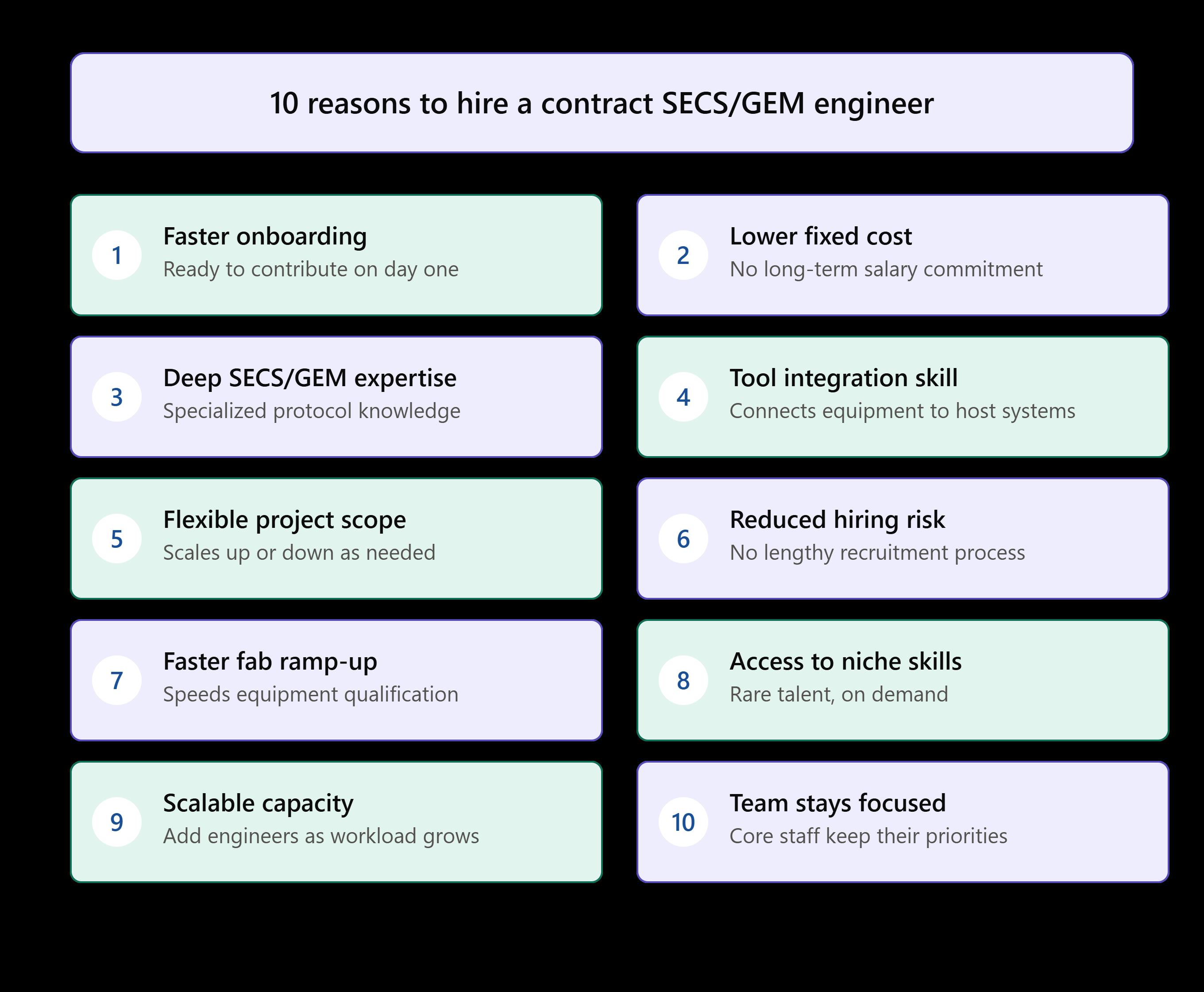
Specialized skills, on demand. SECS/GEM is a niche discipline. A contractor brings deep, tool-tested expertise without the years it takes to train someone internally.
Faster equipment integration. Experienced contractors have already solved common connectivity problems, so new tools can be qualified and connected to the host faster.
Lower overhead. You avoid the cost of a full-time salary, benefits, and training for a skill set you may only need intermittently.
Flexible scaling. Ramp engineers up during a fab expansion or new tool rollout, then scale back down once the project stabilizes.
Reduced downtime risk. A seasoned SECS/GEM engineer can diagnose communication failures and protocol mismatches quickly, minimizing costly tool downtime.
Cross-platform experience. Contractors often work across multiple fabs and equipment vendors, bringing broader troubleshooting knowledge than an engineer who's only seen one environment.
Compliance and standards fluency. Staying aligned with SEMI standards (E4, E5, E30, E37, E39, E40, etc.) requires constant awareness of requirements and updates — something specialists track as part of their job.
Support for legacy and modern systems. Contract engineers frequently bridge older GEM300 implementations with newer MES and host architectures, which is valuable during upgrades or migrations.
Objective, project-focused execution. Without internal politics or competing daily responsibilities, a contractor can focus purely on delivering the integration or fix on schedule.
Knowledge transfer. A good contract engineer doesn't just fix the problem — they document it, train your staff, and leave your internal team stronger than before.
Whether you're standing up a new fab line, integrating a new tool type, or troubleshooting a stubborn host connection issue, a contract SECS/GEM engineer offers a fast, cost-effective way to get expert results without long-term commitment. For many manufacturers, it's the difference between weeks of delay and a smooth, on-schedule ramp.
Beyond immediate troubleshooting, contract SECS/GEM engineers can support equipment qualification, host communication testing, GEM compliance, data collection, alarm management, remote command handling, and MES integration. Their experience can help reduce development bottlenecks while giving internal teams access to specialized expertise exactly when it is needed.
Looking for SECS/GEM support for your next project? A short conversation with a specialist can often save weeks of integration time while reducing project risk, accelerating equipment qualification, and helping your engineering team meet critical fab deployment deadlines.