Industry 4.0 Explained Simply: Meaning, Concepts & Business Benefits
Introduction
The manufacturing world is undergoing a major transformation, often referred to as the industrial revolution 4.0. But many professionals still ask: what is Industry 4.0, and why does it matter today?
In simple terms, Industry 4.0 represents the shift toward intelligent, connected, and automated manufacturing systems. The industry 4.0 meaning goes beyond just automation—it combines digital technologies, data, and real-time connectivity to create smarter factories. If you’re looking for industry 4.0 explained in a practical way, think of it as the integration of machines, software, and analytics working together to improve efficiency, quality, and decision-making.
As global competition increases, companies are adopting Industry 4.0 in manufacturing to stay ahead. From smart manufacturing to digital transformation manufacturing, this new era is reshaping how products are designed, produced, and delivered.
What is Industry 4.0?
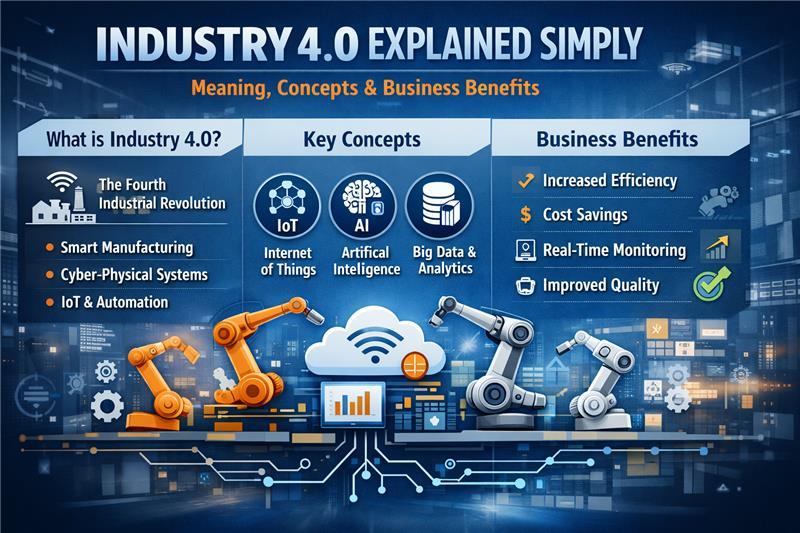
To clearly understand what Industry 4.0 is, it helps to look at how manufacturing has evolved. The industrial revolution 4.0 follows three earlier phases—mechanization, electrification, and digital automation.
Industry 4.0 builds on these foundations by introducing advanced industry 4.0 technologies such as:
- Industrial Internet of Things (IIoT)
- Artificial Intelligence (AI)
- Big Data and Analytics
- Cloud Computing
- Cyber Physical Systems
The industry 4.0 meaning is centered on creating a connected factory, where machines, systems, and humans communicate seamlessly. This connectivity enables real-time insights, predictive decision-making, and higher levels of industrial automation.
In short, industry 4.0 explained simply: it is about turning traditional factories into intelligent ecosystems powered by data.
Core Industry 4.0 Concepts
Understanding Industry 4.0 concepts is essential for businesses planning digital transformation. These concepts form the backbone of Industry 4.0 in manufacturing.
1. Cyber Physical Systems (CPS)
Cyber physical systems connect physical equipment with digital intelligence. Machines are equipped with sensors and software that allow them to monitor performance, communicate data, and respond automatically.
2. IIoT in Manufacturing
IIoT in manufacturing enables machines, devices, and systems to exchange data in real time. This creates visibility across production lines and supports faster decision-making.
3. Smart Manufacturing
Smart manufacturing uses data, analytics, and automation to optimize production processes. It reduces waste, improves quality, and increases efficiency.
4. Connected Factory
A connected factory integrates all systems—from equipment to enterprise software—into a unified platform. This is a key outcome of Industry 4.0.
5. Digital Transformation Manufacturing
Digital transformation manufacturing involves adopting digital tools and technologies to modernize operations. It is a strategic step toward achieving full Industry 4.0 solutions.
These concepts define the industry 4.0 meaning and show how businesses can move toward smarter, more efficient operations.
Industry 4.0 Technologies Driving Change
The success of Industry 4.0 depends on the adoption of advanced technologies. These industry 4.0 technologies enable automation, connectivity, and intelligence.
Key Technologies Include:
Artificial Intelligence (AI): Enables predictive maintenance and intelligent decision-making
- Big Data Analytics: Helps analyze production data for optimization
- Cloud Computing: Supports scalable data storage and processing
- Industrial Automation: Reduces manual intervention and improves consistency
- IIoT in Manufacturing: Connects machines and systems for real-time data exchange
These technologies work together to create industry 4.0 solutions that drive efficiency and innovation.
When we talk about industry 4.0 explained, it’s important to understand that these technologies are not standalone—they are integrated to create a seamless manufacturing ecosystem.
Industry 4.0 in Manufacturing: Real-World Applications
The impact of Industry 4.0 in manufacturing can be seen across multiple areas:
1. Real-Time Monitoring
Factories can monitor equipment performance in real time using connected factory systems.
2. Predictive Maintenance
By analyzing data, companies can predict equipment failures before they occur, reducing downtime.
3. Automated Production
Advanced industrial automation enables machines to operate with minimal human intervention.
4. Quality Control
Data-driven insights improve product quality and reduce defects.
5. Supply Chain Optimization
Digital transformation manufacturing extends beyond the factory floor to improve supply chain efficiency.
These applications highlight how the industrial revolution 4.0 is transforming traditional manufacturing into intelligent, data-driven operations.
Business Benefits of Industry 4.0
Adopting Industry 4.0 offers significant advantages for manufacturers:
1. Increased Efficiency
Automation and real-time data improve production efficiency and reduce waste.
2. Reduced Downtime
Predictive maintenance minimizes unexpected equipment failures.
3. Better Decision-Making
Access to accurate data enables faster and smarter decisions.
4. Improved Product Quality
Consistent monitoring ensures higher quality standards.
5. Enhanced Flexibility
Manufacturers can quickly adapt to changing market demands.
The industry 4.0 meaning becomes clear when these benefits translate into measurable business outcomes.
Challenges in Industry 4.0 Adoption
Despite its advantages, implementing Industry 4.0 solutions comes with challenges:
- Integration with legacy systems
- High initial investment
- Data security concerns
- Skill gaps in workforce
However, with the right strategy and expertise, these challenges can be overcome. Understanding what is Industry 4.0 and its practical applications helps organizations plan better and reduce risks.
The Future of Industry 4.0
The future of Industry 4.0 lies in deeper integration of AI, IIoT, and advanced analytics. As technology evolves, we will see:
- Fully autonomous factories
- Greater use of cyber physical systems
- Increased adoption of smart manufacturing
- Expansion of connected factory ecosystems
The industrial revolution 4.0 is not just a trend—it is a long-term shift that will continue to redefine manufacturing.
Conclusion
To summarize, what is Industry 4.0? It is the transformation of manufacturing through connectivity, automation, and data-driven intelligence. The industry 4.0 meaning goes beyond technology—it represents a new way of thinking about production and business operations.
Through industry 4.0 concepts, advanced technologies, and practical applications, companies can achieve higher efficiency, better quality, and stronger competitiveness. As we move further into the era of the industrial revolution 4.0, businesses that embrace Industry 4.0 solutions will be better positioned for success.
In simple terms, industry 4.0 explained: it is the foundation of modern, intelligent, and future-ready manufacturing.