
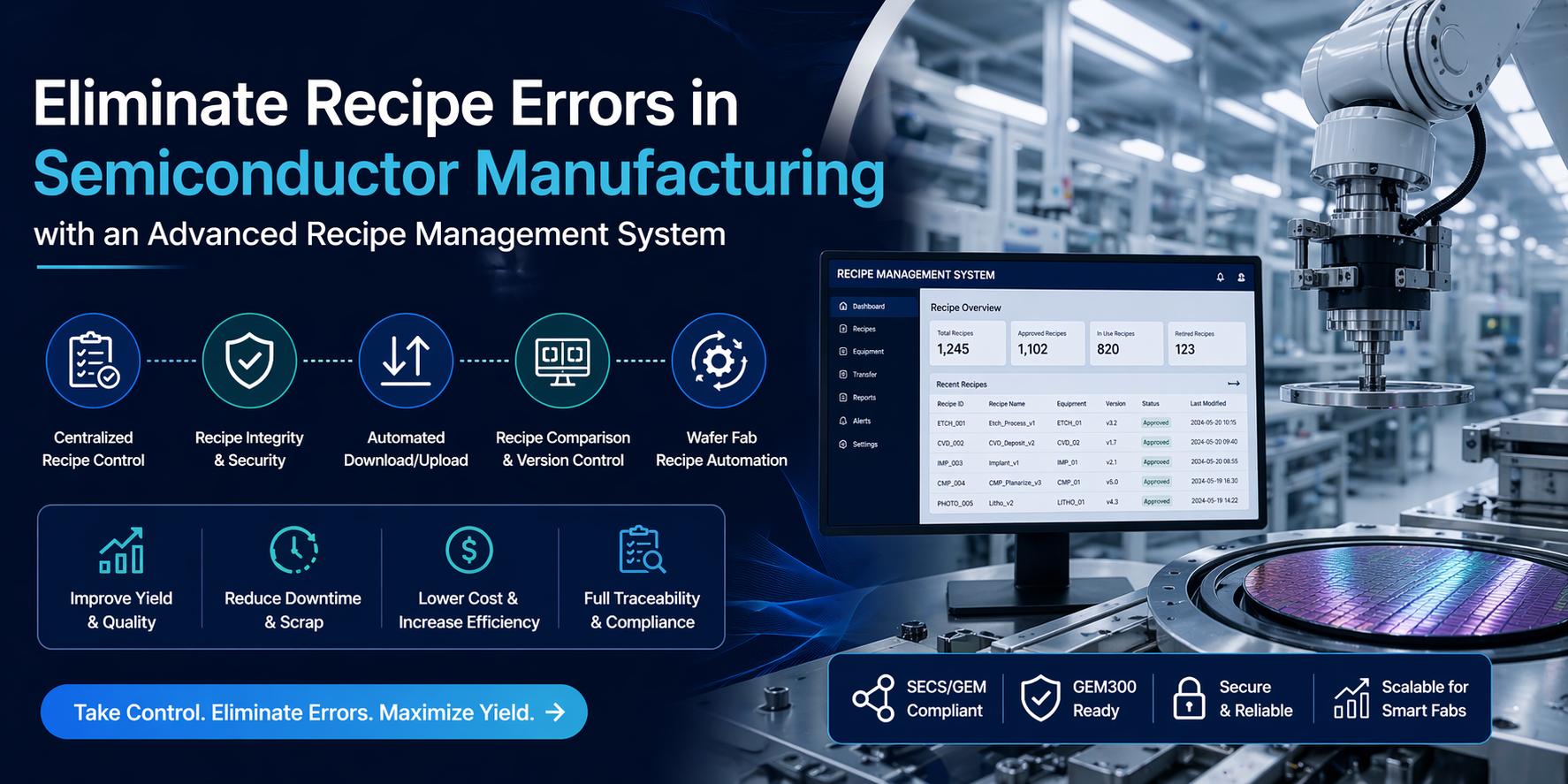
How To Eliminate Recipe Errors In Semiconductor Manufacturing With An Advanced Recipe Management System
Introduction
In modern semiconductor fabs, even a minor recipe mistake can lead to massive yield loss, scrap, and production delays. As processes become more complex and multi-vendor equipment environments grow, manual recipe handling is no longer sustainable. This is where a Semiconductor recipe management system becomes critical.
A robust Semiconductor recipe management software solution ensures that the right recipe is applied to the right tool at the right time—every time. Without it, fabs risk inconsistencies, human errors, and costly downtime. Today’s leading manufacturers are moving toward automated, intelligent solutions that bring control, traceability, and standardization across the factory.
This blog explains how a modern Recipe management system for semiconductor manufacturing eliminates recipe-related errors while improving yield, efficiency, and compliance.
Why Recipe Errors Are a Major Challenge
Semiconductor manufacturing involves hundreds of process steps, each requiring precise parameters. Recipes define these parameters, and any mismatch can result in defective wafers.
Common causes of recipe errors include:
- Manual recipe selection or loading
- Lack of version control
- Inconsistent processes across tools
- Human intervention during setup
- Poor communication between systems
Traditional methods fail to provide centralized control. This is why fabs are adopting advanced Recipe control software semiconductor solutions to automate and standardize recipe handling.
By implementing Equipment recipe management semiconductor, manufacturers can eliminate manual dependency and ensure that only validated recipes are used across tools.
What is an Advanced Recipe Management System?
An advanced Semiconductor recipe management system is a centralized platform that manages, controls, validates, and distributes recipes across all equipment in a fab.
It integrates with MES, equipment, and factory systems to enable:
- Centralized recipe storage and version control
- Automated recipe validation
- Secure recipe distribution
- Real-time monitoring and alerts
Modern Semiconductor recipe management software also supports SECS/GEM recipe management, enabling seamless communication between host systems and equipment.
With a strong GEM300 recipe control system, fabs can ensure compliance with industry standards while enabling automation at scale.
Key Features That Eliminate Recipe Errors
1. Centralized Recipe Control
A Recipe management system for semiconductor manufacturing centralizes all recipes in one platform, eliminating inconsistencies across tools.
2. Automated Recipe Validation
Using Semiconductor recipe parameter control, the system validates recipes before execution, ensuring accuracy and compliance.
3. Recipe Integrity Management
Advanced Recipe integrity management semiconductor features prevent unauthorized changes and ensure only approved recipes are used.
4. Automated Download & Upload
With Equipment recipe download/upload automation, recipes are automatically transferred to tools, removing manual errors.
5. Recipe Comparison & Version Control
Built-in Recipe comparison software helps engineers track changes and maintain version history.
6. Standardization Across Processes
Semiconductor process recipe standardization ensures consistency across multiple tools and production lines.
These capabilities make Wafer process recipe management more reliable and efficient, directly improving production outcomes.
Integration with Equipment and Factory Systems
A key advantage of modern Recipe control software semiconductor is its ability to integrate with existing factory infrastructure.
Using SECS/GEM recipe management, the system communicates directly with equipment to:
- Download correct recipes automatically
- Prevent incorrect recipe execution
- Monitor recipe status in real time
With a GEM300 recipe control system, fabs achieve higher levels of automation, including:
- Recipe verification before wafer processing
- Equipment state monitoring
- Automated process control
This level of integration ensures that Equipment recipe management semiconductor is not isolated but fully connected to the smart factory ecosystem.
Automation and Error Prevention
Automation is the foundation of eliminating recipe errors. A modern Semiconductor recipe management system enables Wafer fab recipe control automation, ensuring zero manual intervention.
Key benefits include:
- No wrong recipe loading
- Automatic recipe selection based on lot
- Real-time alerts for mismatches
- Reduced operator dependency
With Equipment recipe download/upload automation, the system ensures that recipes are always synchronized between host and equipment.
Additionally, Semiconductor recipe parameter control guarantees that even small deviations are detected and corrected before processing begins.
Business Impact: Yield, Cost, and Efficiency
Implementing a Semiconductor recipe management software delivers measurable ROI:
1. Improved Yield
Accurate Wafer process recipe management reduces defects and improves product quality.
2. Reduced Scrap and Rework
By eliminating errors, fabs avoid costly material loss.
3. Lower Engineering Effort
Automation reduces manual intervention and troubleshooting time.
4. Faster Time-to-Market
Standardized processes accelerate production cycles.
5. Compliance and Traceability
With Recipe integrity management semiconductor, every recipe change is tracked and auditable.
Overall, a Recipe management system for semiconductor manufacturing transforms operations from reactive to proactive.
Advanced Capabilities with AI and Smart Analytics
Next-generation Recipe control software semiconductor solutions are now integrating AI/ML capabilities.
These systems can:
- Predict potential recipe failures
- Optimize parameters for better yield
- Detect anomalies in real time
Combined with Recipe comparison software and semiconductor, AI-driven insights help engineers make data-driven decisions.
This evolution is redefining Equipment recipe management in semiconductor, making it smarter and more adaptive.
Best Practices for Implementation
To maximize the benefits of a Semiconductor recipe management system, fabs should:
- Ensure seamless SECS/GEM recipe management integration
- Standardize recipes across all tools
- Use automated validation and approval workflows
- Implement strong access control and security
- Continuously monitor and optimize processes
A well-implemented GEM300 recipe control system ensures scalability and long-term success.
Conclusion
Recipe errors are one of the most preventable yet costly issues in semiconductor manufacturing. Manual processes, lack of standardization, and poor system integration are the root causes.
By adopting an advanced Semiconductor recipe management system, fabs can eliminate these challenges entirely. From automated validation to real-time monitoring and Wafer fab recipe control automation, modern solutions provide complete control over recipes.
A powerful Semiconductor recipe management software not only reduces errors but also improves yield, efficiency, and overall factory performance. With capabilities like Equipment recipe download/upload automation, Semiconductor process recipe standardization, and Recipe integrity management semiconductor, manufacturers can achieve zero-error production environments.
In an industry where precision is everything, investing in the right Recipe management system for semiconductor manufacturing is no longer optional—it is essential.