All-in SECS/GEM Solutions For Semiconductor Old & Legacy Equipment
The semiconductor industry moves fast, but many manufacturing facilities still rely on old and legacy equipment that continues to deliver reliable production results. Across wafer fabrication plants, assembly lines, and testing facilities, older semiconductor machines remain essential for daily operations. Replacing these systems with entirely new platforms is often expensive, time-consuming, and operationally risky.
This is where all-in SECS/GEM solutions become valuable for semiconductor manufacturers looking to modernize without replacing their complete infrastructure.
SECS/GEM integration allows legacy semiconductor equipment to communicate with modern factory automation systems, enabling improved monitoring, data collection, process control, and production efficiency. With proper integration, older semiconductor tools can continue operating effectively in Industry 4.0 manufacturing environments.
Why Legacy Semiconductor Equipment Still Matters
Many semiconductor companies still use legacy equipment because these systems are stable, production-proven, and optimized for specific manufacturing processes. Equipment used for wafer inspection, die bonding, packaging, testing, or lithography often remains operational for decades.
However, old semiconductor equipment creates several challenges:
Lack of communication with modern factory systems
- Limited production data visibility
- Difficulty integrating with MES systems
- Unsupported software or hardware
- Obsolete control systems
- High maintenance complexity
- Limited spare part availability
Without proper modernization, these limitations can reduce productivity and increase downtime. Semiconductor manufacturers need a practical solution that extends equipment life while improving connectivity and automation capabilities.
What Are SECS/GEM Solutions?
SECS/GEM stands for Semiconductor Equipment Communications Standard and Generic Equipment Model. These standards are widely used in semiconductor manufacturing for communication between equipment and factory host systems.
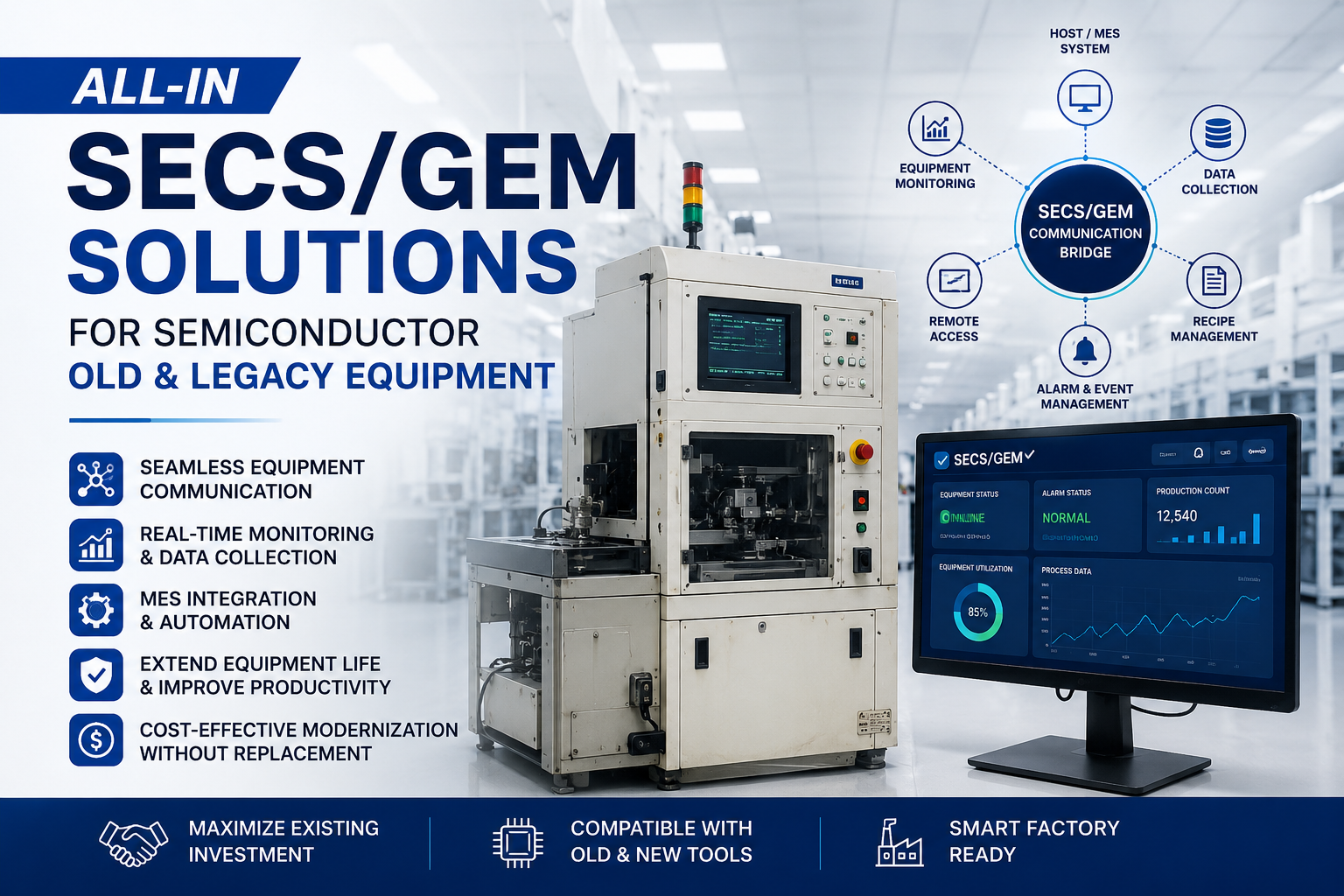
SECS/GEM solutions help semiconductor machines exchange production information such as:
- Equipment status
- Alarm notifications
- Process data
- Recipe management
- Wafer tracking
- Remote commands
- Production reports
Modern semiconductor fabs depend heavily on automated communication between tools and manufacturing execution systems (MES). Legacy equipment often lacks native support for these standards, making integration difficult without customized solutions.
An all-in SECS/GEM solution bridges this gap by enabling older semiconductor machines to operate within modern smart manufacturing environments.
Benefits of SECS/GEM Integration for Old Semiconductor Equipment
Improved Equipment Connectivity
Legacy semiconductor tools can connect with modern factory automation systems through SECS/GEM integration. This creates seamless communication between production equipment and central monitoring platforms.
Manufacturers gain better visibility into machine performance, production status, and operational efficiency.
Extended Equipment Lifespan
Replacing semiconductor manufacturing equipment requires major investment. SECS/GEM retrofitting allows companies to continue using reliable machines while adding modern automation capabilities.
This significantly extends equipment usability and reduces capital expenses.
Better Production Monitoring
Real-time monitoring becomes possible when older semiconductor equipment is connected through SECS/GEM interfaces. Operators can track machine conditions, alarms, process parameters, and production statistics more efficiently.
This helps reduce unexpected downtime and improves preventive maintenance planning.
Easier MES Integration
Manufacturing Execution Systems play a major role in semiconductor production management. Legacy machines often cannot communicate directly with MES platforms.
SECS/GEM solutions provide compatibility between older tools and MES software, improving workflow automation and production control.
Increased Operational Efficiency
Automated communication reduces manual data entry, minimizes human errors, and improves process consistency across semiconductor production lines.
Factories can improve overall equipment effectiveness while reducing operational bottlenecks.
Key Features of All-in SECS/GEM Solutions
Comprehensive SECS/GEM integration services typically include multiple hardware and software capabilities designed specifically for semiconductor legacy equipment.
Equipment Interface Development
Custom interfaces are developed to connect older semiconductor machines with factory host systems. These interfaces enable smooth data exchange and communication standard compliance.
Protocol Conversion
Many old semiconductor tools use proprietary communication protocols. SECS/GEM solutions convert these protocols into industry-standard communication formats compatible with modern systems.
Data Collection Systems
Production data from legacy equipment can be collected, analyzed, and stored for process optimization and quality control purposes.
Alarm and Event Management
Real-time alarm reporting helps operators respond quickly to equipment issues, reducing downtime and improving maintenance response.
Recipe Management Integration
SECS/GEM systems can support recipe upload, download, and validation functions for improved process consistency.
Remote Equipment Monitoring
Factory engineers can monitor equipment performance remotely, improving maintenance efficiency and operational visibility.
Challenges in Legacy Semiconductor Equipment Integration
Integrating older semiconductor equipment is not always straightforward. Each machine may have unique communication architectures, outdated hardware, or undocumented protocols.
Some common integration challenges include:
- Unsupported operating systems
- Proprietary machine communication protocols
- Missing technical documentation
- Obsolete electronic components
- Hardware compatibility limitations
- Limited network connectivity
Experienced SECS/GEM solution providers understand these complexities and develop customized integration strategies based on equipment type and factory requirements.
Importance of Experienced Semiconductor Automation Providers
Successful semiconductor equipment modernization requires deep technical expertise in factory automation, industrial communication protocols, and semiconductor manufacturing processes.
Reliable solution providers typically offer:
- SECS/GEM implementation
- Legacy equipment retrofitting
- Automation engineering
- Protocol conversion
- Equipment software upgrades
- Factory integration support
- Long-term maintenance services
Choosing an experienced semiconductor automation partner helps reduce integration risks and ensures stable production performance.
Future of Legacy Semiconductor Equipment Modernization
As semiconductor manufacturing continues evolving, many companies are adopting hybrid production environments where modern systems coexist with legacy equipment.
Instead of fully replacing older machines, manufacturers increasingly focus on:
- Smart factory integration
- Industrial IoT connectivity
- Real-time analytics
- Predictive maintenance
- Data-driven manufacturing optimization
SECS/GEM solutions play a major role in this transformation by helping older semiconductor equipment become part of connected digital manufacturing ecosystems.
This approach supports cost-effective modernization while protecting existing equipment investments.
Final Thoughts
Old and legacy semiconductor equipment continues to play a critical role in semiconductor manufacturing worldwide. While these machines may lack modern communication capabilities, they can still deliver strong production value when integrated with advanced factory automation systems.
All-in SECS/GEM solutions help semiconductor manufacturers modernize operations without completely replacing reliable legacy tools. From protocol conversion and MES integration to real-time monitoring and automation support, these solutions improve productivity, connectivity, and operational efficiency across semiconductor production facilities.
For semiconductor companies seeking practical modernization strategies, SECS/GEM integration provides a reliable path toward smarter, more connected manufacturing environments while maximizing the value of existing equipment investments.