10 Smart Factory Benefits Of Using A Station Controller
1. Introduction
Modern semiconductor manufacturing depends on more than advanced production equipment. Fabs also need reliable Equipment Connectivity, real-time data, automation, and communication between machines and factory-level software. As production environments become more automated, manufacturers need a structured way to connect equipment with host systems, MES platforms, and other factory applications.
This is where a Station Controller can play an important role.
A Station Controller provides an interface between manufacturing equipment and factory automation systems. It can collect equipment data, alarms, and events while also supporting remote equipment commands. For semiconductor manufacturers, this creates a foundation for connected and data-driven Smart Factory operations.
2. What Is a Station Controller?
A Station Controller is a software platform or application that helps connect manufacturing equipment to factory automation and software systems.
In a semiconductor environment, equipment generates large amounts of operational information, including process parameters, equipment status, alarms, events, and production-related data. A Station Controller helps collect and manage this information and can provide mechanisms for sending authorized commands back to equipment.
For example, a station controller platform can support functions such as:
- Equipment data collection
- Alarm management
- Event monitoring
- Recipe selection
- START, STOP, and ABORT commands
- Factory host communication
- Equipment monitoring and visualization
The exact architecture depends on the factory and equipment requirements. The eInnoSys EIStationController, for example, is designed as a ready-to-deploy station controller and factory host platform for semiconductor fabs and assembly environments.
3. How Does a Station Controller Work?
A simplified Station Controller architecture can be understood as a communication layer between equipment and factory-level systems.
Equipment → Station Controller → Host/EAP → MES/Factory Systems
The equipment produces data, alarms, and events. The Station Controller collects and manages this information according to the configured requirements. The Host or Equipment Automation Program (EAP) can then use the information for factory-level automation and control.
MES operates at a broader manufacturing-management level. It can manage production workflows, work orders, material tracking, recipes, and other manufacturing processes.
A Station Controller therefore should not be viewed as a replacement for MES. Instead, it can help provide the equipment-level connectivity and control required for effective MES Integration and factory automation.
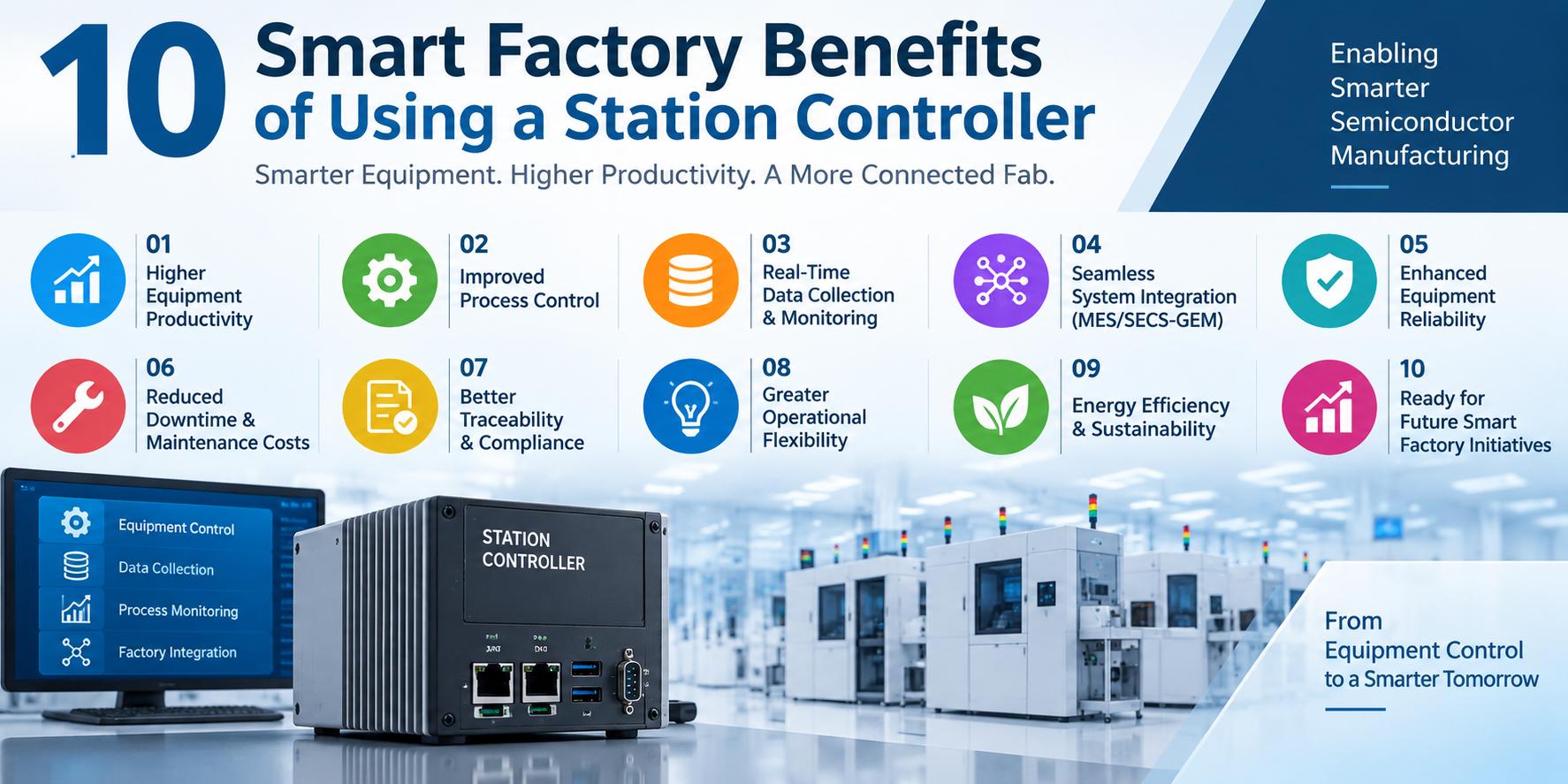
4. 10 Smart Factory Benefits of Using a Station Controller
1. Improved Equipment Connectivity
One of the biggest challenges in semiconductor manufacturing is connecting different types of equipment to factory systems.
A Station Controller provides a structured communication interface between equipment and automation applications. Instead of developing completely different integration approaches for every tool, manufacturers can establish a consistent connectivity layer.
For example, a fab may have process tools from different equipment suppliers. A Station Controller can help bring equipment information into the factory automation environment in a more standardized manner.
Why it matters: Better connectivity creates the foundation for automated manufacturing and centralized equipment visibility.
2. Real-Time Equipment Monitoring
Semiconductor equipment continuously generates operational information. Without timely access to that information, engineers may have limited visibility into equipment conditions.
A Station Controller can collect selected equipment data at configured frequencies and monitor alarms and events. This allows engineers to observe equipment conditions more efficiently.
For example, an engineer could monitor critical process parameters and equipment events from a factory-level monitoring environment rather than relying entirely on manual checks.
Why it matters: Real-time Equipment Monitoring helps teams respond faster to abnormal conditions and make better operational decisions.
3. Faster Factory Automation
Factory automation requires reliable communication between equipment and higher-level systems.
A Station Controller can provide functions needed for equipment automation, including data collection, event handling, and remote commands. This can reduce the amount of custom integration work required for individual tools.
For instance, automated workflows may use equipment communication to support recipe selection or production-related commands.
Why it matters: A consistent connectivity layer can simplify automation projects and help engineering teams deploy automation across more equipment.
4. Standardized Equipment Communication
Different equipment can expose different interfaces, data structures, and operational behaviors. Standardization is therefore important for scalable Semiconductor Equipment Automation.
Station Controller solutions designed around SEMI standards can help establish consistent communication practices across equipment and factory systems. EIStationController, for example, is described by eInnoSys as a SEMI-compliant equipment integration application supporting standardized communication.
Why it matters: Standardized communication can improve interoperability and reduce integration complexity.
5. Reduced Manual Intervention
Manual equipment operations can consume engineering and operator time and may introduce opportunities for human error.
A Station Controller can automate selected equipment interactions. Depending on the implementation, users can configure data collection, alarm handling, event monitoring, and remote commands such as recipe selection, START, STOP, and ABORT.
For example, instead of manually checking multiple machines for equipment status, factory personnel can access centralized information.
Why it matters: Reducing unnecessary manual intervention supports more consistent and efficient Smart Manufacturing workflows.
6. Better Data Visibility
Data is one of the most valuable resources in a modern semiconductor fab. However, data is only useful when it can be collected, organized, and accessed effectively.
A Station Controller can provide visibility into equipment parameters, alarms, events, and operational conditions.
Consider a production line where several tools experience intermittent alarms. Centralized equipment information can help engineers identify when events occurred and examine associated equipment data.
Why it matters: Better data visibility supports troubleshooting, process analysis, maintenance planning, and operational decision-making.
7. Easier MES/Host Integration
MES systems manage manufacturing processes at a factory level, while equipment requires dedicated communication and control mechanisms.
A Station Controller can help bridge equipment-level communication with host and factory systems. This makes it easier to incorporate equipment data and commands into broader automation workflows.
For example, equipment events collected by the Station Controller can become part of a factory automation workflow managed by host applications.
Why it matters: Effective MES Integration depends on reliable equipment communication. A Station Controller can provide an important connectivity layer without attempting to replace the MES itself.
8. Improved Equipment Control
Monitoring is only one part of factory automation. Modern factories also need controlled interaction with equipment.
A Station Controller can support remote commands based on equipment capabilities and factory requirements. EIStationController, for example, includes support for PP_SELECT for recipe selection as well as START, STOP, and ABORT commands.
This can enable authorized users or automation systems to interact with equipment without always requiring physical intervention at the machine.
Why it matters: Controlled remote operation can support automated production workflows and improve operational flexibility.
9. Support for Legacy Equipment
Many semiconductor facilities operate equipment that was installed years or even decades ago. Replacing functional equipment simply because it lacks modern connectivity can be expensive and disruptive.
A Station Controller can be part of a modernization strategy by providing a connectivity and automation layer around existing equipment, depending on the equipment's available interfaces and integration requirements.
This allows manufacturers to explore ways to connect older machines with newer factory systems without necessarily replacing the complete tool.
Why it matters: Legacy modernization can extend the useful life of equipment while improving factory connectivity.
10. Scalable Smart Factory Infrastructure
A Smart Factory is rarely built in a single step. Manufacturers often start with a small number of machines and gradually expand automation.
A Station Controller platform can support this incremental approach. Once a suitable architecture is established, additional equipment and production lines can potentially be integrated using the same overall connectivity strategy.
EIStationController is designed for semiconductor fabs and assembly environments and supports Windows, Linux, and Raspberry Pi platforms, providing flexibility for different deployment environments.
Why it matters: A scalable architecture allows manufacturers to expand automation without redesigning the entire connectivity strategy every time new equipment is added.
5. Station Controller and SECS/GEM
It is important to distinguish between a Station Controller, SECS/GEM, Host/EAP, and MES because they serve different roles.
Station Controller
A Station Controller is an application or platform used to connect, monitor, and control manufacturing equipment within a factory automation architecture.
SECS/GEM
SECS/GEM refers to semiconductor equipment communication standards and protocols used for communication between semiconductor equipment and host systems. It provides standardized mechanisms for equipment data collection, alarms, events, remote commands, and other equipment-host interactions.
SECS/GEM and a Station Controller are therefore not the same technology. SECS/GEM defines standardized equipment communication, while a Station Controller can use or implement such communication capabilities as part of a broader equipment integration and automation solution.
Host/EAP
The Host or Equipment Automation Program operates at the factory automation level and communicates with equipment to coordinate automated manufacturing processes.
MES
MES manages broader manufacturing operations such as production workflows, material tracking, scheduling, and manufacturing records.
In a typical architecture, these technologies and systems work together rather than replacing one another.
6. Station Controller for Legacy Equipment
Legacy equipment is a common challenge in semiconductor manufacturing. Older machines may still perform valuable production functions but lack the connectivity expected by modern Smart Factory systems.
A Station Controller can help provide an integration layer between such equipment and newer automation infrastructure.
Depending on the equipment interface, the solution may collect available data, monitor alarms and events, and provide appropriate control functions. This can support modernization while reducing the need for a complete equipment replacement.
For fabs with large installed equipment bases, this approach can be especially useful when modernization needs to happen gradually.
7. Why Station Controllers Matter for Semiconductor OEMs
For a Semiconductor Equipment OEM, connectivity is increasingly part of the equipment value proposition.
OEMs need to consider how their equipment will communicate with customer factory systems, MES platforms, host applications, and automation infrastructure.
A Station Controller approach can support OEMs by helping provide:
- Faster equipment integration
- Standardized communication
- Easier access to equipment data
- Remote equipment control
- Simplified factory automation
- Scalable deployment across multiple tools
- Reduced integration and maintenance effort
A standardized connectivity architecture can also help OEM engineering teams build equipment that is better prepared for connected manufacturing environments.
8. Conclusion
The transition toward the Smart Factory is driven by connectivity, automation, data visibility, and intelligent equipment management. A Station Controller can serve as an important part of this architecture by connecting manufacturing equipment with factory-level automation and software systems.
From improved Equipment Connectivity and real-time monitoring to remote control, MES Integration, legacy equipment modernization, and scalable Factory Automation, the benefits extend across both semiconductor fabs and equipment OEM environments.
Station Controllers do not replace technologies such as SECS/GEM or MES. Instead, they can work alongside these technologies to create a more connected equipment-to-factory architecture.
For semiconductor manufacturers looking to build a practical path toward Smart Manufacturing, a well-designed Station Controller can provide a valuable foundation for connecting equipment, collecting data, and enabling automation at scale.