10 Reasons Semiconductor Fabs Need A Fully SEMI-Compliant Station Controller
Modern semiconductor manufacturing demands high equipment availability, seamless factory communication, and standardized automation across hundreds of process tools. As fabs continue adopting Industry 4.0 initiatives, integrating equipment from multiple vendors while maintaining compliance with SEMI standards has become increasingly challenging.
This is where a SEMI-compliant Station Controller plays a critical role.
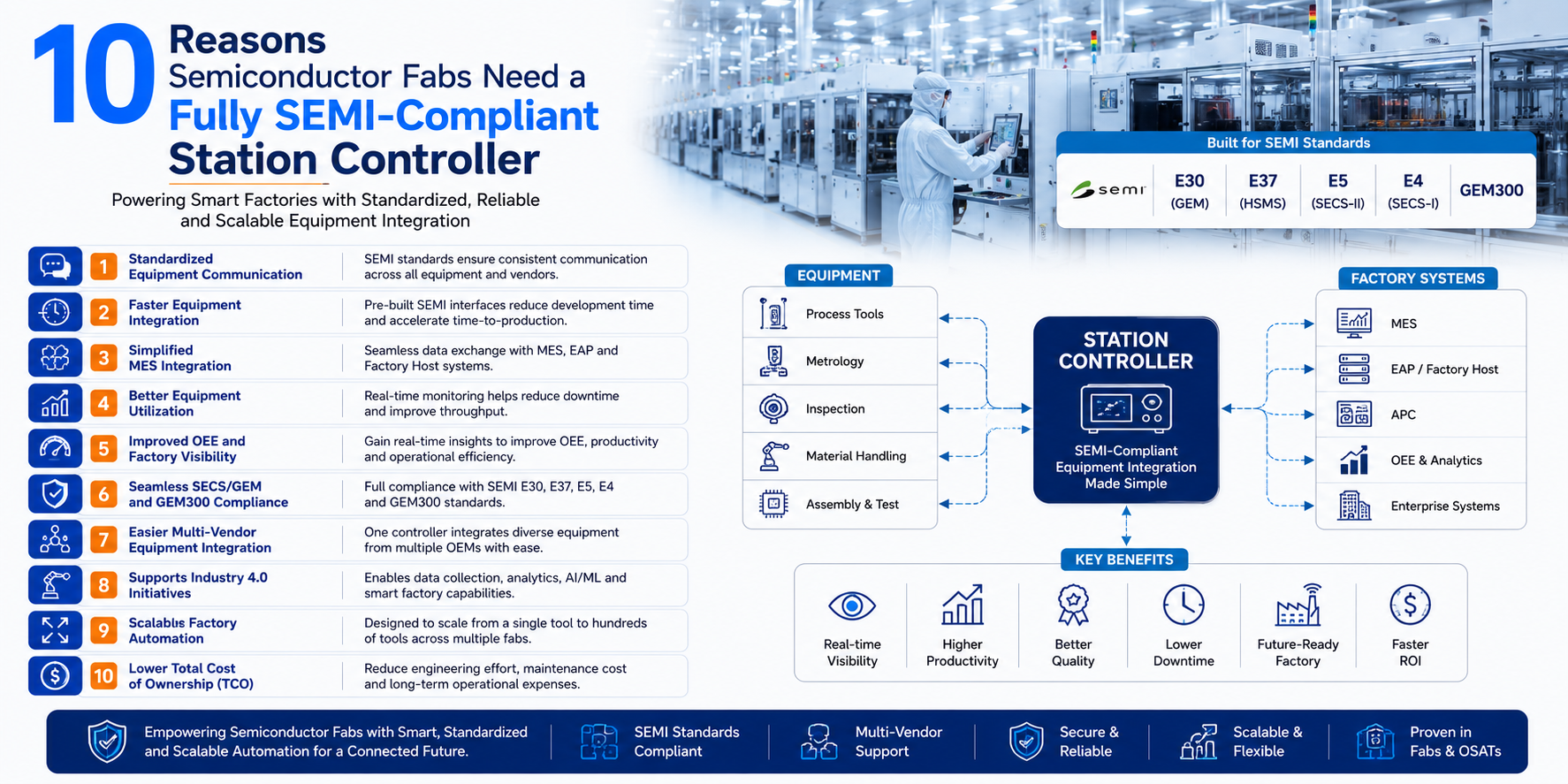
A Station Controller acts as the bridge between manufacturing equipment and factory systems, enabling standardized communication, equipment automation, recipe execution, data collection, and real-time integration with MES, EAP, APC, and Factory Host applications.
Whether you're building a new fab or modernizing an existing production line, investing in a fully SEMI-compliant Station Controller can significantly reduce engineering effort, improve equipment utilization, and accelerate smart manufacturing initiatives.
Let's explore the top ten reasons why.
What Is a Station Controller?
A Station Controller is an equipment integration application that communicates with semiconductor manufacturing equipment and factory-level systems using SEMI standards such as:
- SEMI E30 (GEM)
- SEMI E37 (HSMS)
- SEMI E5 (SECS-II)
- SEMI E4 (SECS-I)
- GEM300 standards for 300mm fabs
It enables equipment to exchange production information, alarms, events, recipes, process data, and control commands with Manufacturing Execution Systems (MES), Equipment Automation Programs (EAP), Factory Hosts, and enterprise applications.
1. Standardized Equipment Communication
Every semiconductor fab operates equipment from multiple OEMs.
Each tool may use different communication methods, making integration expensive and time-consuming.
A fully SEMI-compliant Station Controller standardizes communication using SECS/GEM protocols, enabling every equipment to communicate in the same language regardless of manufacturer.
Benefits include:
- Consistent equipment communication
- Simplified integration
- Reduced engineering effort
- Easier factory expansion
2. Faster Equipment Integration
Traditional equipment integration projects often take months because engineers must develop custom interfaces for every machine.
A Station Controller provides standardized communication interfaces that dramatically reduce implementation time.
Instead of writing custom software for every equipment, engineers configure the Station Controller and connect equipment using existing SEMI standards.
Result:
- Faster project completion
- Reduced implementation risk
- Lower engineering costs
3. Simplified MES Integration
Manufacturing Execution Systems rely on real-time equipment communication.
A Station Controller provides seamless integration between manufacturing equipment and MES by exchanging:
- Lot information
- Recipe selection
- Equipment status
- Production events
- Alarm notifications
- Process data
This eliminates manual data collection and improves production traceability.
4. Better Equipment Utilization
Idle equipment directly impacts fab profitability.
A Station Controller continuously monitors equipment states such as:
- Idle
- Running
- Maintenance
- Alarm
- Offline
This information helps production teams identify bottlenecks and maximize equipment utilization.
Benefits include:
- Reduced idle time
- Increased throughput
- Higher productivity
5. Improved OEE and Factory Visibility
Modern semiconductor fabs require complete visibility into equipment performance.
A Station Controller collects production data that can be used to calculate:
- Availability
- Performance
- Quality
- Overall Equipment Effectiveness (OEE)
Real-time dashboards enable production managers to identify problems before they impact yield.
6. Seamless SECS/GEM and GEM300 Compliance
SEMI compliance is essential for modern fabs.
A fully compliant Station Controller supports:
- SECS-I
- SECS-II
- GEM
- HSMS
- GEM300
This ensures equipment can communicate with factory automation systems while meeting customer acceptance requirements.
7. Easier Multi-Vendor Equipment Integration
Most fabs operate equipment from multiple OEMs.
Without a common integration platform, engineers must maintain different communication methods for every tool.
A Station Controller provides a single standardized integration layer that simplifies communication across:
- Process equipment
- Metrology systems
- Inspection tools
- Material handling equipment
- Assembly tools
- Packaging equipment
8. Supports Industry 4.0 Initiatives
Digital manufacturing requires connected equipment.
A Station Controller becomes the foundation of Industry 4.0 by enabling:
- Real-time equipment monitoring
- Equipment data collection
- Predictive analytics
- AI/ML applications
- Digital dashboards
- Factory-wide automation
This enables smarter manufacturing decisions based on live production data.
9. Scalable Factory Automation
As production expands, adding new equipment should not require rebuilding integration software.
A Station Controller offers a scalable architecture capable of supporting:
- Hundreds of equipment
- Multiple production lines
- New fabs
- Additional MES systems
- Enterprise applications
This future-proofs automation investments.
10. Lower Total Cost of Ownership (TCO)
Developing and maintaining custom equipment integration software requires significant engineering resources.
A commercial, fully SEMI-compliant Station Controller reduces costs by providing:
- Standardized architecture
- Proven communication modules
- Faster deployment
- Easier maintenance
- Simplified upgrades
- Vendor support
Organizations benefit from lower implementation costs and faster return on investment.
Key Features to Look for in a Station Controller
When evaluating a Station Controller, ensure it offers:
- Full SEMI E30 (GEM) compliance
- SECS-I and HSMS support
- GEM300 capability
- Real-time equipment monitoring
- Recipe management integration
- Alarm management
- OEE dashboards
- MES integration
- Factory Host integration
- Multi-equipment scalability
- Role-based security
- Comprehensive event logging
- High availability
- Easy configuration
- API support
Why Choose eInnoSys StationController?
eInnoSys StationController is designed specifically for semiconductor fabs and OSAT facilities seeking reliable, standards-based equipment integration.
Key capabilities include:
- Fully SEMI-compliant architecture
- Seamless SECS/GEM integration
- MES & EAP connectivity
- OEE and production analytics
- Alarm Management
- Equipment data collection
- Recipe management integration
- Multi-vendor equipment support
- Factory automation readiness
- Scalable deployment for fabs and assembly operations
Whether integrating a few tools or an entire semiconductor production line, eInnoSys StationController helps manufacturers simplify automation while accelerating digital transformation.
Conclusion
Semiconductor manufacturing is becoming increasingly connected, automated, and data-driven. A fully SEMI-compliant Station Controller provides the standardized communication layer needed to connect equipment, simplify MES integration, improve factory visibility, and support Industry 4.0 initiatives.
By reducing engineering complexity, improving equipment utilization, and enabling scalable automation, a Station Controller becomes a strategic investment for fabs and OSAT facilities looking to enhance productivity and remain competitive.
As semiconductor production continues to evolve, choosing a robust, standards-compliant Station Controller ensures your factory is prepared for future expansion, advanced analytics, and smart manufacturing.