
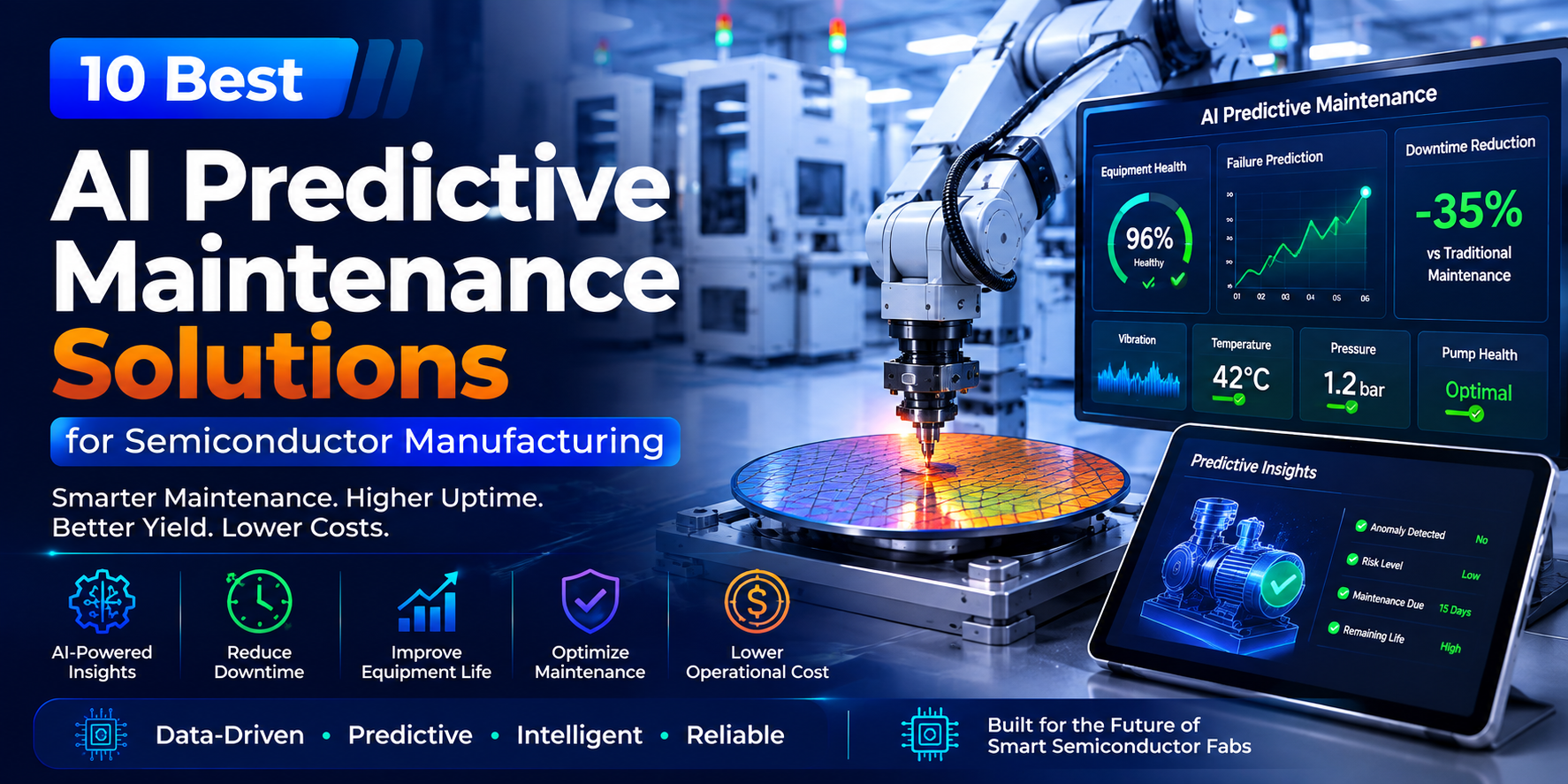
10 Best AI Predictive Maintenance Solutions For Semiconductor Manufacturing
Semiconductor manufacturing depends on highly complex equipment operating continuously and within extremely tight process tolerances. Even a small equipment abnormality can lead to unplanned downtime, wafer loss, reduced throughput, or yield impact.
This is why AI predictive maintenance is becoming increasingly important for semiconductor fabs, OSAT facilities, and equipment manufacturers.
Unlike traditional preventive maintenance, which follows fixed schedules, AI predictive maintenance analyzes equipment data, operating conditions, historical behavior, and machine-learning patterns to identify early signs of degradation or failure. Modern predictive maintenance platforms can help maintenance teams move from reactive troubleshooting to proactive equipment management.
In this article, we explore 10 leading AI predictive maintenance solutions that manufacturing organizations should consider when building a smarter, more reliable maintenance strategy.
What Is AI Predictive Maintenance?
AI predictive maintenance uses artificial intelligence and machine learning to monitor equipment health, detect abnormal behavior, identify potential failure modes, and help maintenance teams determine when intervention may be required.
For semiconductor manufacturing, this can be particularly valuable for equipment such as:
- Vacuum pumps
- Etch and deposition equipment
- Wafer handling systems
- Lithography equipment
- CMP systems
- Furnaces
- Chillers and HVAC systems
- Robotic systems
- Process-control equipment
- Critical facility infrastructure
The objective is not simply to generate more alarms. A successful predictive maintenance program should provide actionable information that helps engineers reduce unplanned downtime, improve equipment availability, optimize maintenance schedules, and protect production.
1. eInnoSys XPump
Best for: Semiconductor vacuum pump monitoring and AI/ML-based predictive maintenance
eInnoSys XPump is designed specifically for monitoring vacuum pump health in semiconductor manufacturing environments.
XPump uses AI/ML-based analytics to analyze pump operating data and identify abnormal conditions that may indicate developing equipment problems.
For semiconductor fabs, vacuum pumps are critical assets across many process applications. Detecting deterioration before a pump failure can help maintenance teams plan intervention instead of responding to unexpected equipment downtime.
Key capabilities include:
- AI/ML-based pump health monitoring
- Predictive equipment analytics
- Early detection of abnormal behavior
- Equipment condition monitoring
- Historical trend analysis
- Support for proactive maintenance decisions
Why consider it: Unlike broad industrial platforms, XPump provides a focused approach for organizations where vacuum pump reliability is critical to semiconductor production.
2. Siemens Senseye Predictive Maintenance
Best for: Enterprise-scale predictive maintenance
Siemens Senseye is a cloud-based predictive maintenance platform designed to forecast machine failures and prioritize maintenance risks. It can work with data from legacy machines, historians, IoT platforms, and sensors, making it suitable for organizations with diverse equipment environments.
For large semiconductor organizations, its ability to work across multiple assets and sites can be valuable when developing an enterprise-wide predictive maintenance program.
3. IBM Maximo Predict
Best for: Predictive maintenance integrated with enterprise asset management
IBM Maximo Predict uses AI and operational data, maintenance records, inspections, and environmental information to predict asset degradation, downtime, and potential failures.
It can be particularly attractive for manufacturers already using the IBM Maximo ecosystem and looking to connect predictive analytics with broader asset-management workflows.
4. Augury Machine Health
Best for: AI-based machine health monitoring
Augury's Machine Health platform combines continuous machine monitoring, AI diagnostics, and expert support to identify developing machine problems. The company reports monitoring hundreds of thousands of machines across industrial environments.
It can be useful for manufacturers looking for broad machine-health monitoring across multiple asset types.
5. C3 AI Reliability
Best for: Enterprise AI and asset reliability programs
C3 AI provides enterprise AI applications designed for industrial use cases, including predictive maintenance and asset reliability.
Its approach is suitable for organizations looking to apply AI across large volumes of operational data and integrate predictive insights into broader digital-transformation initiatives.
For semiconductor manufacturers, the platform can be considered when predictive maintenance is part of a wider enterprise AI strategy.
6. AVEVA Predictive Analytics
Best for: Industrial data and operational analytics
AVEVA's industrial software ecosystem connects operational data, historians, engineering information, and analytics.
Predictive analytics capabilities can help manufacturers identify abnormal equipment behavior and potential failure conditions.
For semiconductor fabs with extensive process and equipment data, platforms within the AVEVA ecosystem can be useful for connecting predictive analytics with existing industrial information infrastructure.
7. GE Vernova APM
Best for: Asset performance management
GE Vernova's Asset Performance Management approach combines asset information, condition monitoring, reliability analytics, and maintenance strategies.
This type of platform is useful for organizations managing large and complex asset portfolios where equipment reliability, risk management, and maintenance planning need to be addressed together.
8. Honeywell Forge
Best for: Connected industrial operations
Honeywell Forge provides an industrial digital platform that brings together operational information, analytics, and asset performance capabilities.
For manufacturing organizations already operating within the Honeywell ecosystem, it can provide a foundation for connected equipment monitoring and data-driven maintenance.
9. PTC ThingWorx
Best for: IoT-connected predictive maintenance
PTC ThingWorx provides industrial IoT capabilities that can connect machines, collect equipment data, and support analytics-driven applications.
For semiconductor equipment environments, an IoT platform can provide the data foundation required for predictive maintenance applications, particularly when equipment data needs to be collected from heterogeneous systems.
10. SKF Predictive Maintenance Solutions
Best for: Condition monitoring and rotating equipment
SKF offers condition-monitoring and predictive-maintenance technologies focused heavily on rotating equipment and machinery health.
Its solutions can be useful for manufacturers monitoring bearings, motors, rotating assemblies, and other mechanical assets where vibration and condition data provide important indicators of equipment health.
AI Predictive Maintenance Solutions Comparison
| Solution | Primary Strength | Semiconductor Relevance |
|---|
| eInnoSys XPump | Vacuum pump predictive maintenance | ⭐⭐⭐⭐⭐ |
| Siemens Senseye | Enterprise predictive maintenance | ⭐⭐⭐⭐ |
| IBM Maximo Predict | EAM + predictive analytics | ⭐⭐⭐⭐ |
| Augury | AI machine health | ⭐⭐⭐⭐ |
| C3 AI Reliability | Enterprise AI | ⭐⭐⭐⭐ |
| AVEVA | Industrial analytics | ⭐⭐⭐⭐ |
| GE Vernova APM | Asset performance management | ⭐⭐⭐ |
| Honeywell Forge | Connected operations | ⭐⭐⭐ |
| PTC ThingWorx | Industrial IoT | ⭐⭐⭐ |
| SKF | Condition monitoring | ⭐⭐⭐ |
Suitability depends on the fab's equipment mix, data infrastructure, integration requirements, and maintenance strategy.
How to Choose an AI Predictive Maintenance Solution
Semiconductor manufacturers should evaluate more than the AI model itself. The quality and accessibility of equipment data are equally important.
Before selecting a platform, consider:
1. Equipment Compatibility
Can the solution collect data from your existing semiconductor equipment, sensors, PLCs, historians, and factory systems?
2. Data Integration
Look for support for industrial connectivity and protocols relevant to your environment, including SECS/GEM, OPC UA, MQTT, Modbus, and other equipment interfaces.
3. AI and Machine Learning
Evaluate whether the system can identify anomalies, equipment degradation, trends, and potential failure patterns rather than simply displaying historical data.
4. Real-Time Monitoring
Predictive maintenance becomes more valuable when equipment conditions can be monitored continuously and maintenance teams can act on emerging problems.
5. Actionable Alerts
Too many false alerts can lead to alert fatigue. The platform should help maintenance engineers prioritize significant equipment risks.
6. Scalability
A solution should be capable of expanding from a pilot asset to multiple equipment types, production lines, and fab locations.
7. Semiconductor-Specific Expertise
Generic industrial predictive maintenance platforms can be useful, but semiconductor manufacturing has unique equipment, process, uptime, and contamination requirements. Industry-specific expertise can significantly improve implementation and outcomes.
Why AI Predictive Maintenance Matters for Semiconductor Fabs
The semiconductor industry is becoming increasingly data-driven. Equipment generates enormous quantities of operational information, but collecting data alone does not guarantee better maintenance decisions.
AI predictive maintenance converts equipment data into actionable equipment-health insights.
When implemented correctly, it can help fabs:
- Reduce unplanned equipment downtime
- Improve equipment availability
- Detect developing failures earlier
- Optimize maintenance schedules
- Reduce unnecessary preventive maintenance
- Improve maintenance planning
- Extend equipment/component life
- Protect production throughput
- Support higher OEE
- Build smarter, more autonomous manufacturing operations
However, successful implementation depends on reliable data, appropriate equipment connectivity, domain expertise, and a maintenance workflow that allows engineers to act on predictive insights.
Final Thoughts
There is no single best AI predictive maintenance solution for every semiconductor manufacturer.
Large enterprises may benefit from platforms such as Siemens Senseye, IBM Maximo Predict, Augury, or other enterprise-scale solutions. Organizations building broader industrial IoT strategies may consider platforms such as AVEVA or PTC ThingWorx.
For semiconductor manufacturers with a specific focus on vacuum pump health and predictive monitoring, eInnoSys XPump provides a specialized approach that aligns directly with a critical equipment category in semiconductor fabs.
The most effective strategy is to start with high-value, failure-critical assets, establish reliable equipment data collection, apply AI/ML analytics, and then expand predictive maintenance across the manufacturing environment.
As semiconductor manufacturing becomes more connected and autonomous, AI predictive maintenance will play an increasingly important role in improving equipment reliability, productivity, and factory performance.