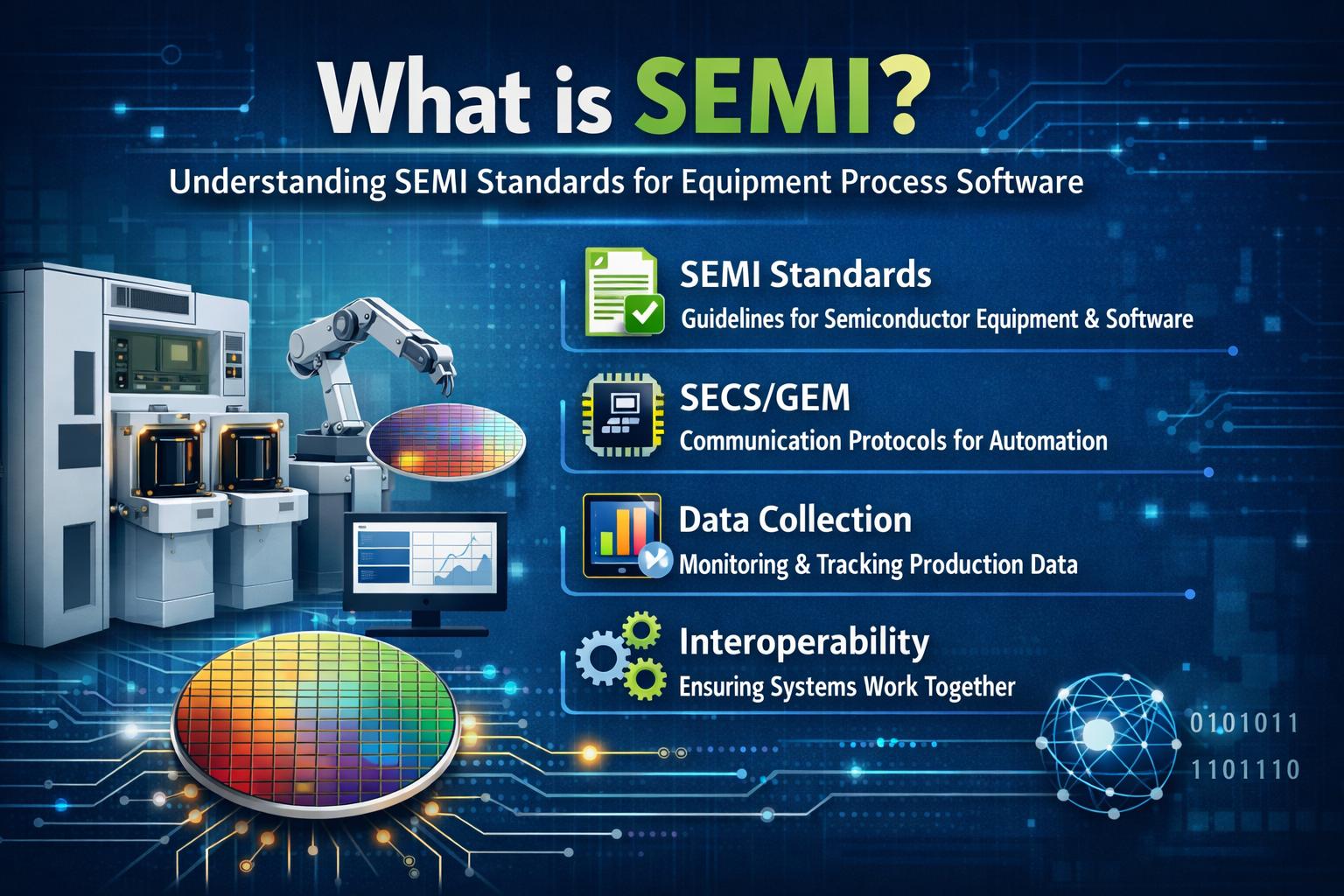
What Is SEMI? Understanding SEMI Standards For Equipment Process Software
The semiconductor industry runs on precision. Tight tolerances. Complex workflows. Zero room for miscommunication. And that’s exactly where SEMI Standards step in.
If you’ve ever worked in fab automation or equipment integration, you’ve probably heard the term thrown around. But still, many ask — What is SEMI? Why does it matter so much?
Let’s break it down. Clearly. Practically. No fluff.
What is SEMI?
What is SEMI? It refers to SEMI, a global industry association that develops technical standards for semiconductor manufacturing.
Simple idea. Big impact.
SEMI creates a common language. A rulebook. A framework that allows equipment, software, and factory systems to communicate without confusion. Without custom hacks. Without endless integration issues.
These SEMI Semiconductor Standards define how machines behave, how data flows, and how factories operate efficiently at scale.
Think of it like traffic rules. Without them, chaos. With them, flow.
Why SEMI Standards Matter in Semiconductor Manufacturing
Modern fabs are not just manufacturing plants. They are highly automated ecosystems.
Hundreds of tools. Thousands of signals. Continuous data exchange.
Without SEMI Equipment Standards, every equipment vendor would follow a different protocol. Integration would become slow. Expensive. Risky.
That’s why SEMI Standards in Semiconductor manufacturing are critical:
Ensure interoperability between tools and systems
- Enable faster equipment integration
- Reduce development time and cost
- Improve production efficiency and traceability
- Support advanced automation and smart factories
In short — they make factories smarter. And scalable.
Core SEMI Standards You Should Know
There are dozens of SEMI standards. But a few are foundational for equipment process software and automation.
Let’s look at the most important ones.
1. SEMI E30 Standard (GEM)
The SEMI E30 standard defines the GEM (Generic Equipment Model).
This is the backbone of equipment communication.
GEM standardizes how equipment is exposed:
- Data collection variables
- Alarms and events
- Remote commands
- Equipment states
It enables consistent behavior across different tools.
So when engineers ask What is SEMI in practical terms — GEM is usually the answer they are looking for.
It’s the reason one host system can control multiple equipment types without rewriting logic every time.
2. SEMI E37 Standard (HSMS Communication)
The SEMI E37 standard defines HSMS (High-Speed SECS Message Services).
This replaces older serial communication with TCP/IP-based communication.
Faster. More reliable. Scalable.
HSMS communication is essential for modern fabs because:
- It supports high data volumes
- Enables real-time monitoring
- Works over standard network infrastructure
Combined with GEM, it forms a powerful communication layer for equipment communication in semiconductor environments.
3. SECS/GEM Protocol
The SECS/GEM protocol is the combination of:
SECS (message structure and transport)
GEM (behavior model defined by SEMI E30 standard)
Together, they enable seamless communication between equipment and host systems.
This is where SEMI Semiconductor Standards become real.
You can:
- Collect production data
- Trigger alarms
- Send commands
- Monitor tool status
- All in a standardized way.
No guesswork. No vendor dependency.
4. GEM300 Standards
GEM300 is a set of advanced standards built on top of GEM.
It is mainly used in 300mm fabs and highly automated environments.
GEM300 includes standards for:
- Wafer tracking
- Carrier management
- Material handling
- Process job management
These SEMI Equipment Standards are essential for fully automated fabs where human intervention is minimal.
If you are working on advanced factory automation semiconductor solutions, GEM300 is not optional. It’s required.
How SEMI Standards Enable Equipment Process Software
Now let’s connect this to software.
Because this is where things get interesting.
Equipment process software sits between:
- Physical equipment
- Factory systems (MES, SCADA, analytics)
Without SEMI Standards in Semiconductor, this layer becomes messy.
Custom integrations. Hardcoded logic. Endless debugging.
With SEMI standards, software becomes:
- Modular
- Scalable
- Vendor-independent
For example:
Using SECS/GEM protocol, software can easily:
Subscribe to equipment events
- Collect process data
- Trigger workflows
- Integrate with MES
This makes MES integration of semiconductor systems smoother and faster.
No need to reinvent the wheel every time.
Real-World Impact on Factory Automation
Let’s talk reality.
In a typical fab:
- Multiple equipment vendors
- Different generations of tools
- Complex production workflows
Without SEMI Semiconductor Standards, integrating all of this would take months. Sometimes years.
But with standardized communication:
Equipment connects faster
Data becomes consistent
Automation workflows become reliable
This directly impacts:
- OEE (Overall Equipment Effectiveness)
- Downtime reduction
- Production yield
That’s why SEMI Equipment Standards are not just technical guidelines. They are business enablers.
Challenges in Implementing SEMI Standards
Of course, it’s not always easy.
Implementing SEMI Standards comes with challenges:
- Understanding complex specifications
- Handling legacy equipment
- Ensuring compliance across vendors
- Testing and validation of communication
Even though the standards exist, real-world implementation requires expertise.
Deep domain knowledge.
That’s where experienced engineering teams make a difference.
Because knowing What is SEMI is one thing. Implementing it correctly is another.
Best Practices for SEMI Standard Implementation
If you are working on equipment integration or automation, here are a few practical tips:
- Start with SEMI E30 standard compliance for GEM
- Use HSMS (SEMI E37 standard) instead of serial communication
- Validate SECS/GEM communication using host simulators
- Plan for GEM300 if targeting advanced fabs
- Ensure seamless MES integration semiconductor workflows
- Use scalable architecture for long-term growth
Keep it simple. Keep it standard.
The Future of SEMI Standards in Smart Manufacturing
The industry is evolving fast.
AI. Machine learning. Predictive maintenance. Digital twins.
All of these rely on data.
And data depends on standardized communication.
That’s why SEMI Standards in Semiconductor will continue to play a critical role in:
- Smart factories
- Industry 4.0 adoption
- Real-time analytics
Autonomous manufacturing systems
Without standardization, none of these scales.
So yes, SEMI is not just relevant. It’s foundational.
Conclusion
So, What is SEMI?
It’s more than an organization. It’s the backbone of semiconductor automation.
SEMI Standards define how equipment talks. How systems interact. How factories operate.
From SEMI E30 standard (GEM) to SEMI E37 standard (HSMS communication), from SECS/GEM protocol to GEM300 standards, these frameworks make modern semiconductor manufacturing possible.
They simplify integration. Improve efficiency. Enable scalability.
And most importantly, they turn complex factories into connected, intelligent ecosystems.
If you’re building or managing equipment process software, understanding SEMI Semiconductor Standards is not optional.
It’s essential.
Because in this industry, communication is everything.