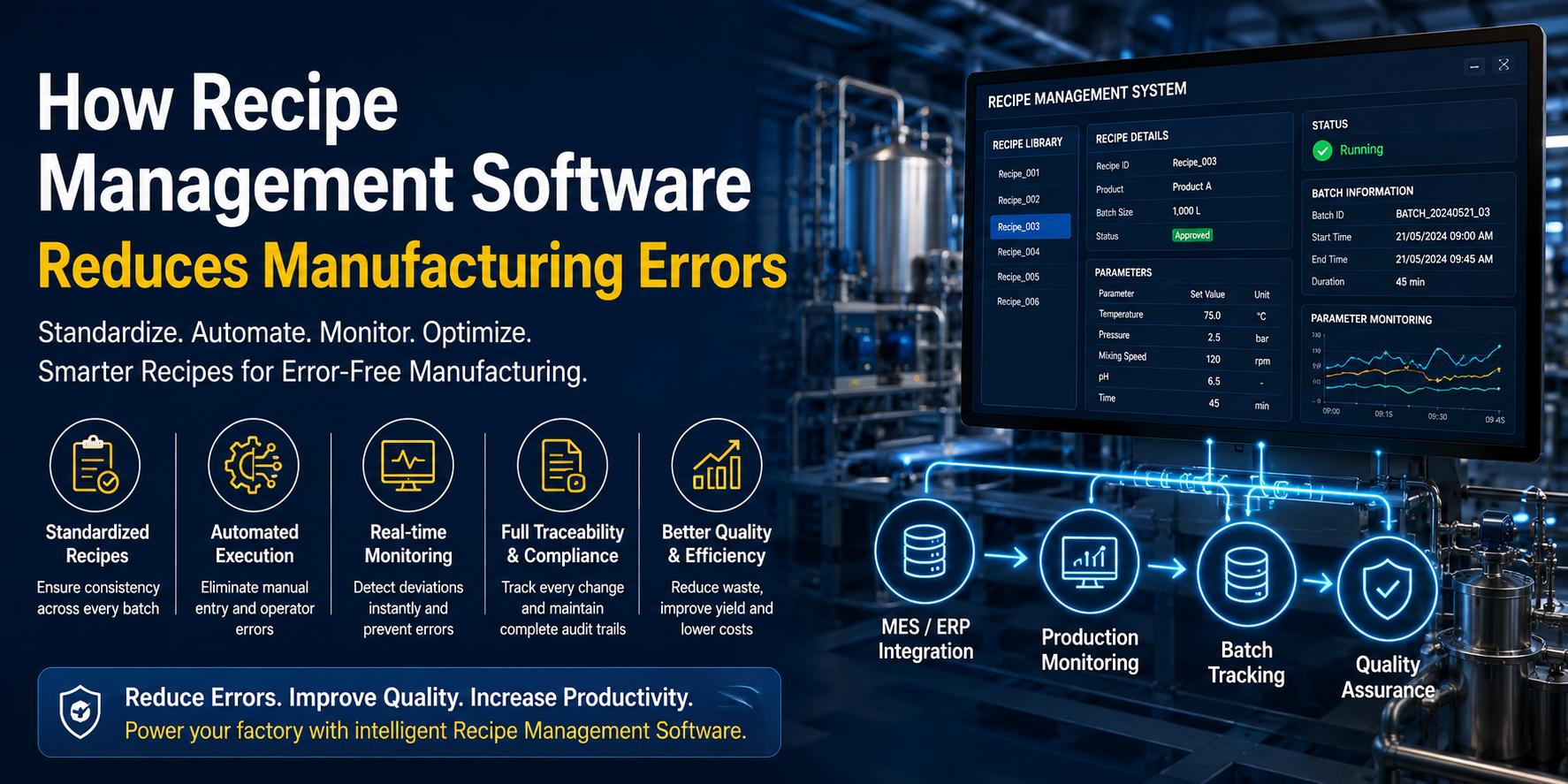
How Recipe Management Software Reduces Manufacturing Errors
In modern manufacturing environments, even small process errors can result in major production losses, quality issues, and operational downtime. Industries such as food processing, pharmaceuticals, chemicals, electronics, and semiconductor manufacturing rely heavily on precise process control and standardized production recipes to maintain product consistency.
This is where Recipe Management Software plays a critical role. By integrating with Manufacturing Software, automation systems, and factory operations, recipe management solutions help manufacturers reduce errors, improve quality, and optimize production efficiency.
As manufacturers continue adopting Smart Manufacturing, Industrial Automation, and Digital Manufacturing technologies, recipe-driven production control has become an essential part of modern factory operations.
This article explains how recipe management systems reduce manufacturing errors and improve overall operational performance.
What is Recipe Management Software?
Recipe Management Software is a digital system used to create, manage, control, validate, and distribute production recipes across manufacturing environments.
A recipe may include:
- Process parameters
- Material specifications
- Machine settings
- Production sequences
- Batch instructions
- Equipment configurations
- Quality limits
Modern recipe systems integrate directly with:
- MES Software
- PLCs and HMIs
- SCADA systems
- ERP platforms
- Industrial databases
- Factory equipment
This integration enables centralized recipe control and automated execution across production lines.
In advanced Manufacturing Execution System environments, recipe management helps ensure production consistency while reducing manual intervention.
Why Manufacturing Errors Occur
Manufacturing errors are often caused by inconsistent processes, manual operations, and lack of production visibility.
Common causes include:
- Incorrect machine parameters
- Manual recipe entry mistakes
- Version control problems
- Inconsistent batch settings
- Operator errors
- Poor process standardization
- Lack of real-time monitoring
Without proper Manufacturing Process Control, these issues can result in:
- Product defects
- Scrap generation
- Rework costs
- Equipment downtime
- Compliance failures
- Customer dissatisfaction
Modern Manufacturing Automation systems address these challenges through centralized and intelligent recipe control.
How Recipe Management Software Reduces Manufacturing Errors
1. Standardized Production Recipes
One of the biggest advantages of Recipe Management Software is process standardization.
The software ensures that:
- Approved recipes are used consistently
- Operators cannot enter unauthorized settings
- Equipment follows predefined process parameters
- Production steps remain synchronized
This eliminates variation between shifts, operators, and production lines.
For industries requiring strict compliance, such as pharmaceuticals and semiconductors, standardized recipes are essential for quality control and traceability.
Modern Manufacturing Management Software platforms use centralized recipe libraries to ensure every machine operates using validated production settings.
2. Automated Process Execution
Manual operations increase the risk of human error. Recipe management systems integrated with Industrial Automation platforms automate critical manufacturing tasks.
Automated recipe execution enables:
- Automatic parameter loading
- Machine configuration validation
- Batch sequencing
- Controlled material flow
- Equipment synchronization
This reduces dependency on manual data entry and improves production accuracy.
Advanced Process Automation capabilities also allow manufacturers to automate recipe changes based on product type, lot number, or production schedules.
3. Real-Time Monitoring and Validation
Modern Production Monitoring Software continuously tracks production activity and validates process conditions in real time.
Recipe systems can monitor:
- Temperature ranges
- Pressure values
- Process timing
- Equipment status
- Batch progression
- Alarm conditions
If abnormal conditions are detected, the system can:
- Generate alarms
- Stop production automatically
- Prevent invalid recipe execution
- Notify operators and supervisors
This level of visibility is critical for reducing manufacturing deviations and improving product quality.
Through Industrial IoT connectivity, manufacturers can monitor production data from multiple machines and factory locations simultaneously.
4. Version Control and Recipe Traceability
One major source of manufacturing errors is outdated or incorrect recipe versions.
A centralized Recipe Management System provides:
Recipe version tracking
Change history logs
Approval workflows
Audit trails
User access control
This ensures only approved process configurations are used during production.
In regulated industries, recipe traceability is extremely important for compliance and quality assurance.
Integrated Batch Tracking Software enables manufacturers to trace every product batch back to its original process recipe and machine settings.
5. Integration with MES and ERP Systems
Modern recipe management platforms integrate directly with:
- MES Software
- Manufacturing ERP Software
- SCADA systems
- Quality systems
- Production databases
This integration enables automatic synchronization between production planning and shop floor execution.
For example:
- ERP systems send production orders
- MES systems assign recipes
- Machines load parameters automatically
- Production data is collected in real time
This seamless data flow reduces communication gaps and improves overall manufacturing accuracy.
Integrated Production Planning Software also helps optimize scheduling and reduce production delays.
6. Improved Quality Management
Product quality depends heavily on process consistency.
Integrated Quality Management Software, combined with recipe management systems, helps manufacturers:
- Enforce process limits
- Validate material usage
- Monitor critical quality parameters
- Reduce process variation
- Improve first-pass yield
Manufacturers can also use Manufacturing Analytics tools to analyze historical production data and identify recurring process issues.
This supports continuous improvement initiatives and long-term operational optimization.
7. Predictive Maintenance and Equipment Reliability
Recipe systems integrated with machine monitoring platforms can support Predictive Maintenance strategies.
By analyzing equipment behavior and process data, manufacturers can identify:
Abnormal machine performance
- Sensor failures
- Parameter drift
- Equipment wear
This reduces unexpected downtime and prevents production errors caused by faulty equipment.
Combined with Factory Automation and Industrial Automation Software, predictive maintenance significantly improves equipment reliability and operational stability.
Industry Applications of Recipe Management Software
Food and Beverage Manufacturing
Recipe systems ensure consistent ingredient mixing, cooking times, and packaging processes.
Pharmaceutical Manufacturing
Strict recipe validation ensures regulatory compliance and batch traceability.
Semiconductor Manufacturing
Advanced Manufacturing Process Software controls highly sensitive equipment parameters for wafer processing and assembly operations.
Chemical Processing
Recipe automation helps maintain safe and accurate chemical formulations.
Electronics Manufacturing
Automated recipe management improves assembly consistency and reduces defects.
Benefits of Recipe Management Software
Manufacturers implementing recipe management solutions experience several operational benefits.
Reduced Human Error
Automated recipe execution minimizes manual intervention.
Improved Production Consistency
Standardized process control ensures repeatable manufacturing quality.
Better Production Visibility
Real-time monitoring improves decision-making and operational control.
Faster Product Changeovers
Digital recipe loading reduces setup time between products.
Enhanced Compliance
Complete traceability supports regulatory requirements and audits.
Higher Equipment Efficiency
Integrated Production Tracking Software improves machine utilization and operational performance.
The Future of Smart Recipe Management
As Smart Manufacturing and Digital Manufacturing continue evolving, recipe management systems are becoming more intelligent.
Future advancements include:
- AI-driven process optimization
- Cloud-based recipe management
- Autonomous process control
- Digital twin integration
- Edge computing
- Advanced manufacturing analytics
Modern Manufacturing Automation Software combined with AI and Industrial IoT technologies will continue reducing manufacturing errors while improving production efficiency.
Conclusion
Manufacturing errors can significantly impact production quality, operational costs, and customer satisfaction. Implementing advanced Recipe Management Software helps manufacturers standardize processes, automate production workflows, improve traceability, and reduce operational risks.
Integrated with MES Software, Manufacturing ERP Software, Industrial Automation, and Production Monitoring Software, recipe management systems play a critical role in modern smart factories.
As industries continue moving toward Industry 4.0, manufacturers adopting intelligent recipe management solutions will gain stronger process control, better product quality, and improved operational efficiency.
For companies focused on reducing production errors and building scalable manufacturing environments, recipe-driven automation is no longer optional—it is a key foundation of future-ready manufacturing.