Best SECS/GEM PLC Integration Solutions In 2026
Introduction
Walk into any leading semiconductor fab today, and you'll find an invisible language running beneath the surface — coordinating equipment, logging process data, and enabling host systems to command machines without a human intermediary. That language is SECS/GEM, and in 2026, mastering it has become a competitive necessity rather than a technical nicety.
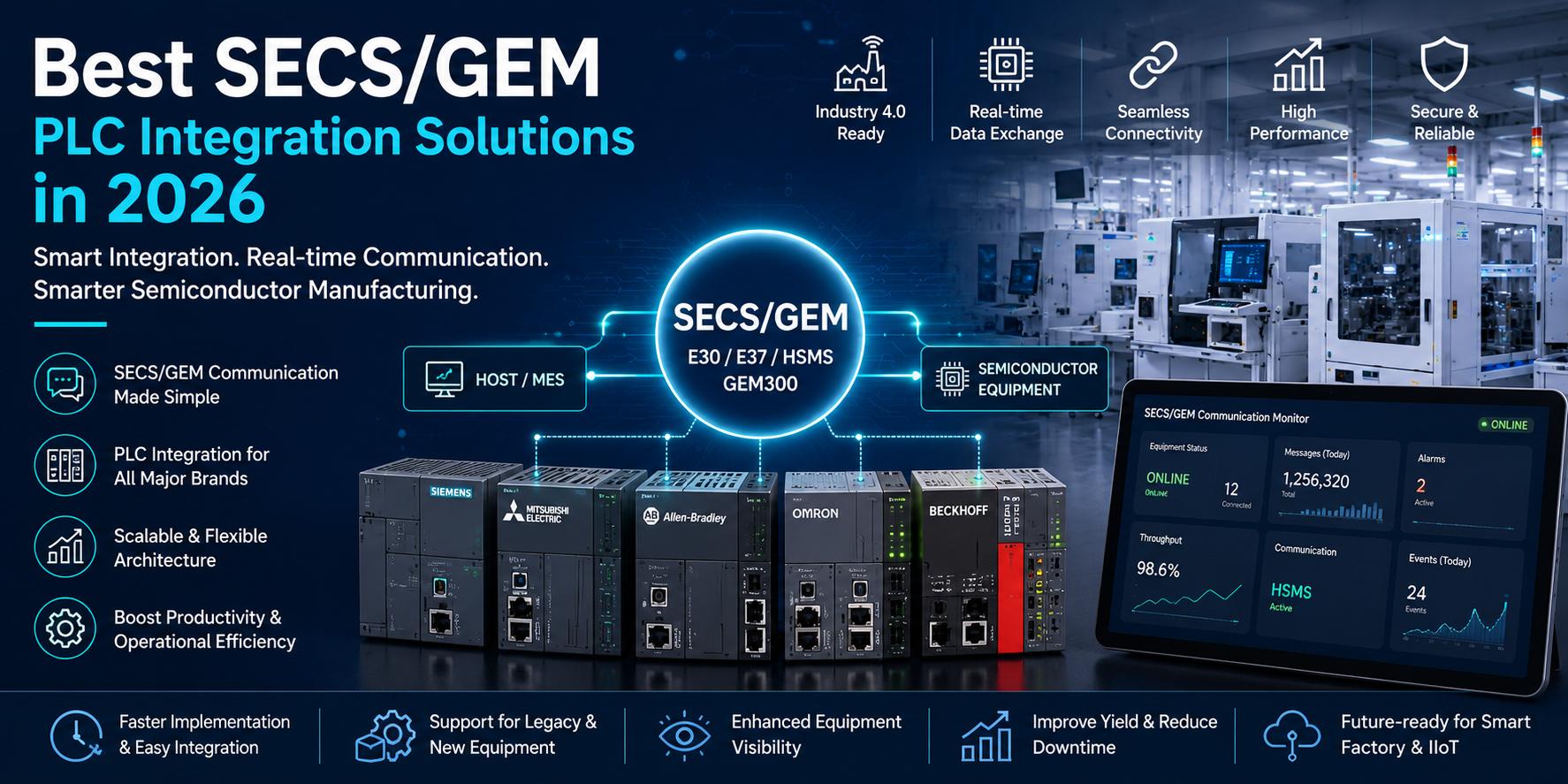
For engineers and automation architects evaluating SECS/GEM PLC Integration, the landscape has matured considerably. A new generation of middleware, edge-aware software, and purpose-built connectors has made it faster — and less risky — to bridge programmable logic controllers with SEMI-standard communication frameworks. But the choices are wider than ever, and selecting the wrong approach can mean months of costly rework.
This guide breaks down what's driving demand for PLC integration solutions in semiconductor manufacturing, what to look for in a modern implementation stack, and which architectural approaches are delivering results on the fab floor in 2026.
Why SECS/GEM PLC Integration Is More Critical Than Ever
The semiconductor industry is operating under extraordinary pressure. Chip demand continues to outpace capacity, fab construction is accelerating globally, and equipment manufacturers face tighter timelines to bring tools to production-ready status. Every delay in semiconductor equipment integration has a measurable cost.
At the same time, equipment complexity has increased. Modern process tools — diffusion furnaces, etch systems, CMP machines — often combine multiple subsystems controlled by industrial PLCs running ladder logic or structured text. Connecting these PLC-driven subsystems to a fab's Manufacturing Execution System (MES) via SECS/GEM Communication requires more than a simple protocol wrapper. It demands a solution that understands both the deterministic world of industrial automation and the session-layer expectations of SEMI E5, E30, E37, and related standards.
This is precisely where SECS/GEM Solutions have evolved most significantly. The best platforms in 2026 don't just translate messages — they map PLC data structures to GEM state machines, handle alarm management, manage equipment constants, and maintain host connectivity across network interruptions, all while keeping cycle times unaffected.
Key Standards Driving Integration Architecture
Before evaluating any SECS/GEM Software, it's worth grounding the conversation in the standards that define compliant behavior.
SECS-I and HSMS define the physical and transport layers — serial and TCP/IP respectively. SECS-II (SEMI E5) defines the message structure and data item encoding. GEM (SEMI E30) defines the behavioral model: how equipment reports events, responds to host commands, manages process programs, and handles alarms. For 300mm fabs and advanced nodes, GEM300 Integration adds further requirements including E40 (process job management), E87 (carrier management), E90 (substrate tracking), and E94 (control job management).
When a PLC controls a tool that must satisfy GEM300 requirements, the integration challenge is significant. The PLC has no native concept of a process job or a carrier ID. A robust PLC integration solution must bridge this semantic gap — translating PLC register states and I/O signals into GEM-compliant event reports, equipment states, and data variable updates in real time.
Understanding this stack is essential for anyone evaluating SECS/GEM automation solutions in 2026 — because a solution that handles basic GEM but stumbles on E87 or E94 will fail qualification in advanced fabs.
Architectural Approaches: How to Integrate PLC with SECS/GEM
There is no single correct architecture for SECS/GEM PLC integration, but there are clear patterns that experienced integration teams return to based on fab requirements.
Embedded Driver Approach
Some semiconductor automation software vendors provide SDK-level libraries that run directly on industrial PCs co-located with the PLC. The integration layer runs as a Windows or Linux service, communicating with the PLC over OPC UA, Modbus TCP, or EtherNet/IP, and presenting a HSMS-compliant SECS/GEM interface to the host. This approach offers low latency and tight control but requires software engineering resources to implement and maintain.
Middleware Gateway Approach
Purpose-built SECS/GEM Software gateways sit between the PLC network and the fab host, handling all SEMI-standard communication while exposing a configuration interface rather than a programming interface. Engineers map PLC tags to GEM data variables, collection events, and alarm codes through a graphical tool — no C++ required. Leading vendors in this space have invested heavily in GEM300 compliance, pre-built equipment models for common tool types, and simulation modes that allow host-side testing before physical equipment is available.
Edge-Integrated Approach
A growing pattern in 2026 combines industrial PLC automation with edge computing platforms. The edge node handles SECS/GEM communication, local data buffering during host disconnection, and lightweight analytics — while the PLC retains sole responsibility for real-time control. This architecture decouples communication reliability from control determinism, which is a significant operational advantage in high-availability environments.
For teams assessing PLC connectivity for semiconductor equipment across a multi-tool installation, the middleware gateway or edge-integrated approach typically offers the best balance of deployment speed, maintainability, and compliance coverage.
What to Look for in SECS/GEM Solutions in 2026
With the architectural pattern selected, evaluation of specific factory automation solutions and software platforms comes down to a consistent set of criteria that experienced integration engineers use in vendor assessments.
Standards coverage depth — Does the platform fully implement E30, E37, E5, and the relevant GEM300 standards? Request a compliance matrix and verify against your fab's host qualification checklist before any commitment.
PLC protocol breadth — The best SECS/GEM PLC integration platforms support OPC UA, EtherNet/IP, Modbus TCP, PROFINET, and legacy serial interfaces. Lock-in to a single PLC vendor's communication stack is a long-term risk.
Simulation and testing tools — Robust SECS/GEM Communication platforms include host simulators that allow equipment-side validation without a live MES connection. This capability alone can shorten qualification timelines by weeks.
Alarm and event management — GEM alarm management is frequently underestimated during initial scoping. Verify that the platform supports alarm enable/disable, alarm history, and multi-severity levels natively.
Vendor track record in semiconductor — Unlike general-purpose industrial PLC automation software, SECS/GEM integration involves nuances that only emerge in actual fab deployments. Vendors with documented deployments at Tier 1 fabs carry significantly lower technical risk than those entering the semiconductor space from adjacent industries.
Support for AI-assisted diagnostics — A newer differentiator in 2026 is the integration of anomaly detection and predictive models directly within the semiconductor automation software layer. Platforms that can flag unusual equipment behavior — based on patterns in SECS-II data streams — before an alarm triggers are delivering measurable yield and uptime benefits for early adopters.
Conclusion
The question of how to integrate PLC with SECS/GEM has no single answer — but it has well-defined principles. Start with the standard, understand the semantic gap between PLC data and GEM behavior, choose an architecture that matches your team's capabilities and your fab's uptime requirements, and evaluate platforms against a rigorous compliance and integration checklist.
The best SECS/GEM PLC integration solutions in 2026 are those that reduce implementation risk, accelerate host qualification, and scale gracefully as equipment fleets grow and GEM300 requirements deepen. Whether you're commissioning a single etch tool or standing up a greenfield fab with hundreds of integrated assets, the investment in getting the semiconductor equipment integration layer right pays compounding dividends across the equipment lifecycle.
The fab floor doesn't forgive poor communication infrastructure. Choose your integration stack with the same rigor you apply to the process tools themselves.